Starting a business in Croatia involves selecting a company structure, registering with the authorities, and completing several administrative steps. The most common options are a limited liability company (d.o.o.) and a simple limited liability company (j.d.o.o.), both of which can be fully owned by foreign nationals.
As a business lawyer in Croatia and founder of Mandracchio Capital, I have advised foreign entrepreneurs and investors on company formation in Croatia for more than a decade. In practice, while the process is relatively structured, the key challenges usually arise from documentation, banking setup, and aligning the company structure with residency and tax planning.
My name is Šime Jozipović, founder and CEO of Mandracchio Capital. I’m a Croatian lawyer based in Split, with a Master of Laws (LL.M.) from Harvard Law School and a doctorate in international tax planning.
For EU nationals, company formation is generally straightforward and aligned with EU freedom of establishment. For non-EU founders, however, starting a business often involves additional considerations, including residence permits, compliance with the Croatian Law on Foreigners, and properly structured documentation to ensure both legal and operational stability.
In this guide, I help you understand how to start a business in Croatia step by step, including company types, costs, legal requirements, tax considerations, and what foreign entrepreneurs should know before incorporating.
Key Facts: Starting a Business in Croatia
| Requirement | Key Information |
|---|---|
| Tax ID (OIB) | Every founder and director must obtain a Croatian Personal Identification Number (OIB). |
| Company Types | Most foreign entrepreneurs choose a d.o.o. (limited liability company). A j.d.o.o. is available for startups with lower initial capital. |
| Minimum Capital | d.o.o.: €2,500 |
| Registered Address | Every company must have a registered business address in Croatia. |
| Company Registration | Registration can be completed remotely for many cases, while some applicants may need a Croatian legal representative or notary. |
| Business Bank Account | Required to deposit share capital and manage company finances after incorporation. |
| Registration Timeline | Most companies are incorporated within 2-4 weeks, depending on documentation and authority processing times. |
| Corporate Income Tax | 10% for annual revenue up to €1 million; 18% above that threshold. |
| Standard VAT Rate | 25% (registration depends on turnover and business activities). |
Setting up an entity in Croatia typically involves establishing a limited liability company (d.o.o.). The process begins with obtaining a Croatian OIB number for all founders and directors, reserving a company name, and preparing incorporation documents before a Croatian public notary.
After the documents are notarised, the required share capital is deposited into a temporary bank account and the company is registered with the Commercial Court Register. Once registration is approved, the company completes tax registration with the Tax Administration and social security registration with HZMO and HZZO. In most cases, the full incorporation process takes approximately 2–4 weeks.

Is Croatia the Right Place to Start Your Business?
Croatia can be an excellent choice for entrepreneurs looking to establish a long-term presence within the European Union. The country offers full access to the EU Single Market, competitive operating costs, a stable legal framework, and the flexibility of 100% foreign ownership.
Croatia may be particularly suitable if you:
- Plan to expand across the European Union.
- Want an EU-based company with relatively competitive corporate taxation.
- Operate in consulting, technology, renewable energy, tourism, or professional services.
- Value long-term legal certainty over aggressive tax optimisation.
However, Croatia may be less suitable if your priority is the lowest possible tax jurisdiction, extremely fast administrative procedures, or large-scale manufacturing requiring a substantial labour force.
If you’re still evaluating whether Croatia fits your commercial objectives, read our comprehensive guide to Doing Business in Croatia, where we cover the economy, taxation, investment climate, labour market, and business environment in greater detail.
Starting a Business as an EU Citizen vs a Non-EU Founder
| Requirement | EU Citizens | Non-EU Founders |
|---|---|---|
| Company ownership | ✅ | ✅ |
| 100% foreign ownership | ✅ | ✅ |
| Work permit | Not required | Usually required if living and working in Croatia |
| Residence registration | Simpler | Additional immigration process |
| Banking | Usually more straightforward | Enhanced AML reviews may apply |
| Documentation | Standard | May require apostilles and certified translation |
For EU citizens, starting a business in Croatia is generally more straightforward due to the EU’s freedom of establishment. In most cases, EU nationals can establish and manage Croatian companies without obtaining a separate work permit, making incorporation and ongoing administration significantly simpler than for third-country nationals.
EU founders also typically benefit from:
- Freedom of establishment within the European Union.
- No work permit requirements.
- More straightforward banking and compliance procedures.
- Easier residence registration when relocating to Croatia.
- The ability to operate throughout the EU using a Croatian company.
Starting Your First Business as a Croatian Resident
Croatian citizens and permanent residents benefit from the simplest incorporation process, with full access to digital registration services such as START and HITRO.HR. While the administrative process is generally straightforward, choosing the appropriate legal structure, understanding tax obligations, and establishing proper accounting procedures remain essential for long-term success.
Many first-time Croatian entrepreneurs choose a d.o.o. for long-term growth or a j.d.o.o. when testing a new business idea with lower initial capital requirements. Professional legal and accounting advice can help avoid costly restructuring later as the business expands.
Remote Business Setup in Croatia
Setting up a business in Croatia remotely is possible, though the process differs for residents and non-residents. Locals can use the START application to register a company online, while foreigners generally need a local notary, Power of Attorney, or specialized legal counsel.
Steps for Remote Incorporation
- Obtain an OIB (Tax ID): Mandatory for all foreign directors.
- Appoint a Representative: Hire a local lawyer or agency to handle notarization and filings if you cannot be present in Croatia.
- Submit Registration Documents:
- Locals: via START digital platform.
- Non-residents: via a notary using Power of Attorney. Required documents include a valid passport and, if applicable, a recent excerpt from your home country’s company register (not older than 30 days).
- Open a Corporate Bank Account: Usually requires physical presence, though some banks and service providers offer remote facilitation. This account is needed to deposit the minimum capital.
- Register for Taxes: Register for VAT (if applicable) and electronic invoicing through FINA. Hiring a local accountant is highly recommended.
Local Requirements & Considerations
- Resident director: Not mandatory for foreign founders.
- Accountant & Tax Number: Hiring a local accountant and obtaining an OIB is required for legal and tax compliance.
- Costs: Notary fees and legal assistance typically range from €500–€2,000, depending on complexity, plus capital contributions for the company type.
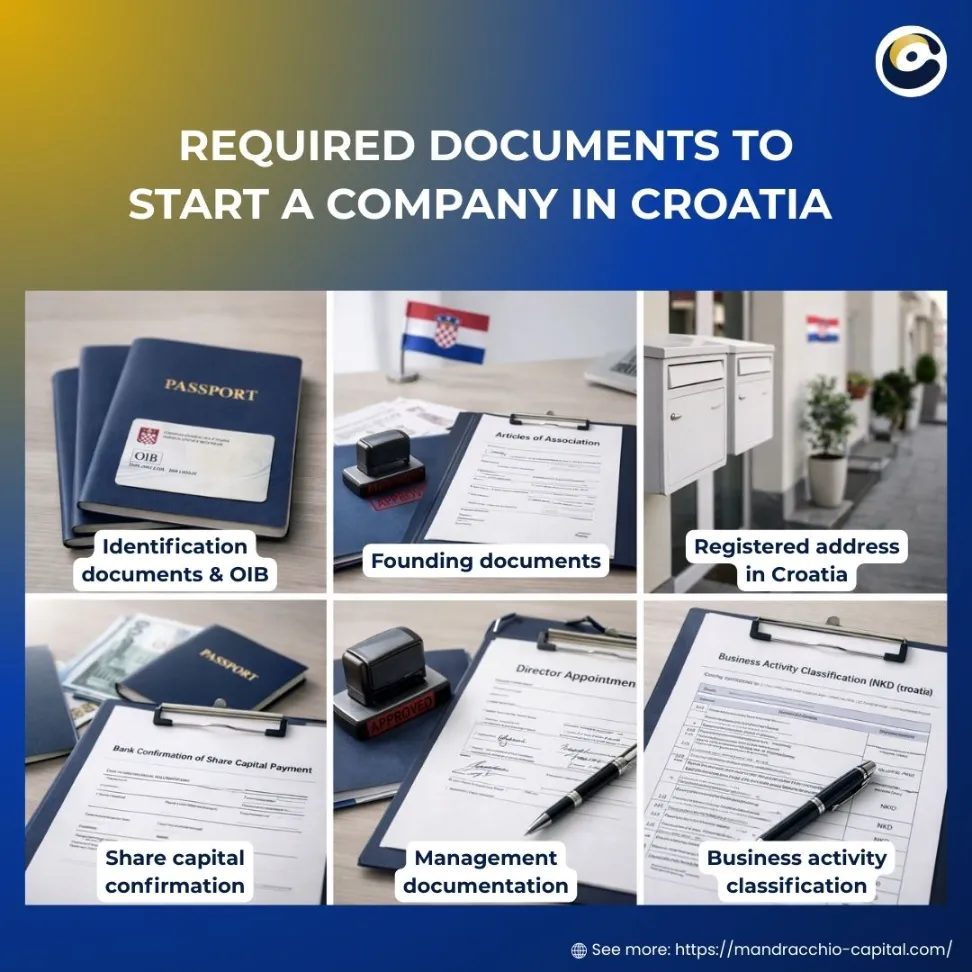
Required documents to Start a company in Croatia
Here’s the list of documents required to start a company in Croatia, how they differ for EU and non-EU founders, and how to prepare them properly so you don’t lose time, money, or business momentum.
Company Formation Process in Croatia
Once you’ve decided on the appropriate business structure, the next stage is incorporating your Croatian company. While the overall process is relatively straightforward, each step must be completed in the correct order to avoid delays with the Commercial Court, banks, or tax authorities.
For a detailed timeline, required documents, government authorities involved, and how we support clients at every stage, read our Croatia Company Registration Process guide.
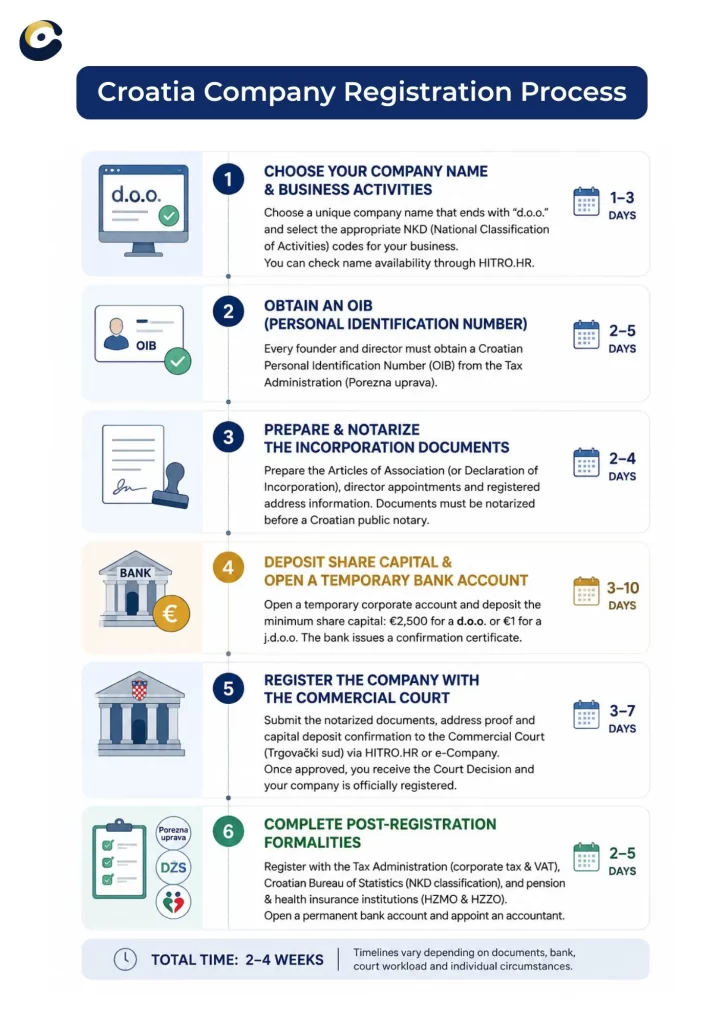
Step 1. Choose Your Company Name & Business Activities
Select a unique company name that complies with Croatian naming rules and choose the appropriate NKD business activity codes before incorporation.
Refer to our guide on How to choose correct company business activity code
Step 2. Obtain an OIB (Tax Identification Number)
Every founder and director must obtain a Croatian Personal Identification Number (OIB), which is required for company registration, banking, and tax purposes.
Step 3. Prepare & Notarize the Incorporation Documents
Draft the Articles of Association (or Declaration of Incorporation), appoint the director, and have all required documents notarized. Foreign documents may require an apostille and certified Croatian translation.
Step 4. Deposit Share Capital & Register the Company
Open a Croatian business bank account, deposit the required share capital, then submit the incorporation documents to the Commercial Court to officially establish the company.
Step 5. Complete Post-Registration Requirements
After approval, register for taxes and VAT (if applicable), obtain the NKD classification notice, arrange accounting, and complete any required pension, health insurance, or licensing registrations before starting operations.
Key Service Providers
- Public Notaries: Essential for notarizing documents.
- HITRO.HR: A one-stop shop for submitting documents and paying fees.
Choosing the Right Business Structure in Croatia
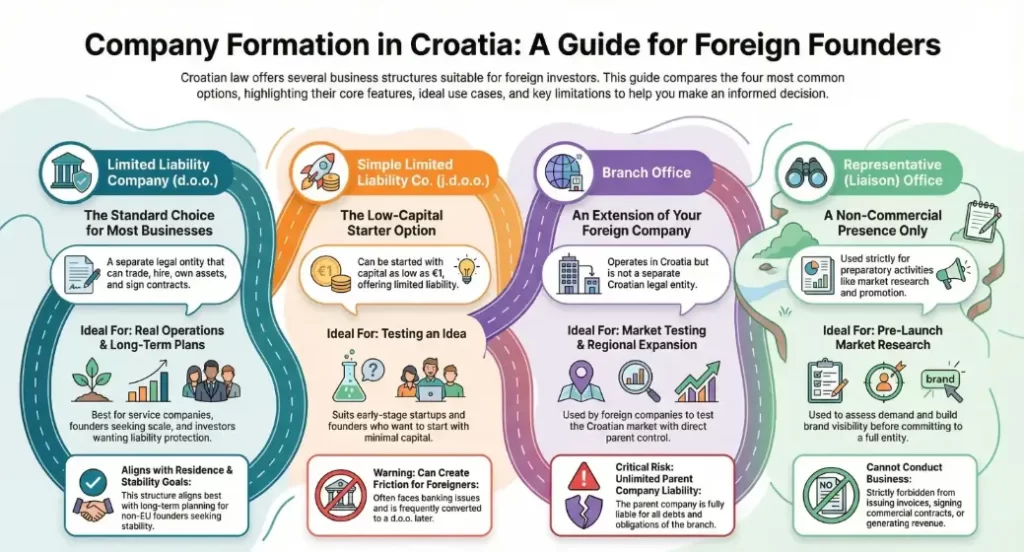
Choosing the right legal structure is one of the most important decisions when starting a business in Croatia. It affects taxation, liability, banking, regulatory compliance, and your ability to grow or expand within the European Union.
For most foreign founders, there are two practical options:
- Establish a Croatian limited liability company (d.o.o.) as a new legal entity.
- Open a Croatian branch office of an existing foreign company.
The right choice depends on whether you are launching a new business or expanding an established one.
| Structure | Best For | Separate Legal Entity | Minimum Capital |
|---|---|---|---|
| d.o.o. (Limited Liability Company) | New businesses, SMEs, foreign investors | ✅ Yes | €2,500 |
| Branch Office | Existing foreign companies expanding into Croatia | ❌ No | None |
| j.d.o.o. | Small startups | ✅ Yes | €1 |
| Obrt | Self-employed individuals | ❌ No | None |
d.o.o. (Limited Liability Company)
A d.o.o. is the preferred structure for most international founders establishing a new business in Croatia. It offers limited liability, allows 100% foreign ownership, and provides a separate legal entity that can enter contracts, employ staff, and operate throughout the European Union.
Key characteristics of d.o.o.:
- Minimum share capital: EUR 2,500
- Shareholders: 1 to 50 members (individuals or legal entities)
- Management: One or more directors (can be foreign nationals)
- Liability: Limited to the amount of share capital invested
- Annual obligations: Audited financial statements for medium/large companies, certified accountant mandatory
- Suitable for: Online services, trading, manufacturing, real estate holding, technology companies
Who this is for
- business owners running real operations
- service companies working with EU clients
- founders planning scale and banking stability
- investors who want liability protection
To understand this structure more deeply, visit our article on d.o.o. limited liability company formation in Croatia and see what the process involves.
Branch Office
A branch office allows an existing foreign company to establish a presence in Croatia without creating a separate Croatian legal entity.
Unlike a d.o.o., the branch remains legally part of the parent company, meaning the parent business retains responsibility for the branch’s obligations and liabilities.
A branch office may be suitable if you:
- Already operate an established company abroad.
- Want to expand into the Croatian or wider EU market.
- Prefer to operate under your existing corporate structure rather than incorporating a new subsidiary.
However, because branches have different legal and tax implications, founders should carefully evaluate whether a branch or a Croatian subsidiary better supports their commercial objectives.
Read our complete guide to Opening a Branch Office in Croatia.
Branch Office or Croatian Subsidiary?
Many foreign companies entering Croatia assume a branch office is always the simplest option. In practice, this depends on your business model.
A branch office can reduce incorporation formalities and may suit businesses expanding an existing operation into Croatia.
A Croatian subsidiary (d.o.o.), however, creates a separate legal entity with limited liability, is often preferred by banks and commercial partners, and generally provides greater flexibility for long-term growth, investment, and local operations.
The right structure depends on several factors, including:
- Where your customers are located.
- How revenue is generated.
- Your tax position.
- Whether you intend to hire employees in Croatia.
- Your long-term expansion strategy within the European Union.
If you’re unsure which option is most appropriate, our legal team can help evaluate the most suitable structure before incorporation.
Considering an Existing Company Instead?
Registering a new company is the most common approach for foreign founders entering Croatia. However, if you need an existing legal entity, operational history, or a faster route to market, purchasing an established Croatian company may be a suitable alternative.
Before proceeding, compare the advantages and disadvantages of both options in our guide to Starting a Business vs Buying an Existing Company in Croatia.
Costs of Opening a Company in Croatia
Total costs vary depending on structure, director role, and whether the company will support tax residency. Read the detail break down: Cost of Opening a Company in Croatia
Opening a standard Limited Liability Company (d.o.o.) in Croatia costs at least €2,500 in share capital plus roughly €300 to €600 in administrative and notary fees if done independently.
Hiring a local consultant or corporate service provider to manage the process remotely typically ranges from €1,500 to €3,000+, depending on whether you need translation services, registered office addresses, or non-resident director support
In practice, most foreign founders choose a full-service setup to avoid delays and compliance issues. Professional fees for end-to-end company formation typically range between €2,000 and €4,000, depending on the complexity of the structure, number of founders, and documentation requirements.
Owners vs Directors: Foreign Founders Must Understand

| Role | Operational Rights | Salary Required | Tax Exposure |
|---|---|---|---|
| Owner only | No | No | Dividends only |
| Director | Yes | Yes | Income + contributions |
In Croatia, owning a company is not the same as running it.
Only the Director can legally operate and represent the company including signing contracts, invoicing clients, and fulfilling compliance obligations.
If you are an EU citizen, you generally have the right to live and work in Croatia without holding a separate residence permit. If you already contribute to social security in another EU country, presenting an A1 certificate may allow you to serve as Director while avoiding double contributions in Croatia.
Banking, Payment Gateways & Fiscalization
When starting a business in Croatia for foreigner, banking, payment acceptance, and fiscalization should be understood as one connected compliance framework, not separate steps.
Corporate Banking Reality
Open a Croatian corporate bank account is mandatory and often underestimated. Croatian banks do not treat account opening as a formality, they assess the ownership structure, business purpose, expected transaction flows, and regulatory exposure before approving an account.
In practice, banks typically require:
- Identification of shareholders and directors
- Notarized incorporation documents
- A clear description of the company’s activities
- Evidence of economic substance and business rationale
While remote onboarding is sometimes possible, it is not guaranteed and depends on the bank, the company structure, and the risk profile of the founders.
EU vs Non-EU Compliance Differences
For EU citizens with complete documentation and a straightforward activity description, banking reviews are generally more predictable and processing timelines tend to be shorter.
For founders from the US, UK, Canada, Australia, New Zealand, or other non-EU jurisdictions, banks usually apply enhanced compliance checks, which may include:
- Apostilled and translated documents
- Source-of-funds verification
- Detailed explanations of planned business activities and client profiles
As a result, account opening may involve additional review rounds and longer timelines.
Accepting Payments & Fiscalization Obligations
Once a company is operational, accepting money from customers triggers additional legal requirements.
If the business accepts card or cash payments, fiscalization must be activated before the first transaction. Fiscalization is a real-time reporting system that:
- Registers each invoice or receipt with the Croatian Tax Authority
- Applies regardless of company size once commercial activity begins
- Is mandatory for retail, hospitality, and many service businesses
Payment gateways and POS systems must be properly integrated with the fiscalization framework to ensure every transaction is reported correctly from day one.
Entrepreneurs starting a business in Croatia should also be aware of broader EU monetary developments, including the upcoming Digital Euro in the EU, which may influence digital payment systems across the Eurozone
After Incorporation: Ongoing Compliance & Tax Obligations
Registering your company is only the first step. Once incorporated, Croatian businesses must comply with ongoing accounting, tax, payroll, and corporate reporting requirements to remain in good standing and avoid penalties.
Key post-incorporation obligations typically include:
- Maintaining accounting records in accordance with Croatian accounting regulations and, where applicable, IFRS standards.
- Filing annual corporate income tax returns and financial statements.
- Registering for and submitting VAT (PDV) returns, where applicable.
- Managing payroll, pension (HZMO), and health insurance (HZZO) contributions if the company has a working director or employees.
- Keeping corporate records and meeting statutory reporting requirements.
Croatia currently applies a 10% corporate income tax rate for companies with annual revenue up to €1 million, and 18% above that threshold. The standard VAT rate is 25%, while dividends are generally subject to a 10% withholding tax, subject to applicable tax treaties.
Accounting services for small and medium-sized businesses typically start from €150–300 per month, depending on transaction volume and reporting requirements.
For a detailed explanation of corporate tax, VAT, payroll obligations, and reporting requirements, see our Croatia Tax System Guide. If you’re looking for bookkeeping, payroll, and ongoing compliance support, read our Accounting & Compliance in Croatia guide.
Explore Business Opportunities in Croatia
Different business activities require different legal, tax, and operational considerations. If you already know the type of business you plan to establish, our dedicated guides explain the key considerations for setting up the appropriate Croatian company or business structure for your activity.
Starting an Ecommerce Business in Croatia
If your business model involves selling physical or digital products online, read our guide to Starting an Ecommerce Business in Croatia, which covers VAT, payment gateways, consumer protection rules, and the legal requirements for operating an online store.
Starting a Yacht Charter Business in Croatia
Understand the company structure, tax considerations, maritime regulations, registration requirements, and operational matters involved in establishing and operating a yacht charter business in Croatia.
Launching a Digital App Business in Croatia
Find out how to structure and establish a Croatian company for a mobile or web application, SaaS product, or other digital business, including key considerations around taxation, intellectual property, VAT, and regulatory compliance.
Starting a Software Business in Croatia
Understand the considerations for establishing a Croatian company for software development or software products, including businesses developing trading software, technology platforms, and other software solutions.
Croatia residency by investment: Residency Linked to Business Ownership
Owning a company can support residency when you take on an active role in daily operations – not if you only hold shares on paper.
If you are an EU citizen, you have the right to live and work in Croatia but must still register your stay after 90 days and document your activity.
For non-EU nationals including founders from the US, UK, Canada, Australia, New Zealand, and other third countries – starting a business in Croatia alone does not grant the right to work or reside in Croatia. To qualify for residency through business activity (often referred to as residency by investment), you must:
- Act as a working Director of the Croatian company
- Receive a qualifying salary in line with local regulations
- Pay mandatory social security contributions
- Ensure the company is properly registered, operational, and compliant
In practice, many international founders adopt a phased setup strategy. A local Director is appointed during the initial incorporation and operational phase, allowing the business to function immediately. Once relocation plans and residence permits are secured, founders often transition into the Director role themselves. This approach balances compliance, flexibility, and long-term residency planning.
Not all “investment routes” in Croatia lead to real residency. Here’s what actually works and what doesn’t when it comes to business-based residence: Croatia Residency by Investment: What’s Possible for Third-Country Nationals?

Benefits vs. Downsides: Foreign Founders Should Know Upfront
Starting a business in Croatia offers clear advantages but it also comes with practical trade-offs. For founders who plan carefully and work with local guidance, these downsides are manageable. For those expecting a quick or hands-off setup, Croatia can feel unnecessarily complex.
For a deeper, unfiltered look at both sides of the equation, see:
→ The Benefits of Doing Business in Croatia for Foreigners
Foreign entrepreneurs should be aware of operational rules not common elsewhere:
• Standard receipts are not deductible; R1 invoices required
• Payment acceptance requires approved fiscalization
• Banks can freeze onboarding for incomplete compliance
• Financial statements are public business records
Avoiding these issues early is essential when starting a business in Croatia for foreigner, as corrections later can be costly and time-consuming.
Read more: 8 Common Mistakes Foreigners Make When Starting a Company in Croatia
Mandracchio Capital – Your Legal Partner for Doing Business in Croatia
Mandracchio Capital, founded by Prof. Dr. Šime Jozipović, supports international investors, founders, and companies entering the Croatian and broader European Union market. With 500+ projects supervised and over €500 million in company value established, the firm helps foreign businesses start and operate in Croatia with regulatory clarity and confidence.
Our advisory work focuses on company formation, tax and VAT compliance, cross-border structuring, and EU market entry strategies, coordinating experienced Croatian lawyers and tax consultants to ensure every stage of your business setup is legally sound.
For founders looking for a structured, fully compliant company setup process, explore our Croatia company formation service, where we coordinate documentation, incorporation filings, bank onboarding, and tax registration so your business enters Croatia correctly from day one.
Based in Split, Croatia, Mandracchio Capital works with clients from the United States, United Kingdom, Canada, Australia, and across the EU, helping them build compliant and scalable operations within the Croatian and European legal framework.
FAQ
Can foreigners start a business in Croatia?
Yes. Foreigners, including both EU and non-EU nationals, can legally establish a business in Croatia. In most cases, foreign founders may own 100% of a Croatian company, provided all registration, tax, and compliance requirements are met.
What is the best business structure for foreign entrepreneurs in Croatia?
For most international founders, a d.o.o. (društvo s ograničenom odgovornošću) is the preferred legal structure. It offers limited liability, operational flexibility, and is the most common choice for foreign entrepreneurs establishing a business in Croatia.
How can non-EU citizens start a business in Croatia?
Non-EU citizens can establish a Croatian company under the same company law as EU nationals. However, if they also wish to obtain temporary residence based on business ownership, additional immigration requirements generally apply. These typically include investing at least €25,000 in the business, employing at least three Croatian citizens on a full-time basis, and meeting other conditions under Croatian immigration law.
Can I open a company in Croatia to obtain residency?
Not automatically. Registering a company alone does not grant residence rights. Residence applications based on business ownership are assessed separately, and Croatian authorities generally expect genuine commercial activity rather than a company created solely for immigration purposes.
Do I need a Croatian partner or local director?
No. Foreign founders can generally own and manage a Croatian company without appointing a Croatian shareholder or local director. However, directors remain responsible for complying with Croatian corporate, tax, and employment regulations.
Can I register a company remotely?
Yes. With Mandracchio Capital, you can establish a Croatian company either in person or remotely. We manage the incorporation process from document preparation and company registration to tax registration and coordination with local professionals. Most international clients complete 90–100% of the process remotely using a notarised and apostilled Power of Attorney, depending on their circumstances and the bank’s account-opening requirements.
How long does it take to start a business in Croatia?
Most company formations are completed within 2–4 weeks once all required documents have been prepared. The overall timeline depends on document legalisation, Commercial Court processing, tax registration, and corporate bank account opening.
How much does it cost to start a business in Croatia?
Costs depend on the company structure and the level of professional assistance required. A standard d.o.o. requires €2,500 in share capital, while additional expenses may include government registration fees, legal services, accounting, translations, and ongoing compliance.
Can I open a branch office instead of incorporating a Croatian company?
Yes. A foreign company may establish a branch office in Croatia without creating a separate legal entity. The branch operates under the legal responsibility of its parent company but must still obtain an OIB, register for tax where applicable, and maintain local accounting records.
Do I need to live in Croatia to own a Croatian company?
No. You can own a Croatian company without living in Croatia. However, if you intend to relocate or actively manage the business from Croatia, separate immigration, tax residency, and employment rules may apply.
Does Croatia offer a five-year income tax exemption for new residents?
No. Croatia does not provide a general five-year income tax exemption for new residents or foreign business owners. Tax obligations depend on your tax residency status, the source of your income, and applicable Croatian tax legislation.
Legal Basis & Official Sources
Croatia allows full foreign ownership of companies under its Company Act (Zakon o trgovačkim društvima). There is no legal requirement for a Croatian partner or shareholder, and both EU and non-EU nationals may establish and own Croatian companies under the same corporate framework.
However, residency and work rights are regulated separately under the Law on Foreigners (Zakon o strancima), administered by the Ministry of the Interior (MUP). Non-EU nationals who wish to actively manage and work in their Croatian company must obtain an appropriate residence and work permit.
Key official references include:
- Croatian Company Act (Zakon o trgovačkim društvima)
- Law on Foreigners (Zakon o strancima)
- Ministry of the Interior (MUP) – Temporary residence and work permits
- Croatian Commercial Court (Sudski registar)
- Tax Administration (Porezna uprava)
- HITRO.HR / FINA company registration system
For official guidance, see:
- Ministry of the Interior: https://mup.gov.hr
- Commercial Court Register: https://sudreg.pravosudje.hr
- Tax Administration: https://www.porezna-uprava.hr