Registering a company in Croatia can be a straightforward way to access the EU Single Market, but the process involves multiple legal and administrative steps that must be completed in the correct order. This guide explains how to register a Croatian company, from obtaining an OIB (tax identification number) and preparing notarized incorporation documents to depositing share capital, registering with the Commercial Court, and completing VAT and other post-incorporation registrations. You’ll also learn the typical costs, timeline, and requirements for foreign founders.
I’m Šime Jozipović, founder and CEO of Mandracchio Capital, a Croatian lawyer based in Split with a Master of Laws (LL.M.) from Harvard Law School and a doctorate specializing in international tax planning. I have advised international entrepreneurs, investors, and digital business owners on Croatian company formation, cross-border taxation, and regulatory compliance.
By the end of this guide, you’ll understand each step of the Croatian company registration process, how long it typically takes, which documents you’ll need, and how to avoid the most common mistakes when establishing your business.
Company Registration Process in Croatia Key facts
- Typical timeline: 2–4 weeks from document preparation to full company registration.
- Business name: Must be unique and registered in the Croatian Commercial Register.
- Tax ID (OIB): Every founder and director must obtain a Croatian personal identification number (OIB).
- Incorporation documents: The Articles of Association or Declaration of Incorporation must be notarized in Croatian.
- Minimum share capital: €2,500 for a d.o.o. or €1 for a j.d.o.o.
- Registration authorities: Commercial Court (Trgovački sud), Tax Administration, State Statistics Bureau, and pension/health insurance authorities.
- Foreign founders: Non-EU nationals typically need to appear before a notary or appoint a legal representative with a power of attorney.
- Language: Official incorporation documents must be in Croatian; certified translations may be required.
- After registration: Open a permanent business bank account, register for VAT if applicable, and comply with Croatian bookkeeping and annual reporting requirements.
If you’re still evaluating the bigger picture, our Starting a Business in Croatia Handbook offers a broader overview of the entire ecosystem before you dive into formation details. If you’re ready for the application process, let’s start now!
How to Set Up a Croatian Company as a Non-Resident
You can set up a Croatian company as a non-resident by choosing a corporate structure like a d.o.o. (limited liability company), obtaining a personal tax ID, and registering through the commercial court. Non-residents can own 100% of the business without a local partner.
Key steps to form the company will be explained below.
Before You Start: Eligibility Requirements
Before beginning the company registration process, make sure you meet the basic legal requirements to establish a Croatian company.
- Foreign ownership: Croatia allows 100% foreign ownership of a d.o.o., whether you’re an EU/EEA or non-EU citizen.
- Croatian OIB: Every founder and director must obtain a Croatian Personal Identification Number (OIB) before incorporation.
- Registered office: Your company must have a registered business address in Croatia.
- Company director: At least one director must be appointed during incorporation.
- Share capital: A standard d.o.o. requires a minimum share capital of €2,500, while a j.d.o.o. can be established with €1.
- Power of attorney (optional): If you cannot travel to Croatia, a Croatian lawyer may complete most incorporation formalities on your behalf using a properly legalized power of attorney.
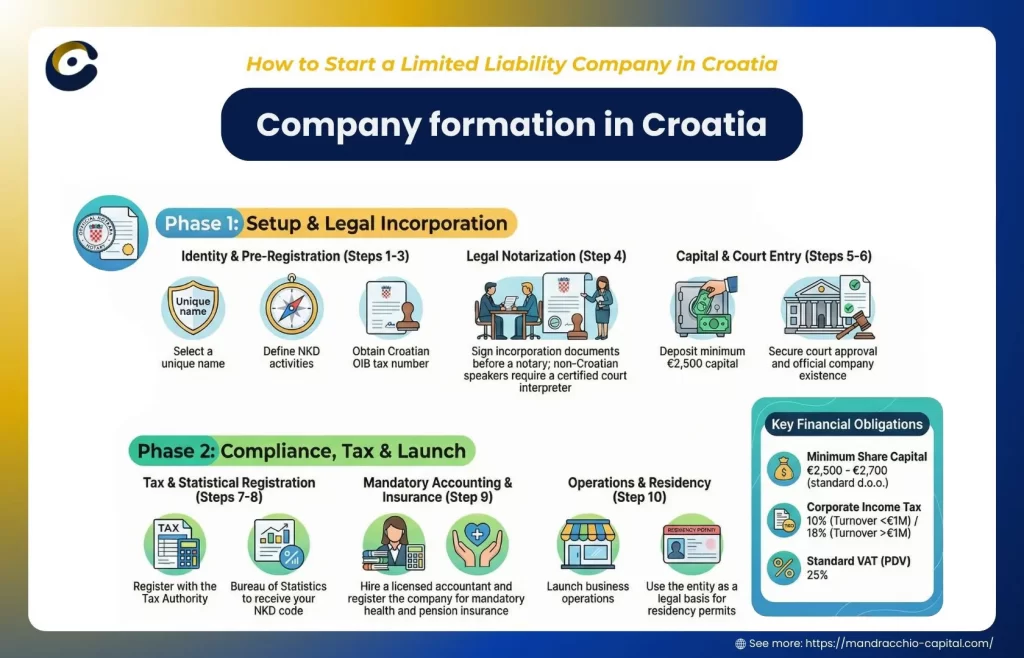
Step 1. Choose Your Company Name & Business Activities
The first step is choosing a company name that complies with Croatian registration rules and deciding what your business will do.
Your company name must be unique, written in the Latin alphabet, and include the legal suffix “d.o.o.”. Before submitting your application, you should also select the appropriate National Classification of Activities (NKD) codes that describe your business activities. Choosing the correct NKD codes from the beginning is important because adding or changing activities later requires additional administrative procedures.
You’ll need a company name that is:
- Unique
- In Croatian or an EU language
- Written in Latin script
- Ending with “d.o.o.”
If you’re working with a Croatian lawyer, they can usually verify name availability, advise on suitable NKD codes, and prepare everything before incorporation.
Step 2. Obtain an OIB (Personal Identification Number)
Every founder and company director must obtain a Croatian Personal Identification Number (OIB) before the company can be incorporated.
The OIB is issued by the Croatian Tax Administration (Porezna uprava) and is required for almost every legal and tax-related procedure in Croatia, including signing incorporation documents, opening bank accounts, and registering the company.
If you are outside Croatia, your lawyer can usually obtain the OIB on your behalf using a properly executed Power of Attorney together with apostilled identification documents.
Step 3: Prepare & Notarize the Incorporation Documents
Once the OIB has been issued, the company’s incorporation documents must be prepared and certified by a Croatian public notary.
Depending on the ownership structure, these documents include either the Articles of Association (for multiple shareholders) or a Declaration of Incorporation (for a single founder), together with director appointments and the company’s registered office information.
Founders who do not speak Croatian must be assisted by a certified court interpreter during notarization. Foreign documents generally need to be apostilled and translated into Croatian by a certified translator before they can be accepted.
Step 4. Deposit Share Capital & Open a Temporary Bank Account
Before the company can be registered, the required share capital must be deposited into a temporary corporate bank account.
A standard d.o.o. requires a minimum share capital of €2,500. After receiving the funds, the bank issues a confirmation certificate that becomes part of the Commercial Court registration.
Banks may request additional compliance documentation from non-resident founders as part of their anti-money laundering (AML) procedures. This is a normal part of the onboarding process and varies between financial institutions.
Step 5. Register the Company with the Commercial Court
After the incorporation documents have been notarized and the share capital deposited, the complete application is submitted to the competent Commercial Court (Trgovački sud).
Applications may be filed through a public notary, HITRO.HR, or electronically using e-Company (e-Osnivanje) where available. Standard registrations typically take 3–10 business days, although electronic applications may be processed faster in eligible cases.
Once approved, the Court issues its official registration decision, and your company becomes a legally established Croatian legal entity.
Step 6. Complete Post-Registration Formalities
After the Commercial Court registration, several additional registrations must be completed before the company can begin operating normally.
These usually include registration with the Croatian Tax Administration for corporate income tax and VAT (where applicable), obtaining the official NKD classification notice from the Croatian Bureau of Statistics, registering with the Croatian Pension Insurance Institute (HZMO) and Croatian Health Insurance Fund (HZZO) where required, appointing an accountant, and opening a permanent business bank account.
Completing these post-registration obligations ensures that your company is fully compliant and ready to invoice clients, employ staff, and conduct business in Croatia.
Cost of Registering a Company in Croatia
Registering a company in Croatia typically costs between €500 and €1,500+ in administrative and legal fees, excluding share capital. A standard limited liability company (d.o.o.) requires a minimum share capital of €2,500.
Key cost components usually include:
- Notary fees: approximately €50-€400
- Court registration fees: approximately €8-€100
- Translation and legal support: approximately €500-€1,500+ (depending on documentation and complexity)
Costs vary based on the company structure, shareholder profile, and documentation requirements. For a full breakdown and real-world examples, see our detailed guide on the cost of registering a company in Croatia
How long is the Company Registration Process in Croatia
| Stage | Time |
|---|---|
| OIB | 2–5 days |
| Notary | 2–4 days |
| Bank | 3–10 days |
| Court | 3–7 days |
| Tax registration | 2–5 days |
Croatia Company Registration Documents Checklist
Preparing the correct documents before starting the registration process can significantly reduce delays with banks, notaries, and the Commercial Court.
Most foreign founders will typically need:
- Valid passport or national ID
- Croatian OIB (Personal Identification Number)
- Proof of the company’s registered address
- Articles of Association or Declaration of Incorporation
- Shareholder and director information
- Power of Attorney (if incorporating remotely)
- Apostilled and certified translations of foreign documents, where required
Document requirements vary depending on your nationality, company structure, and whether you’re registering in person or remotely.
Read our complete guide: Documents Required to Register a Company in Croatia for a detailed checklist and preparation instructions.
What Happens After Registration?
Receiving your Commercial Court registration is not the final step. Before your company can begin operating normally, you’ll usually need to complete several post-incorporation formalities.
These commonly include:
- Converting your temporary bank account into a permanent business account
- Registering for VAT, if your business is required or chooses to do so voluntarily
- Registering with the Croatian Pension Insurance Institute (HZMO) and Croatian Health Insurance Fund (HZZO) if employing staff or directors
- Appointing an accountant to manage bookkeeping, tax filings, and annual financial statements
- Activating e-invoicing and other tax reporting obligations where applicable
- Obtaining any industry-specific licences or permits required for your business activities
Common Mistakes Foreign Founders Make
Many registration delays aren’t caused by Croatian authorities they result from avoidable preparation mistakes. The most common include:
- Choosing the wrong company structure, such as establishing a j.d.o.o. when a standard d.o.o. would better suit long-term business goals.
- Selecting incorrect or incomplete NKD business activity codes.
- Submitting foreign documents without the required apostille or certified Croatian translation.
- Underestimating bank compliance requirements for non-resident shareholders.
- Assuming company registration automatically grants Croatian residence or work rights.
- Waiting until after incorporation to arrange accounting, VAT registration, or mandatory statutory registrations.
Working with an experienced Croatian lawyer and accountant can help you avoid these issues, reducing delays and ensuring your company is compliant from the start.
Why work with a lawyer from Mandracchio Capital
Our business setup package is designed for standard company formations in Croatia and covers most founder and investor scenarios. It excludes large-scale investments, complex AML structures, and unresolved visa or residency issues. More complex cases can be supported following prior review and agreement.
All pricing is explained transparently upfront during a free introductory call, before any engagement begins.
The service is delivered in a concierge-style format. You receive a clear documentation checklist upfront, after which our team and trusted partners manage the full preparation and coordination process, minimizing delays, errors, and institutional back-and-forth.
What Our Professional Support Covers
Our support typically includes:
- Personal identification number registration
- Drafting incorporation and shareholding documents via licensed lawyers
- Business activity, licensing, and registered office guidance
- Notary coordination, translations, and court filings
- AML and beneficial ownership documentation
- Share capital deposit and statutory registrations
- Bank account opening, accounting onboarding, and e-invoicing setup
At Mandracchio Capital, our team also provide targeted coaching on early-stage operations in Croatia, including taxation, employment, social security, compliance, and local business practices, helping you start correctly and avoid costly fixes later.
FAQ
Is a j.d.o.o. enough to start a business in Croatia as a foreigner?
Technically, yes but practically, rarely.
A j.d.o.o. is designed for local Croatian entrepreneurs testing small business ideas.
For foreign founders, it creates problems with:
- Bank account approvals
- Residency applications
- Commercial credibility
- Investment and contracting
If you plan to relocate, open a bank account, sign serious contracts, or build an EU-facing business, a j.d.o.o. is usually the wrong tool. Most foreign nationals end up converting it into a d.o.o. later which costs more than doing it right from the start.
Why do banks and authorities prefer a d.o.o. over a j.d.o.o.?
Because a d.o.o. signals real capitalization, long-term intent, and financial substance.
Croatian banks, tax authorities, and immigration officers all evaluate whether a company is:
- Stable
- Properly funded
- Able to pay taxes, salaries, and obligations
A €1 company sends the opposite signal. A d.o.o. tells regulators you are building a legitimate EU business, not just opening a shell to get a permit.
Can I get Croatian residency through a j.d.o.o.?
In practice, no.
Immigration authorities expect a serious operating company if you apply for residence as a business owner or director. A j.d.o.o.:
- Has no meaningful capital
- Is legally restricted from distributing profits
- Is treated as a temporary startup vehicle
For non-EU founders, a d.o.o. with sufficient capitalization and activity is the standard route.
How much capital do non-EU founders really need for a d.o.o.?
Legally: about €2,500-€2,700.
In practice for residence and banking: often €20,000-€30,000+.
This is not a fixed rule, it varies by:
- Police administration
- Bank compliance team
- Your nationality and business plan
But Croatia expects non-EU founders to demonstrate that their company can actually operate, pay themselves, and support a residence permit.
If I only want a small online business, do I still need a d.o.o.?
If you are living abroad and only need a legal entity, a j.d.o.o. might be possible.
But the moment you need:
- A Croatian bank account
- EU payment processing
- Residency
- Business credibility
You will almost certainly need a d.o.o. anyway.
For most international founders, skipping straight to a d.o.o. avoids months of wasted time.
Can I upgrade a j.d.o.o. to a d.o.o. later?
Yes but it is not simple or cheap.
You must:
- Accumulate mandatory profit reserves
- Amend company documents
- Re-register with the Court
- Update bank and tax records
Many foreigners who started with a j.d.o.o. discover that they could have formed a d.o.o. for less money and less hassle at the beginning.
Does owning 100% of a d.o.o. as a foreigner create problems?
No. Croatia allows 100% foreign ownership of d.o.o. companies.
The issues are not ownership, they are compliance, banking, and residency alignment.
A properly structured d.o.o. is fully accepted under Croatian and EU law.
Is a Croatian d.o.o. respected in the EU?
Yes. A d.o.o. is Croatia’s standard EU-compliant limited liability company.
It can:
- Trade across the EU
- Open European bank accounts
- Sign international contracts
- Own property and IP
- Employ staff
A j.d.o.o., by contrast, is often treated as a starter or micro-entity.
Can I open a Croatian company remotely?
Yes, if you work with a Croatian lawyer.
You will need:
- Apostilled passport copies
- Power of attorney
- Translated documents
The lawyer handles notary, court, tax, and bank coordination on your behalf.
What is the biggest mistake foreign founders make?
Choosing a company type based only on minimum capital instead of long-term strategy.
A €1 company may look cheap but it often blocks:
- Bank accounts
- Residency
- Investors
- Serious contracts
Most successful foreign founders in Croatia start with a properly capitalized d.o.o. from day one.