Starting a company in Croatia as a foreigner is legally possible for both Croatian and Foreign founders, but the process is document-driven and procedural. Most delays and frustrations do not come from legal barriers, but from incomplete paperwork, poor preparation, or misunderstanding how Croatian authorities expect documents to be presented.
My name is Šime Jozipović, founder and CEO of Mandracchio Capital. I’m a Croatian lawyer based in Split, with a Master of Laws (LL.M.) from Harvard Law School and a doctorate in international tax planning.
This guide explains exactly which documents required to start a company in Croatia, how they differ for Croatian and foreign founders, and how to prepare them properly so you don’t lose time, money, or business momentum.
If you are looking for a strategic view, not just incorporation paperwork, we recommend starting with our full handbook: Starting a Business in Croatia

Required Documents for Company Registration
- Passport copy of the shareholder(s) and director(s)
- Proof of address for the shareholder(s) and director(s)
- Power of Attorney (POA) — required if the company formation is completed remotely and the lawyer will act on your behalf in Croatia
- Company details, including:
- Proposed company name
- Registered business activities / NKD activities
- Shareholder structure
- Director details
- Registered office address in Croatia, if already arranged
Additional documents may be requested depending on the proposed business activity and company structure.
How to Start a Company in Croatia for Foreigner?
Registration itself is carried out by the competent Commercial Court (Trgovački sud), which enters the company into the court register (sudski registar) and issues the registration decision. The notarised founding documents, together with confirmation that the share capital has been paid, are submitted to the competent commercial court for entry in the register; once the entry is made, the court delivers the registration decision and the company’s OIB back to the notary or to FINA.
Foreign founders can start the process either at a Croatian notary’s office or through the state one-stop service HITRO.HR, while EU citizens additionally have the option of remote electronic incorporation through the e-Sudski registar system, logging in with an accepted credential from their country of residence.
Croatia follows a formal civil-law system. Authorities do not assess your business idea or nationality,they assess whether:
- Documents are complete
- Forms are correct
- Steps are followed in the correct order
This applies equally to:
- EU citizens
- Non-EU citizens (US, UK, Canada, Australia, Asia)

Most foreign founders register a d.o.o. (limited liability company) because it:
- Allows 100% foreign ownership
- Is accepted by banks and authorities
- Works for residency, trading, and EU operations
Required Documents to Start a Company in Croatia
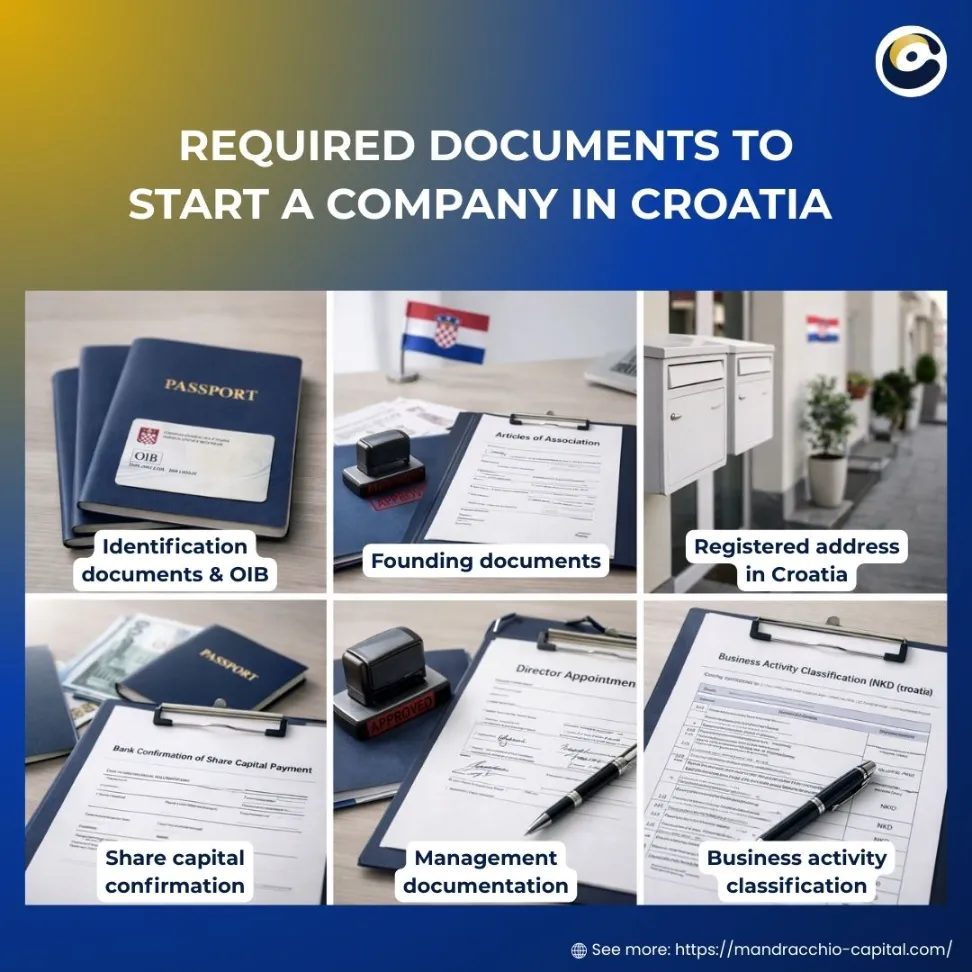
1. Identification documents
All shareholders and directors must be identified in the incorporation documentation. You will need:
- Valid passport of all shareholders and directors
- Certified/notarised passport copies, where required
Whether certified copies are needed depends on the incorporation method and on whether the founders sign in Croatia or from abroad.
2. OIB (Osobni identifikacijski broj)
The OIB is Croatia’s personal identification and tax number, and obtaining it is the first practical step in the incorporation process.
Foreign shareholders and directors generally need to obtain their OIB before the incorporation documents can be completed and registered, because the OIB must be included in the company’s founding documentation.
A foreign individual applies to the Croatian Tax Administration (Porezna uprava) with a completed application form and a passport, a copy of which is enclosed with the application; the form is published in Croatian, English and German. Where the application is filed on behalf of a foreign person by a representative, the power of attorney must be certified.
Read more: Everything About OIB for Foreigners in Croatia
3. Founding documents
Under the Croatian Companies Act (Zakon o trgovačkim društvima, ZTD), you must prepare one of the following:
- Articles of Association – Društveni ugovor (if there are multiple shareholders), or
- Statement of Establishment – Izjava o osnivanju (if there is a single shareholder)
For Articles of Association
This draft is usually prepared by:
- a Croatian lawyer, or
- a notary (sometimes with a lawyer involved)
They must be signed before a Croatian notary, or signed abroad and properly notarised and apostilled, and then accepted by a Croatian notary and the Commercial Court (Trgovački sud).
Company name reservation: Names must be unique and compliant with Croatian naming rules. Many rejections happen here due to similarity with existing companies or restricted terms. You can check whether a name is already taken directly in the court register before filing, and it is worth preparing two or three alternatives.
The document includes:
- company name
- registered seat
- business activities (NKD)
- share capital
- director(s) and representation rules
They must be signed before a Croatian notary, or signed abroad and properly notarised and apostilled, and then accepted by a Croatian notary and the Commercial Court (Trgovački sud).
Company name reservation: Names must be unique and compliant with Croatian naming rules. Many rejections happen here due to similarity with existing companies or restricted terms.
4. Registered address in Croatia
- Lease agreement, ownership document, or consent from property owner
Every Croatian company must have a registered seat (sjedište) – company’s official, legally registered address in Croatia Virtual or serviced addresses are possible, but they must be legally valid.
You must provide one of the following:
- A lease agreement for: an office, or a residential property (if business activity is allowed)
- Ownership Document: a land registry extract (vlasnički list) or purchase deed
- Owner’s Consent (If you use an address you do not own)
Virtual or serviced offices are permitted in Croatia if:
- the address is a real, physical location, and
- the property owner provides written consent.
5. Share capital confirmation
- Proof of share capital deposit
- Standard d.o.o.: €2,500
Capital is deposited into a temporary bank account before registration or paid after registration, depending on the method used.
Deposit before registration (most common): Share capital is deposited into a temporary bank account or via FINA, or Share capital is paid after registration into the company’s permanent bank account.
6. Management documentation
- Appointment decision for director(s)
- Specimen signatures (notarized)
- Director’s declaration of acceptance
Directors do not need to be Croatian residents, but their appointment must be clearly documented and notarized.
7. Business activity classification (NKD codes)
The company is classified by the Croatian Bureau of Statistics (Državni zavod za statistiku, DZS), which assigns the official NKD (Nacionalna klasifikacija djelatnosti) business activity codes and issues the classification notice (Obavijest o razvrstavanju).
Choosing incorrect or overly broad NKD codes can create problems later especially for licensing, VAT, or residency purposes.
Browse the full official list of activity codes: NKD 2025 search tool (DZS)
This is the core list of documents required to start a company in Croatia.
Note: If you are not physically present in Croatia, you will almost always need a Power of Attorney authorising a lawyer or notary to act for you.
How to Register a Company in Croatia
Step 1. Choose Your Company Name & Business Activities
We help you select a unique company name that complies with Croatian naming rules and determine the appropriate NKD business activities based on your intended business model.
Our legal team reviews the proposed activities to help ensure that your company is structured appropriately from the outset.
Step 2. Obtain an OIB (Tax Identification Number)
Every founder and director needs a Croatian Personal Identification Number (OIB) for the company registration process.
You do not need to navigate this process alone. Our junior lawyer can obtain the OIB on your behalf, so you can proceed with the incorporation without having to handle the application yourself.
Step 3. Prepare & Notarize the Incorporation Documents
Our legal team prepares the required incorporation documents, including the Articles of Association or Statement of Establishment, and the documentation relating to the company’s director and shareholders.
We coordinate the notarization and filing process and advise you on any additional requirements for documents signed abroad, including apostille/legalisation and certified Croatian translations where applicable.
If you are establishing the company remotely, we can also assist with the Power of Attorney (POA) required for us to act on your behalf in Croatia.
Step 4. Deposit Share Capital & Register the Company
We guide you through the share capital deposit and company registration process.
When required, our team can accompany and support you during the share capital deposit, helping ensure the process is completed correctly.
We then coordinate the submission of the incorporation documents to the Commercial Court (Trgovački sud) and follow the registration process until the company is officially established.
Step 5. Complete Post-Registration Requirements
Once your company is registered, we continue to assist with the remaining setup steps, including:
- Obtaining the company’s NKD classification notice
- Tax registration and VAT registration, where applicable
- Opening and setting up the company’s permanent bank account
- Coordinating accounting arrangements
- Completing applicable pension, health insurance or other registrations
- Advising on any licensing or regulatory requirements relevant to your business activity
From choosing your business activities to completing the post-registration setup, our legal team supports you throughout the company formation process in Croatia.
For detail information, here’s our complete guide to the Croatia company registration process
How to Prepare the Founding Documentation
Preparing documents required to start a company in Croatia is where most foreign founders lose time.
Articles of Association / Statement of Establishment
These must be:
- Properly translated (if prepared abroad)
- Legally consistent with Croatian company law
- Aligned with your long-term goals (residency, hiring, EU operations)
Passport copies
- Names must match exactly across all documents
- Middle names and spelling differences often cause rejections
Specimen signatures
- Must be notarized
- Must match future banking documents
These documents are not “just formalities.” Croatian authorities cross-check them at multiple stages
At Mandracchio Capital, we prepare and review founding documentation for foreign founders to ensure:
- legal consistency across all authorities,
- correct translations and notarisation,
- alignment with long-term business and residence plans.
This step is handled as part of our standard company formation support to prevent downstream delays.
What Can Be Avoided When Preparing Documents
Most founders don’t fail because Croatia is “too difficult.” They fail because they:
- Use generic templates not aligned with Croatian law
- Choose incorrect business activities
- Submit incomplete or inconsistent documentation
- Misjudge timelines and miss business opportunities
Delays often mean:
- Missed contracts
- Lost market entry timing
- Extra travel and notary costs
- Re-submission fees
- Delayed residence permits (for non-EU founders)
For founders, time lost often costs more than legal fees.
Working with a local lawyer will help:
- Correct documents the first time
- Faster registration
- Predictable timelines
- Reduced financial and opportunity loss
This is especially critical if your company is tied to:
- Investment timing
- Client onboarding
- Immigration planning
- EU expansion
Frequently Asked Questions (FAQ)
What documents do I need to start a company in Croatia?
The exact documents depend on your company structure and whether you are registering remotely, but most founders will need:
- A valid passport or national ID
- A Croatian OIB (Personal Identification Number)
- Articles of Association or Statement of Establishment
- Proof of a registered business address in Croatia
- Share capital confirmation (where applicable)
- Director appointment documents and specimen signatures
- A Power of Attorney if someone is registering the company on your behalf
Foreign documents may also require notarisation, apostille, and certified Croatian translations.
Do I need Croatian residency before opening a company?
No. Company registration and residence permits are separate legal procedures.
Do I need to travel to Croatia to register a company?
Not necessarily. Many foreign founders complete the incorporation process remotely by granting a Power of Attorney to a Croatian lawyer. Depending on your circumstances, some documents may need to be notarised and apostilled in your home country before they can be used in Croatia.
What is an OIB and why is it required?
An OIB (Osobni identifikacijski broj) is Croatia’s personal identification number for individuals and companies. Every shareholder and director must obtain an OIB before the company can be incorporated, as it is required for the Articles of Association, tax registration, banking, and other official procedures.
Do all foreign documents need an apostille?
Not always. Whether an apostille is required depends on the country where the document was issued and any applicable international agreements. Many foreign documents must also be translated into Croatian by a certified court interpreter before they can be accepted by Croatian authorities.
How much share capital is required?
For a standard d.o.o., the minimum share capital is €2,500 as of 2026.
How long does company registration take?
If all documents are correctly prepared, most company registrations are completed within 1 to 3 weeks. Delays are usually caused by incomplete documentation, translation issues, banking procedures, or requests from the Commercial Court.
Can I use a virtual office as my registered address?
Yes, provided the address is legally valid and the property owner gives the necessary consent.
However, if you later apply for a Croatian residence permit based on your business, immigration authorities may examine whether the company operates from a genuine business location.
Can I open a Croatian business bank account remotely?
It can be 90%. For some parts, some Croatian banks allow parts of the onboarding process to be completed remotely, while others require directors or authorised representatives to attend in person for identity verification and AML compliance.
What are the most common mistakes foreign founders make?
The most common issues include:
- Choosing unsuitable business activities (NKD codes)
- Using incorporation documents that don’t comply with Croatian law
- Inconsistent names across passports and legal documents
- Planning company formation before considering immigration or tax implications
- Assuming company registration automatically provides residency
Proper planning usually prevents these delays and avoids costly amendments later.