Starting an LLC in Croatia can be a straightforward process for foreign entrepreneurs, but it requires more than simply filing an application.
To start a standard Croatian LLC (d.o.o.), you’ll need to obtain a Croatian tax identification number (OIB), prepare and notarize the incorporation documents, deposit the minimum €2,500 share capital, register the company with the Commercial Court, and complete several post-registration requirements before you can legally operate.
I’m Šime Jozipović, founder and CEO of Mandracchio Capital, a Croatian lawyer based in Split with a Master of Laws (LL.M.) from Harvard Law School and a doctorate specializing in international tax planning. I regularly advise foreign entrepreneurs and investors on Croatian company formation, tax planning, and cross-border business matters.
By the end of this guide, you’ll know exactly how to start a Croatian d.o.o. (LLC), which documents you’ll need, how long registration takes, and what to do after incorporation, including VAT registration and opening a business bank account.
Key Facts
- Croatia offers two main LLC structures: a standard d.o.o. requiring a minimum share capital of €2,500 (with at least 25% paid before registration) and a simplified j.d.o.o. requiring just €1 in share capital.
- Every founder and director must obtain an OIB (Personal Identification Number) before starting the company registration process.
- The incorporation process includes choosing and reserving a company name, preparing and notarizing the founding documents, depositing the required share capital, and registering the company with the Commercial Court.
- Electronic registration is available for eligible applicants through Croatia’s digital registration systems, while many foreign entrepreneurs—especially non-EU nationals—complete the process through a local lawyer, notary, or authorized representative.
- After incorporation, businesses must activate a permanent corporate bank account, register for corporate tax and VAT (where applicable), and complete mandatory employer registrations with Croatia’s pension (HZMO) and health insurance (HZZO) systems.
What Is an LLC (d.o.o.) in Croatia?
A društvo s ograničenom odgovornošću (d.o.o.), or limited liability company (LLC), is the most common business structure in Croatia. It is suitable for businesses of all sizes, from startups and family-owned companies to subsidiaries of international corporations.
A Croatian d.o.o. is a separate legal entity, meaning the company is legally distinct from its owners. In most cases, shareholders are only liable up to the amount of their capital contribution, helping protect their personal assets from business debts and obligations.
Whether you’re launching a local business, expanding into the Croatian market, or setting up a European company, a d.o.o. offers a flexible and widely recognized legal structure.
What Is a d.o.o.?
A Croatian d.o.o. is equivalent to a limited liability company (LLC) in many other countries. It can be established by one or more founders, who may be individuals or legal entities.
A d.o.o. can:
- Conduct commercial activities throughout Croatia.
- Own property and enter into contracts.
- Hire employees.
- Open Croatian business bank accounts.
- Trade with customers and suppliers across the EU and internationally.
Key Features of a Croatian LLC
Some of the main characteristics of a Croatian d.o.o. include:
- Separate legal entity with limited liability for shareholders.
- Minimum share capital of €2,500, with at least 25% paid before registration.
- May be owned by one or multiple shareholders.
- Directors can be Croatian or foreign nationals.
- Eligible to conduct business throughout Croatia and the European Union.
- Subject to Croatian corporate tax, accounting, and annual reporting requirements.
When Should You Choose a d.o.o.?
A standard d.o.o. is generally the preferred option if you:
- Plan to operate a long-term business in Croatia.
- Expect to hire employees.
- Want to build credibility with clients, banks, or investors.
- Require greater flexibility as your business expands.
- Plan to work with international customers or business partners.
For most entrepreneurs, the higher initial capital requirement is outweighed by the legal stability and professional image that a d.o.o. provides.
d.o.o. vs j.d.o.o.: Which is right for you?
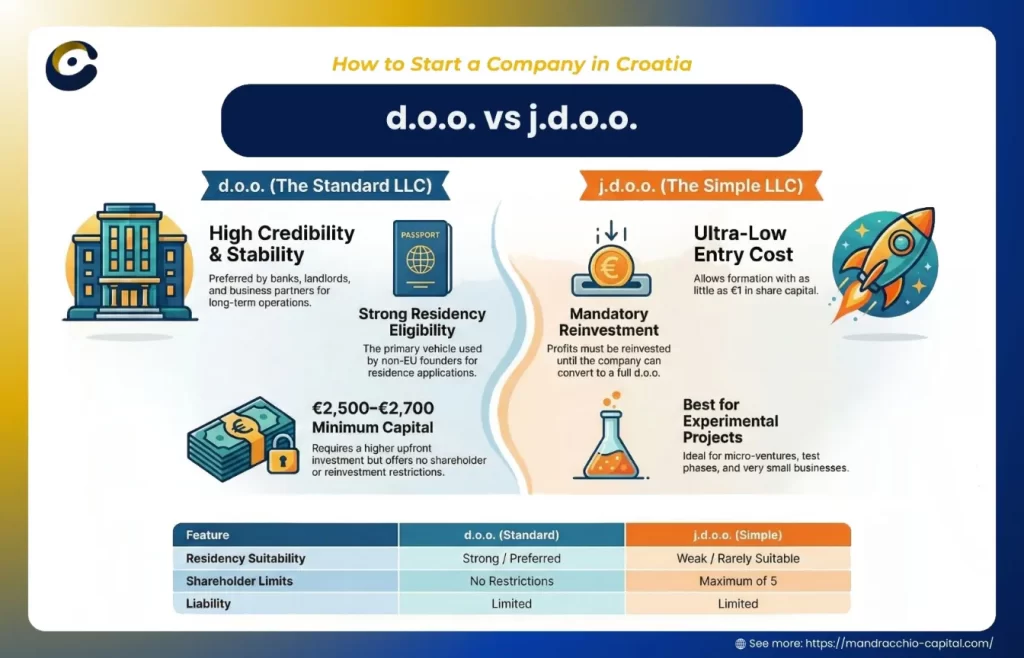
A j.d.o.o. is a simplified version created to lower the entry barrier for very small businesses. It reduces upfront requirements but introduces structural limits that can become restrictive once the business grows or becomes more complex.
One of the most common mistake founders make is choosing a j.d.o.o. because it feels faster or cheaper at the start then discovering it no longer fits once real operations begin.
| Feature | d.o.o. (Limited Liability Company) | j.d.o.o. (Simple Limited Liability Company) |
|---|---|---|
| Purpose | Suitable for small and medium-sized businesses; widely used by foreign investors | Designed for start-ups and very small businesses seeking low-cost entry |
| Minimum Share Capital | €2,500 | €1 |
| Credibility | High, preferred by banks, landlords, and business partners | Moderate, often viewed as temporary or entry-level |
| Residency Eligibility | Strong, commonly used by non-EU founders; higher capital often required in practice | Weak, rarely suitable for residence applications |
| Special Capital Requirements (Non-EU/EEA) | Non-EU founders may need higher capital in practice when using a d.o.o. for residence | Low-cost entry, but generally unsuitable for residence pathways |
| Liability | Limited liability, personal assets protected up to invested capital | Limited liability |
| Shareholder Limits | No restrictions | Maximum of 5 shareholders |
| Reinvestment Obligation | No reinvestment requirement | Mandatory reinvestment of profits until conversion to d.o.o. is possible |
| Formation Process | Notary procedures and full legal steps required | Simplified formation with reduced capital |
| Accounting | Accounting services required | Accounting services required |
| Best For | Foreign investors, relocations, and long-term business operations | Small experimental projects, micro-ventures, test-phase activities |
Emily R. (United Kingdom): “I sell handmade nail products and digital goods online, mostly to clients outside Croatia. Should I start with a j.d.o.o. or a d.o.o.?”
Mandracchio Capital: Hello Emily. Because your business is low-overhead and largely international, a j.d.o.o. may look attractive at first. However, once residency planning and EU credibility come into play, a standard d.o.o. is usually the better long-term choice.
Marco B. (Italy): “I want to start a small wine business in Croatia. What structure makes sense?”
Mandracchio Capital: Hi Marco! In cases involving production, supplier contracts, distribution, or export, a d.o.o. is the appropriate structure. A j.d.o.o. often becomes limiting very quickly in this sector, especially when working with international partners or planning long-term growth.
Sophie M. (France): “I want to open a spa and wellness studio with local clients. Does the company structure really matter?”
Mandracchio Capital: Hi Sophie. Any business with a physical location, employees, inspections, or local permits is best structured as a d.o.o.. It provides a clear framework for leases, staff contracts, regulatory compliance, and ongoing operations. Simpler structures tend to create complications in practice.
Daniel K. (United States): “I’m planning a car-rental or a smart-space rental service aimed at both locals tourists. Can I use a simplified structure?”
Mandracchio Capital: For operational businesses involving vehicles, insurance, and liability exposure, a d.o.o. is essential. Insurance providers and regulators expect a structure that clearly limits personal liability and supports operational risk management.
Have a specific situation?
If your case involves residency planning, company structure, or cross-border considerations, you can book a consultation with our team to review your situation in detail.
Who Can Start an LLC in Croatia?
Croatian law allows both individuals and companies to establish a d.o.o.. Depending on your circumstances, additional documentation or procedures may apply.
Individuals
A Croatian LLC may be founded by one or more individuals. Founders do not need prior business ownership experience, but each founder and appointed director must obtain a Croatian Personal Identification Number (OIB) before registration.
Companies (Corporate Shareholders)
Existing companies can also establish a Croatian subsidiary or become shareholders in a new d.o.o. Corporate founders are typically required to provide incorporation documents, proof of legal existence, and other supporting documentation, which may need notarization, apostille, or certified Croatian translation.
Croatian Citizens
Croatian citizens can establish a d.o.o. through the standard incorporation process. Depending on eligibility, some registrations may be completed using Croatia’s electronic business registration systems, such as the START platform.
Foreign Citizens
Foreign nationals, including both EU and non-EU citizens, can generally own and establish a Croatian d.o.o. Additional requirements may apply depending on the founder’s country of residence, document legalization requirements, and whether the registration is completed remotely or in person. Many international founders choose to appoint a Croatian lawyer or authorized representative to assist with the incorporation process.
How to Start an LLC in Croatia (d.o.o.)
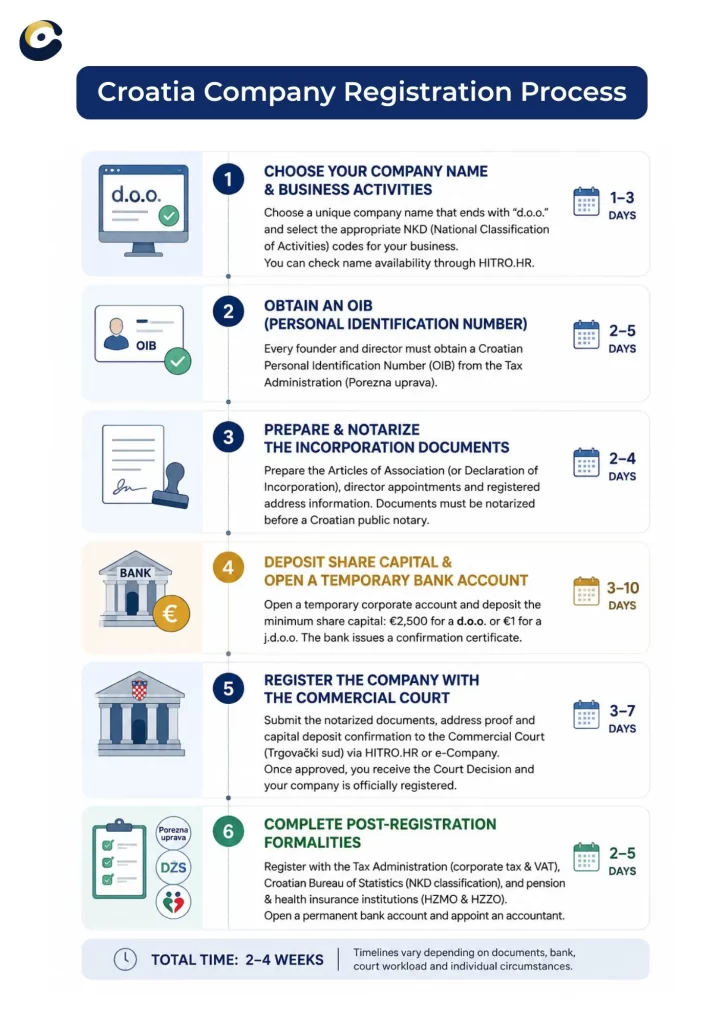
Step 1. Choose Your Company Name & Business Activities
Select a unique company name that complies with Croatian naming rules and choose the appropriate NKD business activity codes before incorporation.
Step 2. Obtain an OIB (Tax Identification Number)
Every founder and director must obtain a Croatian Personal Identification Number (OIB), which is required for company registration, banking, and tax purposes.
Step 3. Prepare & Notarize the Incorporation Documents
Draft the Articles of Association (or Declaration of Incorporation), appoint the director, and have all required documents notarized. Foreign documents may require an apostille and certified Croatian translation.
Step 4. Deposit Share Capital & Register the Company
Open a temporary business bank account, deposit the required share capital, then submit the incorporation documents to the Commercial Court to officially establish the company.
Step 5. Complete Post-Registration Requirements
After approval, register for taxes and VAT (if applicable), obtain the NKD classification notice, arrange accounting, and complete any required pension, health insurance, or licensing registrations before starting operations.
For detail information, here’s our complete guide to the Croatia company registration process
Before incorporating a Croatian d.o.o., you must meet several legal and administrative requirements. These ensure your company complies with Croatian company law and can be registered with the Commercial Court.
Requirements to Start an LLC in Croatia
Minimum Share Capital
A standard d.o.o. requires a minimum share capital of €2,500. At least 25% of each shareholder’s contribution must be paid before registration, while the remaining amount can be contributed later in accordance with Croatian law.
Founders and Shareholders
A Croatian LLC can be established by one or more founders, who may be:
- Individuals or legal entities
- Croatian or foreign citizens
- Croatian or foreign companies
Each shareholder contributes share capital and receives ownership in proportion to their contribution unless otherwise agreed in the Articles of Association.
Company Director
Every d.o.o. must appoint at least one director responsible for managing the company and representing it before government authorities, banks, and third parties.
The director may be:
- A shareholder or a separate individual
- A Croatian citizen or a foreign national
All appointed directors must obtain a Croatian Personal Identification Number (OIB) before registration.
Registered Office
Every Croatian LLC must have a registered business address in Croatia. This address serves as the company’s official correspondence address and appears in the Commercial Court Register.
Businesses without physical premises often use a registered office or virtual office service that complies with Croatian regulations.
Business Activities
When incorporating a company, founders must specify the business activities the company intends to carry out using Croatia’s National Classification of Activities (NKD) codes.
Choosing the correct NKD codes is important, as certain regulated activities may require additional licenses or approvals before the business can begin operating.
Croatian OIB (Personal Identification Number)
The OIB (Osobni identifikacijski broj) is Croatia’s personal identification number used for taxation and official administration.
The documents required to establish a Croatian d.o.o. depend on whether the founders are individuals or companies, as well as whether the application involves foreign-issued documents.
Documents Required to Start an LLC in Croatia
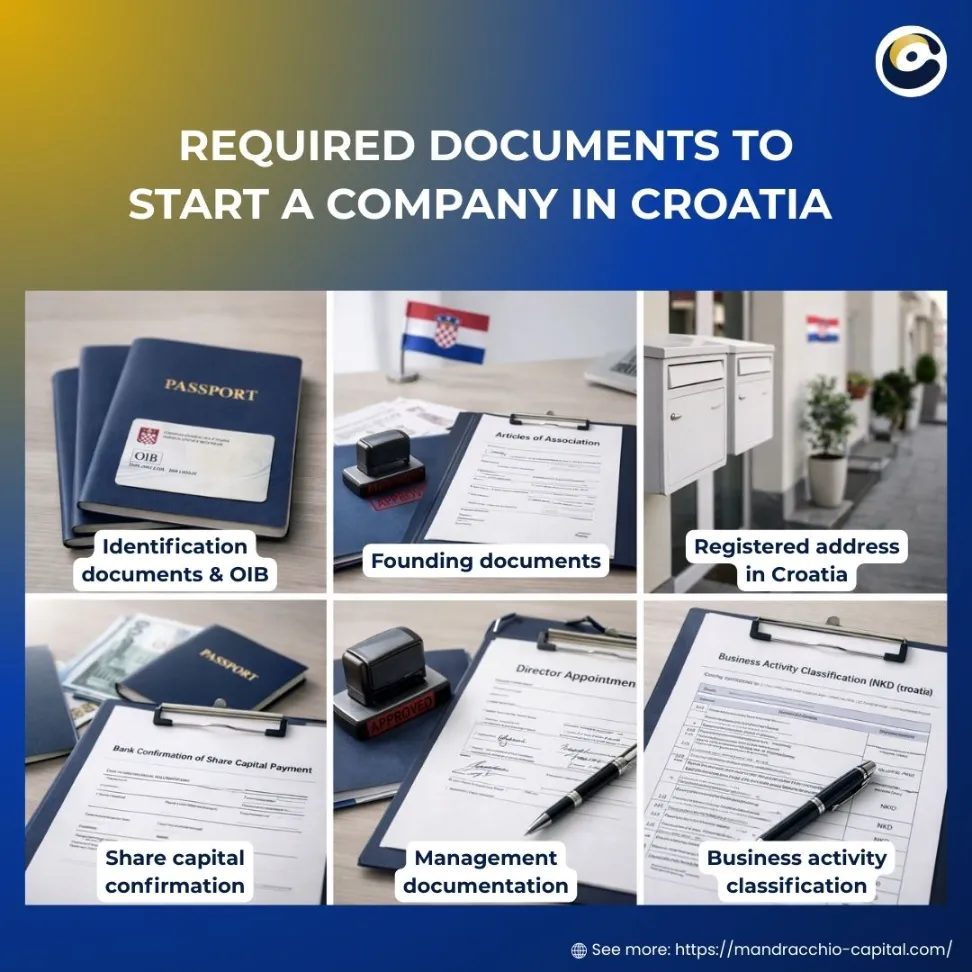
For Individual Founders
Individual founders generally need:
- A valid passport or national ID
- Croatian OIB (Personal Identification Number)
- Registered office details
- Incorporation documents
- Proof of share capital deposit
For Corporate Shareholders
Corporate founders typically need:
- Certificate of Incorporation or Company Extract
- Articles of Association
- Board resolution (if applicable)
- Details of the authorized representative
Additional Requirements for Foreign Applicants
Foreign applicants may also need:
- Apostilled or legalized documents (where applicable)
- Certified Croatian translations
- A notarized Power of Attorney for remote registration
Need the complete checklist? Read our detailed guide on Documents Required to Register a Company in Croatia, which explains every required document, notarization, apostille, and translation requirement for both Croatian and foreign founders.
Can You Start an LLC in Croatia Remotely?
Yes. In many cases, a Croatian d.o.o. can be established without travelling to Croatia. By appointing a local lawyer or authorized representative through a Power of Attorney, much of the incorporation process including document preparation, court registration, and administrative filings can be completed remotely.
However, some banks or specific circumstances may still require the director or beneficial owner to appear in person for identity verification.
How Long Does It Take to Start an LLC in Croatia?
The time required to establish a Croatian d.o.o. depends on document preparation, bank processing, notarization, and Commercial Court approval. In most cases, the incorporation process takes 2 to 4 weeks.
Applications with complete documentation and no legal issues are generally processed faster, while foreign-issued documents, translations, or banking requirements may extend the timeline.
How Much Does It Cost to Start an LLC in Croatia?
The total cost to start an LLC (d.o.o.) in Croatia typically ranges between €1,000 and €2,000 (VAT excluded). The final amount depends on the specifics of the case and the scope of support required.
This total generally includes:
- Fixed costs, primarily notary, court, and administrative fees, which vary depending on the company structure and documentation requirements.
- Professional legal and advisory fees, reflecting the level of assistance provided throughout the setup process.
All costs are outlined transparently in advance, so you know exactly what is included before the process begins.
Read next: Our guide to Company Registration Costs in Croatia explains every expected incorporation expense in detail.
Legal and Tax Obligations After Registration
Registering your company is only the first step. Once incorporated, a Croatian LLC must continue to meet ongoing legal and tax obligations, including:
- Maintaining proper accounting records
- Filing annual financial statements
- Paying corporate income tax
- Registering for VAT, where required
- Meeting employer obligations if hiring staff
- Keeping company information up to date with the authorities
Failure to comply may result in financial penalties or administrative sanctions.
Mandracchio Capital Company Formation Services
Mandracchio Capital business setup package is designed for standard company formations in Croatia and covers the majority of founder and investor use cases. It does not include large-scale investments, complex anti–money laundering structures, or unresolved visa or residency issues. That said, we regularly support more complex situations, provided they are reviewed and agreed upon in advance.
Pricing follows a transparent, fixed-cost structure, consisting of:
- Official third-party costs (notary, administrative fees, apostilles, court registrations, etc.)
- A professional consulting fee
- VAT (where applicable)
The service is delivered in a concierge-style format. You receive a clear documentation checklist upfront. Once the required documents are provided, Mandracchio Capital’s team and trusted local partners handle the preparation, coordination, and execution of the entire setup process so you avoid missteps, delays, and unnecessary back-and-forth with institutions.
Our support typically includes:
- Registering your personal identification number required for company formation
- Drafting core legal documents (bylaws, shareholding arrangements, and incorporation resolutions) through licensed lawyers
- Advising on business activities, licensing requirements, and registered office setup
- Coordinating notary appointments, certified translations, and court filings
- Preparing anti–money laundering and beneficial ownership documentation
- Assisting with share capital deposit, tax registration, and statistical registration
- Supporting bank account opening, accounting onboarding, and e-invoicing setup
In addition, we provide practical coaching on your first operational steps in Croatia, covering taxation, employment considerations, social security, compliance obligations, and local business practices. This guidance is tailored to your profile and business model and is intended to help you start correctly and avoid costly corrections later.
FAQ – How to Start an LLC in Croatia
Can I open an LLC (d.o.o.) in Croatia and then apply for citizenship?
No, opening a Croatian LLC (d.o.o.) does not directly lead to Croatian citizenship. Citizenship is a separate process governed by Croatian nationality law.
Croatian citizenship is granted only under specific legal grounds (such as descent, marriage, naturalization, or special interest). Business ownership alone is not a shortcut to citizenship.
To understand who qualifies for Croatian citizenship and under which legal articles, see our full guide here: How to Get Croatian Citizenship
What is the main difference between a d.o.o. and a j.d.o.o.?
Both are limited liability companies under Croatian law, meaning personal assets are protected. The difference is practical, not legal. A d.o.o. is the standard, fully recognized LLC designed for long-term operations, credibility, and growth. A j.d.o.o. is a simplified version intended for very small, early-stage projects and comes with structural limits that often become restrictive for foreign founders.
Which structure is better for foreign founders?
In practice, a d.o.o. is almost always the better choice for foreign founders, especially non-EU nationals. Banks, landlords, authorities, and business partners expect a d.o.o. in cross-border cases. A j.d.o.o. is rarely suitable for residency planning or long-term operations.
What do I need to start an LLC (d.o.o.) in Croatia?
To start an LLC (d.o.o.) in Croatia, you must follow a defined legal sequence. At a high level, this includes preparing a notarized founding document (Articles of Association or a Declaration of Incorporation), depositing the required share capital, opening a corporate bank account, and registering the company with the Commercial Court (Trade Register).
Every founder must obtain an OIB (Croatian tax ID). After incorporation, the company must be registered for taxes, and where applicable VAT, as well as with the Croatian Pension Fund (HZMO) and Health Insurance Fund (HZZO) especially if the founder or employees will work in Croatia. Some activities also require sector-specific licenses or approvals.
What documents are required for foreigners to start a company in Croatia?
Foreign founders typically need identification documents, notarized and translated founding documents, proof of address, and documents required to obtain an OIB. Requirements can vary depending on nationality and whether the founder applies remotely or in person.
How to open an LLC in Croatia?
To open an LLC in Croatia (a d.o.o.), you must prepare a notarized founding document, deposit the required share capital, obtain an OIB (Croatian tax ID), register the company with the Commercial Court (Trade Register), open a corporate bank account, and register for taxes, pension (HZMO), and health insurance (HZZO). Croatian citizens may use the online START system, while most foreign founders work through a notary or legal representative.
Can I invest in Croatia through a company, and how should it be structured?
Yes, many foreign investors use Croatian companies to invest in businesses, real estate, or long-term projects. However, how the company is structured matters far more than simply forming one. The wrong setup can lead to residency issues, tax inefficiencies, compliance delays, or weak asset protection, especially when investment and residence planning are not aligned from the start.
If your goal involves residency by investment, property acquisition, or capital deployment in Croatia, structure comes before execution.
What is the LLC equivalent in Croatia?
The Croatian equivalent of an LLC is a d.o.o. (društvo s ograničenom odgovornošću). It offers limited liability protection, allows full foreign ownership, and is the most commonly used structure for both local and international businesses.
Can a foreigner start a business in Croatia?
Yes. Foreign nationals, including non-EU citizens, can own 100% of a Croatian company without restriction. However, business ownership alone does not grant the right to live or work in Croatia. Residency and work permissions must be obtained separately and structured correctly, especially for non-EU founders.
How can I set up a company in Croatia without hidden legal or tax risks?
Many foreign founders register a company but overlook compliance sequencing, liability exposure, or tax classification from day one. These issues often surface later, when fixing them is costly.
Sources and Legal References
The information in this guide is based on official Croatian legal and administrative sources governing company formation, taxation, and business registration. Key references include:
- Croatian Companies Act (Zakon o trgovačkim društvima) – governing company structures such as d.o.o. and j.d.o.o., share capital requirements, and corporate governance rules.
- Invest Croatia – Founding a Company Guide
- Official overview of company types, share capital requirements, and incorporation procedures for foreign investors.
- https://investcroatia.gov.hr/en/founding-a-company/
- Court Register of the Republic of Croatia (Sudski registar) – the official registry where companies become legally active after incorporation.
https://sudreg.pravosudje.hr - Croatian Financial Agency (FINA) – responsible for business services including share capital deposits, payment systems, and company-related administrative processes.
https://www.fina.hr - Croatian Tax Administration (Porezna uprava) – authority responsible for issuing the OIB (personal identification number) required for company founders and directors.
https://porezna.gov.hr - Croatian Bureau of Statistics (DZS) – responsible for the NKD classification system used to categorize business activities.
https://dzs.gov.hr