Choose Cyprus if you distribute most of your profit every year and choose Croatia if you reinvest, hold assets long term, or need a base inside the Schengen Area. That is the short answer, and most comparisons stop there.
The problem is that the number most of those comparisons are built on is wrong. You will read that Cyprus costs founders “around 5%.” That figure only counts the tax on the dividend. It leaves out the 15% corporate tax the company pays first. Once both layers are counted, the gap between Cyprus and Croatia is a few percentage points, not twenty and for several types of digital founder, Croatia comes out ahead.
Hi, my name is Šime Jozipović, founder and CEO of Mandracchio Capital. I’m a Croatian lawyer based in Split, with an LL.M. from Harvard Law School and a doctorate in international tax planning.
In this article I will walk you through what each country actually costs to set up and run in 2026, where the tax genuinely differs once you take money out, and the substance question that decides more cases than either rate does.
If you are still comparing jurisdictions more broadly, our guide to Top EU Countries to Start a Business covers the wider factors founders should consider before choosing where to incorporate
Company formation in Croatia vs Cyprus
Croatia and Cyprus are two of the jurisdictions that consistently come up when founders compare places to base an EU business, but they compete on very different terms.
Cyprus raised its corporate tax from 12.5% to 15% on 1 January 2026 and, in the same reform, abolished the deemed dividend distribution rules for profits earned from 2026 onwards.
A Cyprus tax resident with non-domiciled status pays no special defence contribution on dividends only a 2.65% healthcare contribution, capped at €4,770 per year.
Croatia charges 10% corporate tax under €1,000,000 revenue, plus a 12% dividend tax, giving a combined effective rate of about 20.8%.
On fully distributed profit, Cyprus lands at roughly 16% and Croatia at roughly 21% – a gap of four to five points, not the twenty the “5%” articles imply.
A Cyprus private limited company needs no notary and no minimum share capital, and registers in one to three weeks. A Croatian d.o.o. needs €2,500 share capital with €625 paid in a notary, and two to four weeks.
Every Cyprus company files assured financial statements annually a full statutory audit above modest size thresholds. A small Croatian d.o.o. files unaudited statements.
Croatia requires a director contribution base of €1,295.45 gross per month regardless of revenue; Cyprus has no equivalent salary floor.
Croatia has been inside the Schengen Area since January 2023. Cyprus, as of September 2026, has not joined.
Why I wrote this comparison and how I researched it
Why this comparison keeps getting answered badly
If you are comparing Croatia and Cyprus, the biggest problem is not a lack of information. It is that the most repeated figure in this niche is an accounting trick.
Among the highest-ranking pages I reviewed for this comparison, the errors are material.
One quotes a Cyprus effective rate of “around 5%” — its own €100,000 worked example shows €5,000 of total tax, which is less than the corporate tax alone would be.
Several still cite Croatian dividend tax at 10%. It has been 12% since 1 January 2024, when the local surtax was abolished.
Croatian income tax bands are quoted from years ago. Rates are now set locally, 15–23% in the lower band and 25–33% in the higher, with the higher rate starting above €60,000.
One page runs its Croatian example at the 18% corporate rate for a company with €100,000 of revenue — a company sitting comfortably inside the 10% bracket — and treats revenue as if it were profit.
And almost nothing published before January 2026 survives contact with the Cyprus tax reform, which changed the corporate rate, the dividend rules and the treatment of retained profits in one stroke.
My aim is therefore: 2026 figures, primary sources, and calculations you can apply to your own numbers.
How I put this together
I verified rates, thresholds, fees and legal requirements against the issuing authorities and legislation, including the Croatian Tax Administration (Porezna uprava), Narodne novine, the Cyprus Tax Department, the Cyprus Registrar of Companies, the amending laws of the Cyprus tax reform published in the Official Gazette on 31 December 2025, and the Cyprus Civil Registry and Migration Department.
Where official or credible sources conflict, I have not silently chosen whichever figure fits the argument. I flag one unresolved point in the article: the timing of Cyprus’s Schengen accession, which was before the Council of the European Union at the time of writing.
The practical sections also reflect company formations we handled for foreign founders, including recurring friction points around banking, tax registration and getting a newly incorporated company operational.
Cyprus sells you a tax status, Croatia sells you a base
Before you compare rates, you need to understand what each country is actually offering — because unlike Estonia, which sells a company you can run from anywhere, both Cyprus and Croatia are selling you a place you have to move to.
Cyprus’s product is a personal tax status. The famous numbers: 0% on dividends beyond a small healthcare contribution, 0% on share disposals belong to the non-domiciled regime, and the non-domiciled regime belongs to individuals who are genuinely Cyprus tax residents. The company is almost incidental. Register a Cyprus company and stay living in Munich, and you have a 15% corporate tax jurisdiction with an audit obligation and none of the personal benefits.
Croatia’s product is an operating base. A d.o.o. with a 10% rate at the revenue levels most digital businesses actually run at, a residency pathway attached, and since January 2023 a residence permit that moves freely across mainland Schengen Europe.
These are different products. The right question is not “which rate is lower” but “which package matches how you will actually live and take money out.”
At Mandracchio Capital, we see three distinct groups asking about Cyprus.
Group one: the distributor. Profitable, established, taking most or all of the profit out every year, ready to relocate personally. This is the founder Cyprus was built for.
Group two: the builder. Revenue growing, most profit reinvested into people, tools and marketing. Distribution is years away. For this group, Cyprus’s headline advantage barely applies — and Croatia’s 10% on the first million of revenue does.
Group three: the relocator. They are choosing a country as much as a structure: family, schools, travel, safety. For this group, one fact most comparisons bury changes the ranking — Cyprus is not in the Schengen Area, and Croatia is.
If you pay everything out and truly move, Cyprus is cheaper on tax. If you reinvest, hold assets long term, or need Schengen, Croatia is usually the stronger base. I will prove both halves of that with specific numbers.
Corporate tax in Croatia and Cyprus compared
This is the section most people came for. It is also where the popular “5%” summary breaks down.
How the Cyprus system works after the 2026 reform
Cyprus overhauled its tax system with effect from 1 January 2026. The reform was approved by Parliament on 22 December 2025 and the amending laws were published in the Government Gazette on 31 December 2025. Three changes matter for founders (IBCCS TAX)
First, the corporate income tax rate rose from 12.5% to 15%, aligning Cyprus with the OECD global minimum tax framework. Any comparison still quoting 12.5% is out of date
Second, the deemed dividend distribution mechanism, which treated a Cyprus company as having distributed 70% of its profits two years after year-end, whether or not any dividend was paid, was abolished for profits earned from 2026 onwards. Retained profit in a Cyprus company is now genuinely untaxed at the shareholder level until you actually distribute it. One trap survives for existing structures: undistributed 2024 and 2025 profits remain within the old deemed distribution rules until 31 December 2027.
Third, the dividend layer depends on who you are. For Cyprus tax resident and domiciled individuals, the special defence contribution on dividends fell from 17% to 5% for post-2026 profits. But the founders reading this article will almost all qualify as non-domiciled, and non-domiciled Cyprus tax residents continue to receive dividends free of the special defence contribution entirely. What a non-domiciled resident does pay is the General Healthcare System contribution: 2.65%, on income capped at €180,000 per year, giving a maximum annual contribution of €4,770, dividends above the cap attract nothing further (Cyprus Tax Reform 2026).
How Croatia’s two-tier system works
Croatia uses a conventional system with two rates. You pay 10% corporate profit tax if revenue in the tax period stays under €1,000,000, and 18% above it (Porezna uprava).
The threshold measures revenue, not profit. For the full breakdown of thresholds, brackets and Form PD mechanics, see our [Croatia corporate tax guide].
Dividends paid to individuals are taxed at 12%, withheld at the time of payment.
And here is the distinction almost every comparison gets wrong: Croatia has three rates in this area and they are not interchangeable.
- 12% — dividend tax on distributions to individual shareholders
- 10% — withholding tax on dividends paid to non-resident companies, reducible to zero under the EU Parent–Subsidiary Directive or a treaty
- 15% — general withholding rate on other categories such as interest and royalties
If you take money out personally, 12% is your number.
The calculation at €1M turnover
One business, €1,000,000 of revenue, a 40% margin (€400,000 profit), the founder taking everything out as dividends, resident in the country where the company sits.
| Croatia (revenue just under €1M) | Cyprus (non-domiciled resident) | |
| Corporate tax | €40,000 | €60,000 |
| Tax on dividends | €43,200 | €4,770 |
| Total tax | €83,200 | €64,770 |
| Effective rate | 20.8% | 16.2% |
| Net to founder | €316,800 | €335,230 |
When all profit is distributed, the founder in Cyprus keeps about €18,400 more per year. That is roughly 4.6 percentage points — real money, worth relocating for in some cases, but nowhere near the twenty-plus points the “5%” articles imply.
At smaller profits the gap shrinks further. On €100,000 of profit fully distributed, Croatia costs €20,800 combined; Cyprus costs €15,000 in corporate tax plus roughly €2,250 in healthcare contributions.
That is a difference of about €3,500 — before Cyprus’s higher compliance costs, which we get to below.
The €1M threshold is a cliff, not a ramp
Croatia’s 10% rate depends on revenue. Once revenue exceeds €1,000,000, the 18% rate applies to the entire profit, not only the portion above the line.
In the table above, crossing the threshold raises corporate tax by €32,000. Founders operating near €1M should plan revenue timing and structure with their adviser before year-end.
Where Croatia wins outright: profit you keep in the company
Most growing digital businesses do not distribute everything. On retained profit, the comparison is simply 10% against 15% — and at €400,000 of profit, that leaves €20,000 more working capital in the Croatian company every single year.
Neither country penalises retention anymore. Croatia has no surcharge on undistributed profits, and Cyprus removed its deemed distribution rule for profits earned from 2026.
The difference is purely the corporate rate — and under €1M of revenue, Croatia’s is a third lower.
Capital gains, crypto and exit
For founders with portfolios alongside the business, the two countries split the categories between them.
Croatia taxes capital gains on financial assets at 12% when held under two years. Gains on assets held longer than two years fall outside taxation for private individuals — and the Tax Administration confirmed the application of this rule in a binding opinion dated 12 January 2026.
Read the limit carefully, because it is widely misreported. This is an individual, asset-specific rule covering shares, ETFs and crypto held personally. It does not let a company sell a subsidiary tax-free.
Cyprus exempts gains on the disposal of securities — shares, bonds, options and similar — from income tax with no holding period at all. For a stock and ETF portfolio, that is the most generous rule in this comparison.
Crypto is now different: the 2026 reform introduced a flat 8% tax on crypto-asset disposals, with no holding-period exemption. For a founder holding crypto long term, Croatia’s rate is 0% and Cyprus’s is 8% (Source: Agplaw).
On exit, both countries can get a personally held company sale to zero — Croatia through the two-year rule, Cyprus through the securities exemption. As with Estonia, the structure has to be decided before you incorporate, not in the year you sell.
Company formation process and timeline
Tax rates decide the long game. Formation cost and timeline decide whether you start this quarter or next.
Registering a Cyprus private limited company
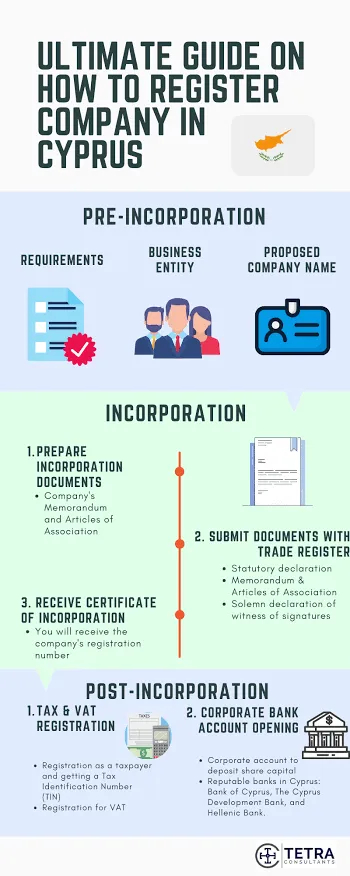
Cyprus runs on a lawyer-driven process under the Companies Law, Cap. 113. There is no notary and no minimum share capital — €1,000 of authorised capital is customary.
But the incorporation documents must be prepared and filed through a Cyprus-licensed lawyer, and every company must appoint a company secretary and maintain a registered office on the island.
The government fees are small: €30 for name approval plus €165 to register at standard capital levels. Professional fees for a standard incorporation typically run €800 to €2,000 on top.
Approval and registration take a few working days once the documents are submitted — realistically one to three weeks end to end, including name approval and document preparation (Source: Binderr).
One cost that used to sit in every Cyprus comparison is gone: the €350 annual company levy was abolished when the House of Representatives passed the Companies (Amendment) Law on 29 February 2024 (Source: Mondaq).
The honest warning is the same one I give about Croatia: banking, not incorporation, is the slow step. Cyprus banks apply heavy know-your-customer scrutiny to foreign-owned companies, and many founders end up on fintech accounts while the bank file crawls.
Registering a Croatian d.o.o.
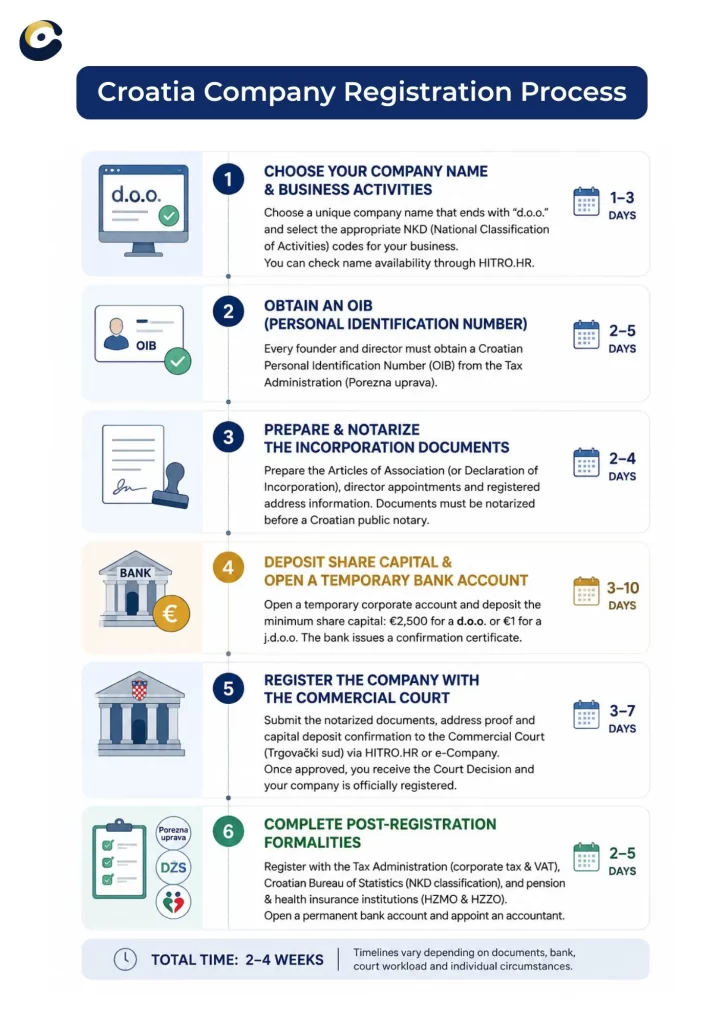
Croatia’s process is more traditional and more predictable, because each step has a defined authority behind it. For a detailed walkthrough, see our [guide to the Croatia company registration process].
| Cost item | Cyprus Ltd | Croatia d.o.o. |
| Government fees (one-off) | €30 name approval + ~€165 registration | Notary, court and stamp fees |
| Share capital (stays your money) | No minimum; €1,000 customary | €2,500 (€625 paid in first) |
| Mandatory setup | Cyprus lawyer, company secretary, registered office | Notary, registered address |
| Typical year-one total | ~€1,200–€2,500 before accounting and audit | ~€3,050–€3,800 all in |
Cyprus looks cheaper at formation. The picture reverses in the next section, because Cyprus front-loads almost nothing and back-loads a recurring obligation Croatia does not have.
What it costs to keep the company running
Cyprus’s mandatory audit
This is the recurring cost the Cyprus formation agents mention last, if at all.
Under the Companies Law, every Cyprus private limited company must have its annual financial statements audited by a licensed statutory auditor, prepared under IFRS as adopted by the EU. There is no general small-company exemption.
The only relief is a lighter “review engagement,” available where net turnover stays below €200,000 and gross assets below €500,000 for two consecutive years — with the turnover threshold rising to €300,000 for financial years beginning on or after 6 February 2026 (Source: Mondaq).
Read that against the scenario this article is built on. A company with €1,000,000 of revenue is five times over the review threshold.
A full audit is mandatory, every year, and combined accounting and audit for even a simple trading company runs to several thousand euros annually on published provider pricing. The €18,400 tax saving at €400,000 of profit is real — but a slice of it goes straight back out in assurance fees.
What Cyprus does not have is a salary floor. There is no statutory minimum director remuneration; social insurance applies only if you actually run payroll.
Croatia’s mandatory director contribution base
Croatia flips the equation. A small d.o.o. below the statutory audit thresholds files unaudited statements — but the largest recurring cost sits in payroll instead.
A full-time managing director must be paid at or above the minimum contribution base of €1,295.45 gross per month, or €15,545.40 per year, regardless of company revenue (Narodne novine 150/2025).
Earn nothing in year one and the obligation still stands. This is not the general minimum wage; directors are held to a higher floor.
One exception matters. If you are already employed full-time elsewhere, that employer covers your contributions and you can serve as director without a salary, taking profit out as dividends at 12%. For anyone building alongside a job, this changes the arithmetic completely.
Croatian accounting is mandatory double-entry under Croatian Financial Reporting Standards; published prices for a small company commonly start around €200 to €300 per month. Through the Mandracchio Capital network of English-speaking accountants, support starts from €300 per month for eligible businesses.
For a broader overview of the ongoing obligations and costs involved, read our guide to Accounting and Compliance After Company Formation in Croatia.
The trade nobody prices in
So the recurring comparison is: Croatia charges you a director salary floor and no audit; Cyprus charges you an audit and no salary floor.
At small scale, those roughly wash. Which means the decision falls back to the tax gap — and the tax gap only exists if you clear the bar in the next section.
Substance, residency and where the savings actually live
This section decides more cases than the rates do. It is also the one most formation agents skip, because it complicates the sale.
Cyprus’s numbers are personal, not corporate
Every attractive Cyprus figure in this article — the €4,770 dividend cap, the 0% on securities — belongs to a Cyprus tax resident with non-domiciled status. Neither comes from merely owning a Cyprus company.
To be a Cyprus tax resident, you either spend more than 183 days there, or qualify under the 60-day rule.
And the 60-day rule requires all of its conditions at once: at least 60 days in Cyprus in the tax year, no more than 183 days in any other single state, and not being tax resident anywhere else — alongside a Cyprus business or directorship and a permanent home on the island.
Non-domiciled status then lasts until you have been Cyprus tax resident for 17 of the previous 20 years — a long runway for anyone relocating from abroad (Source: GK Law Firm).
The trap scenario is the founder who registers a Cyprus company, files a non-domiciled election, and keeps living in Munich or Milan.
Their home tax authority looks at where decisions are made, where the work is performed and where the founder sleeps — the place-of-effective-management test — and claims the company, the dividends, or both. The 4.6-point saving evaporates, and penalties arrive on top.
The 2026 reform pushes the same direction from the Cyprus side: it strengthens economic substance requirements to prevent tax avoidance.
Cyprus is not a remote wrapper. It is a place you move to. The same is true of Croatia — a d.o.o. run entirely from Berlin has the identical problem — but Croatia’s marketing has never pretended otherwise.
The US treaty footnote
For American founders, one asymmetry: the US–Croatia income tax treaty was signed in 2022 but has not yet entered into force; it was transmitted to the US Senate as a treaty document on 14 September 2026.
Cyprus has had a US treaty in force for decades. US founders should model both positions with a US adviser before choosing either.
VAT, invoicing and the digital infrastructure question
Cyprus applies a standard VAT rate of 19%, with reduced rates below, and a domestic registration threshold of €15,600.
Croatia VAT rate applies 25%, with reduced rates of 13% and 5%, and registration triggers above €60,000 of turnover in any rolling 12-month period (Porezna uprava).
The 25% versus 19% gap looks larger than it is for a digital business. Services sold to consumers in other EU countries are charged at the customer’s country’s rate through the One-Stop Shop, and cross-border sales to EU businesses are usually reverse-charged.
The difference mainly matters for domestic sales — and note that Cyprus’s low registration threshold pulls small businesses into the VAT system far sooner than Croatia’s.
On infrastructure, the same 2019 assumption I dismantled in the Estonia comparison applies here.
Croatia’s Fiscalization Act made domestic business-to-business e-invoicing mandatory for VAT-registered businesses from 1 January 2026, with structured invoices and real-time reporting to Porezna uprava. Cyprus has no equivalent mandatory regime yet.
Croatia means more compliance setup in year one — and a more heavily digitised tax administration once you are running. As of 2026 there is no downloadable blank Obrazac PDV; the Croatian VAT return is generated and filed entirely through ePorezna.
Conclusion
Everything above leads here. No hedging in this section.
Choose Cyprus if this is you
You distribute most of the profit and you will genuinely relocate. At €400,000 of profit paid out in full, the founder keeps roughly €18,400 more per year in Cyprus. The advantage grows with profit, because the healthcare contribution caps at €4,770.
You hold a large securities portfolio. The exemption on share and bond disposals has no holding period at all.
You are a US, UK or other visa-free traveller who wants to preserve Schengen days. Time in Cyprus does not touch the 90-in-180 clock.
You want English and common law. Contracts, courts and daily business run in English on a legal system UK and US founders already understand.
Choose Croatia if this is you
In the conversations I have with clients weighing Croatia against Cyprus, the same points stack up:
You reinvest. Under €1,000,000 of revenue, retained profit is taxed at 10% against Cyprus’s 15% — €20,000 a year more working capital at a €400,000 profit, in exactly the years a business needs it.
You hold crypto long term. Croatia’s two-year exemption takes the rate to 0%; Cyprus now charges a flat 8% with no holding-period relief.
You need Schengen. A Croatian residence permit moves across mainland Europe today. A Cyprus permit, as of this writing, does not.
You run small and lean. Below the review thresholds a Cyprus company still needs assured statements; a small Croatian d.o.o. files unaudited accounts, and the total burden stays predictable.
You want to test before committing. The Croatian Digital Nomad Permit lets a non-EU founder live in Croatia with qualifying foreign income exempt from Croatian income tax — a genuine trial period Cyprus’s permit does not offer.
And the combination argument from our Estonia comparison holds here too: a moderate burden on both the company and the person, a normal EU entity that passes scrutiny with banks and tax authorities, and a safe, functioning coastal city to live in.
No single factor wins on its own. Croatia’s argument is that all of them hold at once.
Frequently asked questions
Is Cyprus’s effective tax rate really 5%?
No. Around 5% is the personal-level cost on dividends for a non-domiciled resident. The company first pays 15% corporate tax. Counting both layers, the combined rate on fully distributed profit is about 16–17%, depending on profit size.
Which is cheaper if I take all my profit out every year?
Cyprus, by roughly four to five percentage points — provided you actually relocate and qualify as non-domiciled. On €400,000 of profit distributed in full, Cyprus costs about €64,770 in combined tax against Croatia’s €83,200.
Which is cheaper if I reinvest?
Croatia, under €1,000,000 of revenue: 10% on retained profit against Cyprus’s 15%. Neither country taxes profits that stay in the company beyond the corporate rate — Croatia has no surcharge on retention, and Cyprus abolished deemed dividend distribution for profits earned from 2026.
Can I get the Cyprus non-dom benefits without moving there?
No. The benefits attach to Cyprus tax residency — more than 183 days, or the 60-day rule, which itself requires that you are not tax resident anywhere else. A Cyprus company owned by someone living in another country gets none of the personal exemptions and creates permanent establishment risk at home.
Do days in Cyprus count toward the Schengen 90/180 limit?
Not currently, because Cyprus is outside the Schengen Area. Croatia is inside it, so days there count — and a Croatian residence permit covers Schengen travel.
Do I have to pay myself a salary in each country?
In Croatia, usually yes: a full-time managing director must be paid at or above €1,295.45 gross per month, unless already employed full-time elsewhere. Cyprus has no statutory director salary floor.
Does a Cyprus company really need an audit?
Every Cyprus company files assured financial statements. A lighter review engagement is available only below €200,000 net turnover (rising to €300,000 for financial years beginning on or after 6 February 2026) and €500,000 of assets, held for two consecutive years. Above that, a full statutory audit is mandatory.
What about US founders?
The US–Cyprus treaty has been in force for decades; the US–Croatia treaty was signed in 2022 but is not yet in force, having been transmitted to the US Senate in September 2026. US founders should model both with a US adviser.