Choose Estonia for a digital-first business that reinvests profit. Choose Croatia for a physical EU base with lower corporate tax at smaller revenues. That is the short answer, and most comparisons stop there.
The problem is that a tax rate alone decides very little. This guide covers what each country costs to set up and run in 2026, how the numbers change once you take money out, and the substance question that settles more cases than either rate.
My name is Šime Jozipović, founder and CEO of Mandracchio Capital. I’m a Croatian lawyer based in Split, with an LL.M. from Harvard Law School and a doctorate in international tax planning.
In this article I will walk you through what each country actually costs to set up and run in 2026, where the tax genuinely differs once you take money out, and the substance question that decides more cases than either rate does
Company formation in Croatia vs Estonia
Croatia and Estonia are two of the jurisdictions that consistently come up when founders compare good place to start a business in the EU, but they represent very different approaches to structure and taxation
- Estonia charges 0% on retained profit and 22% on distribution, calculated as 22/78, which works out to roughly 28.2% of the net dividend received
- Croatia charges 10% corporate tax under €1,000,000 revenue and 18% above, plus 12% dividend tax, giving a combined effective rate of about 20.8%
- An Estonian OÜ costs €265 in state fees, needs share capital from €0.01, and registers in one to five business days
- A Croatian d.o.o. needs €2,500 share capital with €625 paid in, a notary, and two to four weeks
- Croatia requires a director contribution base of €1,295.45 gross per month regardless of revenue; Estonia has no equivalent floor for a non-resident board member
- e-Residency is a digital identity, not a residence permit; Croatia offers an actual residency pathway
Why I wrote this comparison and how I researched it
Why this comparison keeps getting answered badly
If you are comparing Croatia and Estonia for a company, relocation, or tax structure, the biggest problem is outdated information.
Three high-ranking pages I found contain outdated figures, while one does not cover Croatia at all. Some corrections are material: Estonia’s e-Residency state fee is now €265, the application fee is €150, the dividend tax increased from 20% to 22% in 2025, the standard VAT rate rose from 22% to 24%, and the former 14/86 reduced dividend rate no longer applies.
These changes can directly affect incorporation costs, tax calculations, and a Croatia-versus-Estonia decision.
My aim is simple: provide 2026 figures, primary sources, and practical calculations rather than recycled country rankings.
How I put this together
I verified rates, thresholds, fees and legal requirements against the issuing authorities and legislation, including the Croatian Tax Administration (Porezna uprava), the Estonian Tax and Customs Board, Narodne novine, Riigi Teataja, Croatia’s Ministry of the Interior (MUP), and the Estonian Police and Border Guard Board.
Where sources conflict, I flag the uncertainty rather than choosing the figure that fits the argument. The article also draws on practical company-formation experience, including common issues around banking, tax registration and getting a newly incorporated company operational.
Before comparing tax rates, you need to understand that you are choosing between two different products, not two versions of the same one.
Estonia sells you a vehicle, Croatia sells you a location
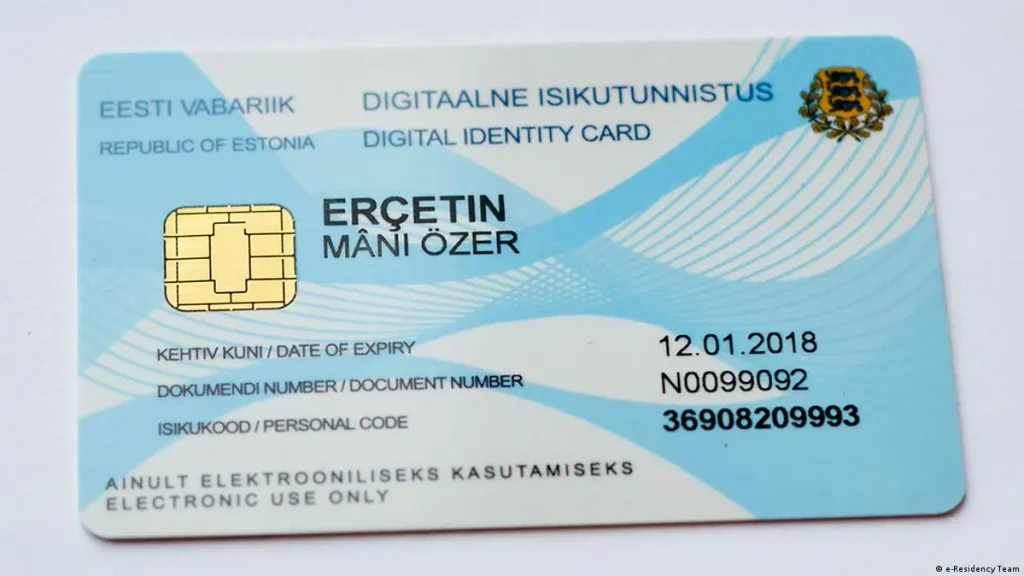
Estonia’s product is a company you can open and run from anywhere. You never need to set foot in Tallinn, except once to collect your e-Residency card at an embassy. No other EU country offers this. That is why the programme has issued more than 142,000 digital identities and produced more than 43,000 companies as of July 2026 (according to e-Residency statistics dashboard).
Croatia’s product is a real EU operating base. You can live there, hire local staff, hold a bank account with an actual branch behind it, and apply for residency. A Croatian d.o.o. ties you to one specific country, in both the good sense and the bad.
These two products solve two different problems. So placing Estonia’s 0% next to Croatia’s 10% and drawing a conclusion will send you the wrong way.
The three founders who search this question:
At Mandracchio Capital, we see three distinct groups.
Group one: the remote invoicer. EU nationals or digital nomads. Revenue between €80,000 and €500,000 a year. No employees. They need an EU legal entity and a VAT number to work with European clients.
Group two: the relocator. They need a residence permit, a base for their family, a place to actually be. For this group, Estonia’s headline advantage is close to meaningless. The reason is simple: e-Residency is a digital identity, not a visa. Most readers in this group have not realised that yet when they start reading.
Group three: the restructurer. They already run a company in the UK, the US, Cyprus or Dubai. The business is profitable. Now they are hitting bank rejections, worrying about economic substance rules, or facing a change in tax residency.
If you will not be physically present in the EU, Estonia is the cheaper wrapper. If you will be present, Croatia is usually the stronger base. And if you take profits out every year, Croatia is cheaper on tax.
That last point reverses what most people expect. I will prove it with specific numbers in the next section.
Corporate tax in Croatia and Estonia compared
This is the section most people came for. It is also where the popular summary breaks down.
How Estonia’s deferred taxation model works
Estonia does not tax profit when you earn it. It taxes profit when you take it out.
Retained and reinvested earnings sit at 0% corporate income tax, with no cap on the amount or the duration (Estonian Tax and Customs Board). Leave €500,000 in the company for eight years and Estonia charges nothing.
Distribution triggers the tax, and “distribution” is broader than most founders assume. It covers dividends, share buy-backs, capital reductions, liquidation proceeds and deemed distributions (PwC Worldwide Tax Summaries).
The rate is 22%, applied as 22/78 of the net amount paid out. Your company has €100 available. You receive €78. The company pays €22 in tax.
Now flip it, because this is the version most guides skip. To put a clean €100 in your hand, the company pays €28.21. The effective rate on what you actually receive is roughly 28.2%, not 22%.
Two details change the picture:
- Estonia treats this as corporate income tax, not withholding tax, so a double taxation treaty does not reduce it (PwC).
- The reduced 14/86 rate for regular dividends was abolished on 1 January 2025 (EMTA). Any article still mentioning 14% is out of date.
One point worth stating clearly, because 2025 caused genuine confusion: the legislated increase to 24% was repealed by the Riigikogu in December 2025. The rate stays at 22% for 2026 (KPMG Baltics, Estonia Tax Card 2026).
How Croatia’s two-tier corporate tax works
Croatia uses a conventional system with two rates.
You pay 10% corporate profit tax if revenue in the tax period stays under €1,000,000, and 18% above it (Porezna uprava). The threshold measures revenue, not profit. This structure carried from 2025 into 2026 unchanged. For the full breakdown of thresholds, brackets and Form PD mechanics, see our Croatia corporate tax guide
Resident companies are taxed on worldwide income, non-residents only on Croatian-source income (PwC).
One practical warning from our formation work at Mandracchio Capital: taxable profit is not accounting profit. Croatian law adds back non-deductible expenses. Your accountant calculates this on Form PD each year, so budget for a gap between your bookkeeping figure and your tax bill.
What happens when you take the money out
In Croatia, distribution costs you a second layer.
Dividends paid to individuals are taxed at 12%, withheld at the time of payment (Porezna uprava). Stack that on the corporate rate:
- 10% bracket: roughly 20.8% combined
- 18% bracket: roughly 27.84% combined
Here is a distinction almost every comparison gets wrong, including several AI summaries currently ranking for this query. Croatia has three rates in this area and they are not interchangeable (Porezna uprava):
- 12% — dividend tax on distributions to individual shareholders
- 10% — withholding tax on dividends and profit shares paid to non-resident companies
- 15% — general withholding rate on other categories, such as interest and royalties
If you take money out personally, 12% is your number. If a foreign parent holds your d.o.o., you are on the 10% line, and relief under the EU Parent-Subsidiary Directive or a treaty may reduce it to zero (PwC).under the EU Parent-Subsidiary Directive or a double taxation treaty may reduce it to zero.
Side by side on €100,000 of profit
One company, €100,000 of pre-tax profit, three scenarios.
Capital gains and exit
Croatia taxes capital gains on financial assets at 12% when held under two years. Gains on assets held longer than two years fall outside taxation for private individuals.
Read that limit carefully, because it is widely misreported. This is an individual, asset-specific rule covering things like shares, ETFs and crypto held personally. It does not mean a company can sell a subsidiary or a business tax-free after holding it for two years. Corporate disposals are assessed under corporate income tax.
Estonia has no separate capital gains tax. Gains are treated as ordinary income at the corporate level and taxed when distributed.
One point almost nobody covers: in Estonia, exiting by selling your shares personally produces a materially different outcome from extracting the same value as dividends. If an exit is on your roadmap, decide the structure before you incorporate, not in the year you sell.
Company formation process and timeline
Tax rates decide the long game. Formation cost and timeline decide whether you start this quarter or next year.
Registering an Estonian OÜ
Estonia’s process runs online from start to finish, with one exception nobody mentions upfront.
Step one: e-Residency, if you do not already hold an EU digital identity. The state fee is €150. Approval currently takes at least two months. Then you collect the card in person at an Estonian embassy or consulate.
That collection trip is the physical step most guides bury three-quarters of the way down the page. If your nearest Estonian consulate is a flight away, factor in the cost and the calendar.
Step two: register the OÜ through the e-Business Register. The state fee is €265. The register often processes applications within one business day. Realistically, plan for one to five business days.
Step three: share capital. Since February 2023, the minimum is €0.01 per shareholder. You pay it in full before filing, and the board members confirm the contribution. No bank confirmation is required at registration.
Here is the part almost no comparison article tells you. If your share capital sits below €2,500, the shortfall up to €2,500 remains a liability of the shareholders. So “incorporate for one cent” is technically true and practically misleading. You have not eliminated the €2,500, you have deferred it as personal exposure.
Registering a Croatian d.o.o.
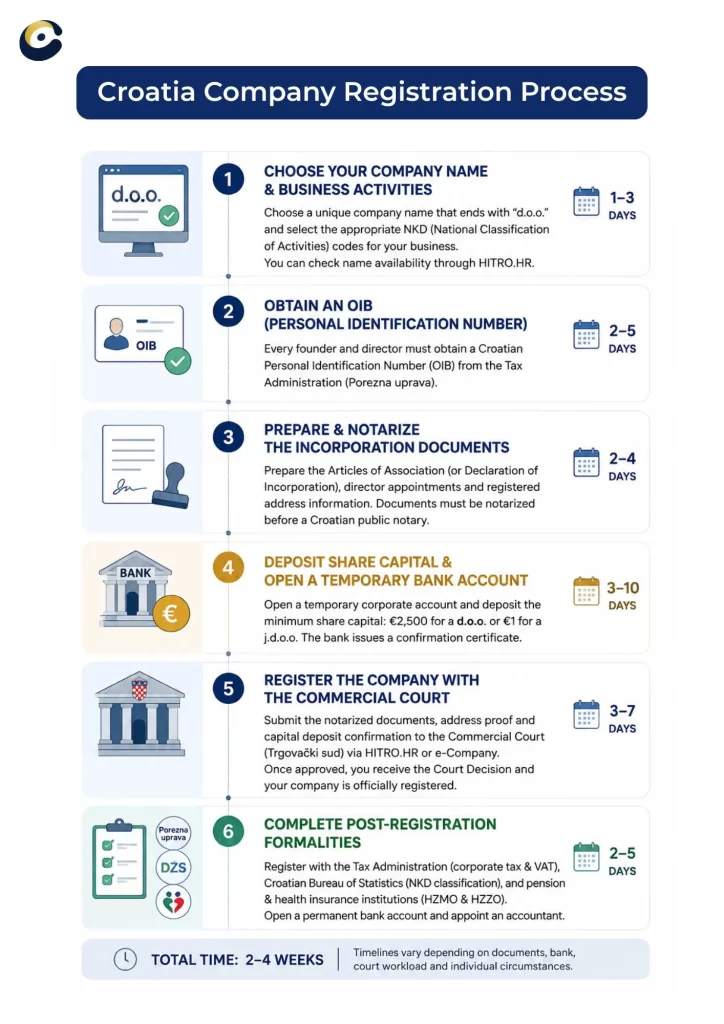
Croatia’s process is more traditional. It is also more predictable, because each step has a defined authority behind it. For a detailed overview of each step, see our guide to the Croatia company registration process
Step one: OIB. Every founder and director needs a Croatian personal identification number. Nothing moves before this. At Mandracchio Capital, this is the first thing we file, and delays here delay everything downstream.
Step two: company name check and reservation. The name must be unique in the Court Register. Reserving it early prevents rejection later.
Step three: the founding act. A Croatian public notary drafts and certifies it. You can sign in Croatia, or execute abroad by power of attorney with notarisation and apostille.
Step four: share capital. A d.o.o. requires €2,500, with at least 25% (€625) paid into a temporary bank account before filing.
Step five: Court Register filing via HITRO.HR, followed by tax registration with Porezna uprava.
Total timeline: 2 to four 4 weeks from instruction to an operating entity.
Foreign founders can own 100% of a Croatian company with no residency requirement attached. A virtual office address from a licensed provider satisfies the registered address requirement for the Court Register and the tax authority.
One honest warning. Banking is the longest single step for foreign-owned structures, not incorporation. Croatian banks apply strict KYC and AML checks, and the director usually needs to appear in person.
This table answers the complaint that drives most of the distrust in this niche. People get quoted €265, then receive an invoice for €3,000.
| Cost item | Estonia OÜ | Croatia d.o.o. |
| Government fees (one-off) | €150 e-Residency + €265 registration | Notary, court and stamp fees |
| Share capital (one-off, stays your money) | From €0.01, with liability up to €2,500 | €2,500 (€625 paid in first) |
| Provider fees (recurring) | €200–€400/year legal address and contact person | Registered address, accounting |
| Typical year-one total | €615–€815 before accounting | €3,050–€3,800 all in |
Estonia looks dramatically cheaper on this table. It is, at formation. The gap narrows sharply once recurring costs enter the picture, which is the next section.
What it costs to keep the company running
Formation is a one-off. Running costs repeat every year, and they decide more cases than the tax rate does.
Croatia’s mandatory director contribution base
This is the largest recurring cost in a Croatian d.o.o., and it catches people out.
A full-time managing director must be paid at or above the minimum contribution base of €1,295.45 gross per month, or €15,545.40 per year, regardless of company revenue (Narodne novine 150/2025). Earn nothing in year one and the obligation still stands.
This is not the general minimum wage of €1,050 gross. Directors are held to a higher floor.
One exception matters. If you are already employed full-time elsewhere, that employer covers your contributions and you can serve as director without a salary. Profit then comes out as dividends at 12%. For anyone keeping a job while building on the side, this changes the arithmetic completely.
Estonia’s recurring costs
Estonia has no equivalent floor for a non-resident board member. That is its real cost advantage.
Payroll costs apply only if you run payroll: 33% social tax plus 0.8% employer unemployment insurance, with a minimum monthly base of €886 in 2026 (EMTA). Draw nothing and you pay nothing.
Unavoidable fixed costs: legal address and licensed contact person from around €320 per year, plus accounting and annual filing. Published provider pricing puts the realistic all-in range at €800 to €3,500 per year.
Croatia’s ongoing accounting cost
Croatian companies must keep double-entry records under Croatian Financial Reporting Standards. An accountant is not optional in practice.
Published prices for a small company commonly start around €200 to €300 per month. Through the Mandracchio Capital network of English-speaking accountants, support starts from €300 per month for eligible businesses, moving with transaction volume, VAT scope, payroll and complexity.
The gap that decides it for solo founders
Take a one-person company earning €100,000 and distributing all of it.
- Tax: Croatia €20,800, Estonia €22,000. Croatia saves €1,200.
- Director floor: Croatia €15,545.40 per year. Estonia €0.
The salary obligation is roughly 13 times larger than the tax saving. For a solo founder with no other employment, Croatia’s tax advantage disappears under its own payroll floor. Unless the exception above applies, in which case Croatia wins on both counts.
Substance, permanent establishment and where your company is really taxed
This section decides more cases than tax rates do. It is also the one most formation agents skip, because it complicates the sale.
Why your registered address is not where you are taxed
Registering a company in Estonia makes it an Estonian legal entity. It does not guarantee the profit is taxed in Estonia.
Tax authorities look at where the business actually happens. The concept is place of effective management: the country where key management and commercial decisions are genuinely made.
Three practical tests apply:
- Where are decisions made? If you are the sole director living in Spain, decisions are made in Spain.
- Where is the work performed? Wherever you are sitting.
- Where are contracts signed? A digital signature from your sofa in Barcelona still counts as signing in Spain.
You do not have to take my word for it. Estonia’s own e-Residency knowledge base warns e-residents about permanent establishment and dual residence, and names place of effective management as a common additional residency criterion (e-Residency knowledge base). The programme that sells you the company also tells you where its limits are.
The scenario that catches people out
A freelance developer lives in Madrid. He invoices German and US clients through his Estonian OÜ. No Estonian clients, no Estonian employees, no office in Tallinn.
Two tax authorities look at the same facts and reach opposite conclusions. Estonia sees a company with no local activity and questions the VAT number. Spain sees a person living, working and deciding in Spain, and asks why the profit is not taxed there.
Both are right. And the treaty does not rescue him. A double taxation treaty prevents the same income being taxed twice. It does not help when Spain argues the income was Spanish-sourced and Estonia agrees there was no real Estonian activity.
He is not caught between two claims. He is caught with a company nobody wants to defend.
What changed in Estonia in 2025 and 2026
August 2025. VAT number applications now require a demonstrable economic connection to Estonia. The rule applies to all new Estonian companies, but hits e-residents hardest.
The Tax and Customs Board has published no definitive checklist. Based on patterns reported by Estonian service providers, four factors help: Estonian clients or suppliers, people employed in Estonia even part-time, use of Estonian services beyond bare company maintenance, and a business model where EU VAT registration through Estonia specifically makes sense.
What does not help: an OÜ registered purely to invoice non-Estonian clients, with nothing connecting it to Estonia except the company address.
2026. Substance and active operations carry more weight, including at e-Residency renewal, where turnover and employment figures matter. Passive-asset and non-transparent holding structures face more frequent audit. Estonia also exchanges tax information automatically with over 100 jurisdictions under CRS, so your liability at home does not disappear.
A widely shared article asked whether Estonia quietly killed e-Residency. The frustration was real and the change was communicated badly. But the fairer reading is that Estonia closed a loophole allowing VAT numbers without genuine economic activity. The programme did not die. It grew up.
VAT, invoicing and the digital infrastructure question
Most founders treat VAT as an afterthought. Here it is one of the sharpest differences between the two countries.
VAT rates and registration thresholds
Estonia applies a standard rate of 24%, permanent since 1 July 2025. Mandatory registration starts above €40,000 of annual taxable turnover, with voluntary registration available below that (EMTA). One detail matters for non-resident founders: businesses not established in Estonia have no threshold and may need to register from the first taxable supply.
Croatia applies 25%, with reduced rates of 13% and 5%. Registration triggers above €60,000 within any rolling 12-month period, and the obligation begins on the first day of the following month (Porezna uprava).
A practical note founders ask us about at Mandracchio Capital: as of 2026 there is no downloadable blank Obrazac PDV. The VAT return is generated and filed entirely through
. Any PDF circulating online is a layout reference, not a form you can submit.
The Estonian VAT number problem
Getting an Estonian VAT number is no longer routine. This has caused the most frustration of any change since August 2025.
The practical consequence is what matters. You can still register the company in 1 to 5 business days, but you may not get a VAT number, and operating without one limits your ability to trade with other VAT-registered EU businesses.
Croatia is no longer the analogue option
Almost every comparison still runs on one assumption: Estonia is the digital one, Croatia is the paperwork one. That is a 2019 assumption.
Croatia’s Parliament passed the Fiscalization Act on 13 June 2025, and from 1 January 2026 domestic B2B e-invoicing became mandatory for VAT-registered businesses (KPMG). In practice:
- Invoices must be structured documents based on EN 16931-1:2017, in UBL 2.1 aligned with Croatia’s national CIUS
- They travel through secure access points and authorised intermediaries
- Fiscalisation and e-reporting data goes separately to Porezna uprava in the tax authority’s XML formats
- B2C fiscalisation now covers all transactions regardless of payment method (ecosio)
Croatia has run mandatory B2G e-invoicing since 2019 through FINA’s eRačun platform on Peppol, with full implementation of the wider regime expected by 1 January 2027.
The conclusion is uncomfortable for the popular narrative. Croatia now operates real-time invoice clearance. Estonia does not.
This cuts both ways. Real-time reporting means more compliance setup in year one, and you need invoicing software that speaks the right format. But Croatia is not the bureaucratic option people assume. It is the more heavily digitised tax administration of the two.
If someone tells you Croatia means stacks of paper, they last checked in 2019.
Residency and lifestyle
e-Residency is not immigration
Estonian e-Residency does not give you the right to live anywhere.
It is a government-issued digital identity giving remote access to Estonian e-services, an EU-valid digital signature, and the ability to form and run a company online. It is not residence, citizenship or personal tax residency.
If you came here looking for a way to live in Europe, that single fact removes Estonia from your shortlist.
e-Residency in numbers
The programme succeeds at what it does. Official dashboard figures, updated 16 July 2026 (e-Residency statistics):
- More than 142,000 e-residents worldwide
- More than 43,000 companies established by e-residents
- 5,556 companies founded in 2025, a record, up 15% year on year
Sector concentration tells you who it suits: computer programming and consultancy accounts for 10,394 companies, management consultancy 6,452, and retail trade 3,686 (e-Residency). If your business does not resemble one of those three, ask why.
The two digital nomad routes compared
| Estonia | Croatia | |
|---|---|---|
| Income requirement | €4,500 per month, proven over 6 months | €3,622.50 per month, or €43,470 in bank balance |
| Duration | Type C up to 90 days, Type D up to 1 year | 12 months |
| Renewal | Not renewable consecutively | Renewable after a break |
| Tax while there | Applies after 183 days in 12 months | Qualifying foreign work income exempt |
| Local work restriction | Clients outside Estonia only | Cannot invoice Croatian clients or run a local d.o.o. |
Sources: e-Residency, MUP.
Croatia’s threshold sits roughly €880 per month lower. For freelancers and early-stage founders, that gap decides eligibility.
Living there, honestly
Tallinn and Split are not interchangeable.
Tallinn gives you the best digital public administration in Europe, a dense startup community, very short winter days, and widely spoken English. Split gives you the Adriatic coast, a mild Mediterranean climate, lower costs outside summer, and a smaller startup scene.
Climate sounds like a soft factor until you have lived through a year of one or the other. If you are choosing a place to actually be, put it in the decision.
Who should choose Estonia, who should choose Croatia
Everything above leads here. No hedging in this section.
Choose Estonia if this is you
You reinvest nearly everything and distribute little or nothing. This is the single strongest case. Leave €200,000 in the company for five years and Estonia charges you €0. No other EU country matches that.
Your business is genuinely international. Clients in four countries, no single place where all the work happens, no fixed team anywhere. Estonia was built for exactly this shape.
You need an EU entity for credibility and will never be physically present in the EU. European clients often prefer invoicing from an EU company. If you live in Bangkok or Buenos Aires, an Estonian OÜ solves a real problem that no amount of sole-trader invoicing can fix.
You relocate every year or two. Re-registering a business every time you move is exhausting. An Estonian company stays put while you do not.
You are a small team funding growth out of revenue. Hiring contractors, buying tools, funding development. The 0% on retained profit is a genuine advantage over any country that taxes profit whether you take it out or not.
Choose Croatia if this is you
In the conversations I have with clients weighing Croatia against other EU options, the same four things stack up:
You extract profit annually. The combined rate is roughly 20.8% in Croatia against about 28.2% effective in Estonia. That is close to seven points in your favour, every single year.
You want to live in the EU, not only invoice from it. Croatia gives you a residency pathway. Estonia gives you a digital identity. These are not comparable products.
You will hire locally or run something with a physical footprint. Staff, an office, inventory, a service business. Croatia is built for this. Estonia is not.
You want a bank relationship rather than a fintech account. A real IBAN, a branch, a lending conversation, inside the Eurozone.
Tax efficiency that holds at the personal level, not just the corporate one. A 10% corporate rate is easy to find on a comparison table. What matters more is the total burden once profit reaches the founder personally, and Croatia’s combined 20.8% stands up well against most of the EU.
The ability to structure the business properly through a Croatian company. Not a shell that exists for a rate, but an entity that can hire, contract, hold assets and pass scrutiny. The d.o.o. is a normal EU company. It behaves like one when a bank, a client or a tax authority looks at it.
A moderate burden on both the business and the person. Founders comparing jurisdictions often model corporate tax and forget they also have to live somewhere and pay tax there. Croatia is one of the few places where both sides of that equation stay reasonable at the same time.
Safety and quality of life. This is the factor people leave out of written comparisons and raise in the first ten minutes of every call. Croatia is a safe, EU-integrated country with a Mediterranean climate. Split is a functioning city, not a tax address. Founders relocating with families weigh this as heavily as any rate.
No one of these wins on its own. Ireland has a lower headline corporate rate. Estonia defers tax indefinitely. Portugal has better weather in winter. Croatia’s argument is that all four hold at once, in one country you can actually live in.
That combination is what makes the structure defensible rather than theoretical. It is also, honestly, why founders stay after the first year.
Frequently asked questions
Is Estonia or Croatia better for company formation?
Neither is better outright. Estonia suits founders who reinvest profit and never set foot in the EU. Croatia suits founders who extract profit annually, want residency, or plan to hire locally. The deciding factor is whether you need a company you can run remotely or a country you can operate from.
Does Estonian e-Residency give you residency in the EU?
No. e-Residency is a digital identity, not a visa or residence permit. It gives you remote access to Estonian e-services and lets you form and run an OÜ online, but it grants no right to enter, live or work in Estonia or any other EU country. Residency requires a separate permit.
Which has lower tax, Croatia’s 10% or Estonia’s 0%?
It depends entirely on whether you distribute profit. Estonia charges 0% while profit stays in the company and 22% on distribution, which works out to roughly 28.2% of what you actually receive. Croatia charges 10% corporate tax plus 12% dividend tax, giving a combined rate of about 20.8%.
Which is actually cheaper if I take my profits out every year?
Croatia, by roughly seven percentage points. On €100,000 of profit distributed in full, Croatia costs about €20,800 in combined corporate and dividend tax. Estonia costs €22,000 and leaves you €78,000. Estonia’s 0% headline only helps when profit stays inside the company.
Can I open a Croatian d.o.o. without living in Croatia?
Yes. Foreign founders can own 100% of a Croatian d.o.o. with no residency requirement. Formation can be completed by power of attorney with notarisation and apostille. In practice, the director usually still needs to travel once, because Croatian banks generally require an in-person appointment to open the corporate account.
How much share capital do I need in each country?
Estonia requires from €0.01 per shareholder, though any shortfall below €2,500 remains a shareholder liability. Croatia requires €2,500 for a d.o.o., with at least 25% (€625) paid into a temporary account before filing, or €1 for a j.d.o.o. Share capital stays company money, not a fee.
Do I have to pay myself a salary as a d.o.o. director?
Usually yes. A full-time managing director must be paid at or above €1,295.45 gross per month, which is €15,545.40 per year, regardless of company revenue. One exception applies: if you are already employed full-time elsewhere, that employer covers your contributions and you can serve without a salary.
What is permanent establishment risk for an Estonian company?
It is the risk that your home country taxes your Estonian company because the real business happens there. Tax authorities look at where decisions are made, where work is performed and where contracts are signed. A sole director working from Madrid can create a Spanish permanent establishment despite Estonian registration.