If you hold Croatian temporary residence for the return of Croatian emigrants, you may already have the right to run your own business here. Many founders still assume they need a separate self-employment permit, with its investment and hiring conditions.
I recently advised a client who held Croatian diaspora residence and wanted to establish her own d.o.o. She asked whether she would need to switch to a different residence permit to start and run her company legally. Her question raised an important distinction between the rights already granted by diaspora residence and the requirements that apply to other work-permit routes.
In this guide, I’ll explain how these rules apply to company ownership, self-employment and directorship, including the June 2026 amendments, so you can understand your options before registering your company.
Hi, I’m Šime Jozipović, a Croatian lawyer based in Split and founder of Mandracchio Capital. I advise clients on both Croatian immigration and business law, helping them navigate residence requirements, assess their right to work and self-employment, and structure their companies in line with the applicable legal framework. My goal is to help you understand your options and make informed decisions about both your residence status and your business.
Diaspora residence and company formation at a glance
Can I open and run a Croatian company on diaspora residence?
Yes, if your residence is specifically for the immigration and return of Croatian emigrants.
Do I need a separate residence-and-work permit?
Generally, no. This residence status includes the right to employment and self-employment under the Croatian Aliens Act.
Do the standard self-employment conditions apply to me?
Not necessarily. The better reading of the Act is that the investment, hiring and salary requirements for the specific self-employment permit route do not automatically apply to someone who already has the right to self-employment under diaspora residence.
Can I be the director of my Croatian company?
Potentially, yes. However, the June 2026 amendments introduced a director-application rule that requires careful review before you register your company.
How long is diaspora temporary residence granted for?
It can be granted for up to two years and may be renewed, subject to the applicable requirements.
When can I apply for permanent residence?
You may become eligible to apply after three years of continuous temporary residence on this basis, subject to the statutory conditions.
Is is possible to open a company in Croatia with a diaspora residence permit?
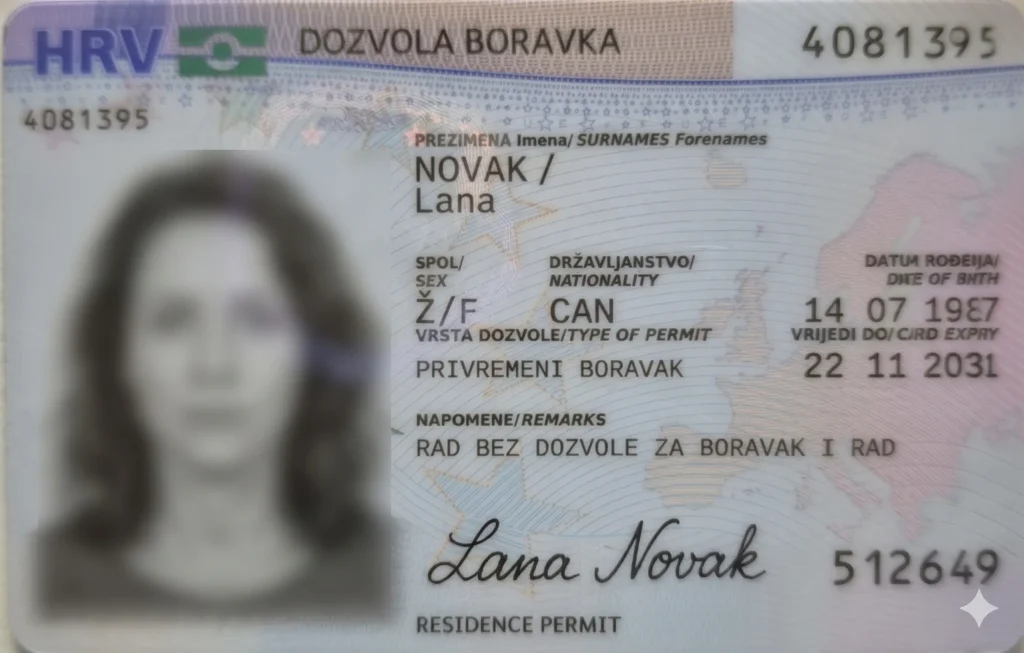
Yes. Temporary residence for the immigration and return of Croatian emigrants (privremeni boravak u svrhu useljavanja i povratka hrvatskog iseljeništva) lets you establish and run a Croatian company without a separate residence and work permit. The exact answer for you depends on two things: the residence category on your decision, and the role you will take in the company.
The Aliens Act (Zakon o strancima) treats citizens of countries outside the European Union, the European Economic Area and Switzerland as third-country nationals. Most of them need a residence and work permit before they can work in Croatia. A smaller group already has the right to work through another residence status, and qualifying diaspora residence holders belong to that group.
Owning, incorporating and working are different activities
The law treats three activities separately, and each one raises its own question.
| Activity | What the law says |
| Owning shares | Holding a stake in a company is not work under the Aliens Act |
| Preparing the incorporation | Article 88(2) excludes certain preparatory acts for setting up and registering a company from the definition of work. |
| Running the company | Managing operations, providing services or acting as director is work |
Owning a company does not prove that everything you do for it is authorised. Equally, working for your own company does not mean you need the standard self-employment permit when your residence status already lets you work.
For a step-by-step breakdown of notarisation, capital deposits, and court registration, see our comprehensive guide to starting a business in Croatia
Does diaspora residence allow self-employment?
Yes, and the Aliens Act says so directly. Article 79.a(4) gives third-country nationals with diaspora residence the right to employment and self-employment without a residence and work permit or a work registration certificate. Article 89(1), point 16, lists the same group among those who may work without these documents.
Together, these provisions separate a diaspora residence holder from a foreign founder whose only route to working in Croatia is a permit based on company ownership.
Take Lucía, born in Buenos Aires to a family from Hvar. She holds diaspora residence and wants to set up a design studio as a Croatian limited liability company (društvo s ograničenom odgovornošću, or d.o.o.). She will own 100% of it and manage it herself. Her residence status already gives her the right to work in that business. She does not need to apply for a self-employment permit first.
That right covers immigration only. Lucía still has to register the company, keep its books, pay tax and handle contributions like any other founder.
Your first step is to check that your residence decision or card records the purpose useljavanje i povratak hrvatskog iseljeništva. A different temporary residence category can lead to a different answer.
Do you need a self-employment permit to run your company?
The standard self-employment route
Croatia has a separate residence and work permit for third-country nationals who work through their own companies. Articles 110 and 113 of the Aliens Act govern it. For a founder who owns at least 51% of a Croatian company, Article 113 sets conditions such as an investment of at least €26,544.56, the employment of at least three Croatian citizens on full-time, indefinite contracts, and a gross salary for the founder of at least 1.5 times the national average.
These conditions belong to that permit. They are not universal rules for every foreign national who owns or runs a Croatian company.
Why your diaspora status changes the answer
Article 113(5) can look like it catches every majority owner. It requires a third-country national who owns at least 51% of a company to regulate residence and work through the self-employment provision, and it closes the ordinary employee permit route under Article 97 to them.
Articles 79.a(4) and 89(1), point 16, provide a separate legal basis to work without that permit. The stronger reading is that Article 113(5) decides which permit applies to people who need one. It does not remove a right to work granted elsewhere in the Act. Applying the standard self-employment conditions to diaspora residence holders would also leave the express right to self-employment in Article 79.a(4) with little practical effect.
This reading follows the structure of the Act. It is still an interpretation, so treat it as a strong position rather than a guarantee, especially after the June 2026 amendments on company directors.
Can You Be a Director of Your Own Company Under Diaspora Residence?
The June 2026 director rule
Amendments to the Croatian Aliens Act took effect on 4 June 2026. Under Article 111(5), where only third-country nationals are registered as persons authorised to manage and represent a company, one of them must apply for a key-personnel residence and work permit within 30 days of registration.
The provision does not expressly exempt third-country nationals who already have the right to work in Croatia under another residence status. This creates a question for diaspora residence holders, whose right to employment and self-employment is expressly recognised under Article 79.a(4).
How the director rule interacts with your existing right to work
Other provisions introduced or addressed by the 2026 amendments refer to the distinction between third-country nationals who need a work permit and those who may work without one under Article 89(1). Article 111(8), for example, addresses referrals to the inspectorate where a director cannot work without a permit under Article 89(1), or has not submitted the application required by Article 111(5). Article 93(1), point 17, also contains an exception referring to Article 89(1).
Read together with Article 79.a(4), these provisions support the interpretation that a person holding qualifying diaspora residence retains the right to work as a company director without obtaining a separate residence and work permit. Under this interpretation, the 30-day application requirement should not override a right to work that the Act already grants.
However, Article 111(5) does not expressly exclude holders of this residence status. The interaction between the provisions is therefore not entirely clear, and a police administration may still request a key-personnel permit application after the company is registered. The statutory basis for the existing right to work can be raised in response, but the outcome of an individual administrative assessment cannot be guaranteed.
What to check before registering your company
Before appointing a director, confirm that your residence decision or card records the purpose useljavanje i povratak hrvatskog iseljeništva. You should also establish who will be registered as authorised to manage and represent the company and whether Article 111(5) is likely to be raised by the relevant police administration.
If you already hold qualifying diaspora residence, do not assume that you must automatically switch to a key-personnel or self-employment permit. Equally, do not assume that the director-registration procedure can be disregarded. Confirm how the rule applies to your proposed company structure before registration.
Do you need to change your residence permit after opening a company?
Owning or running a Croatian company does not require you to give up valid diaspora residence and switch to a self-employment permit. Your statutory right to self-employment lets you stay in your current category while you run the business. Switching could be unnecessary, and it would move you onto a different set of residence and renewal conditions.
Diaspora residence versus a self-employment permit
| Diaspora temporary residence | Self-employment residence and work permit | |
| Right to run your own company | Yes, by statute | Yes, if the permit conditions are met |
| Investment and hiring conditions | Not triggered by ownership alone | Apply under Article 113 |
| Duration | Up to two years (Article 61(1)) | Set by the permit |
| Proof of means and health insurance at application | Not required (Article 79.a(3)); the health insurance obligation itself still applies | Required |
| Route to permanent residence | Eligible after three years of continuous residence on this basis (Article 156(1), point 2) | Under the general rules |
Does a company affect your citizenship application?
No, not on its own. Running a company in line with Croatian law does not invalidate an application for Croatian citizenship by descent. Citizenship and residence or work authorisation are separate legal questions, and your citizenship eligibility should be assessed on its own terms.
Keeping your residence and your company compliant
Confirm the exact residence category
Check your residence decision or card for the purpose useljavanje i povratak hrvatskog iseljeništva. Everything in this guide depends on that category.
Renew on time and watch your absences
Your right to work lasts as long as your residence status. Under Article 62(1), you must file a renewal application at least 60 days before your permit expires. Article 89(9) keeps your right to work in place while a timely renewal is pending, until the decision becomes enforceable.
Long absences can put your status at risk. Article 87(1), point 5, sets the absence limits that can lead to revocation. Article 87(5) allows a justified absence of up to 90 days if you notify the police administration beforehand. Check the limits against your own plans before a long stay abroad.
Tax and contributions still apply
Your exemption from the work permit does not exempt you or your company from tax and social insurance rules. Depending on your role and how you are paid, look at five areas:
- Personal income tax and your tax residency
- Corporate tax, accounting and reporting
- Social insurance contributions on employment or directorship
- Director remuneration and the minimum contribution base
- Services you provide to the company without being employed by it
A shareholder who does not work in the company usually has a different social insurance position from a founder who serves as director.
How Mandracchio Capital can help
At Mandracchio Capital, we look at your residence status and business plans together. Rather than treating immigration, company formation and tax as separate matters, we assess how they interact and what that means for your specific situation.
For Croatian diaspora residence holders, this means reviewing your residence decision alongside your intended ownership and management structure, the director-registration rules and the relevant company and tax obligations. Our integrated approach helps identify issues that might otherwise be missed when immigration and business advice are obtained separately, so you can make informed decisions before incorporating.
If you plan to establish a Croatian d.o.o. while holding diaspora residence, book a consultation with your residence decision at hand. We can assess your situation from both the immigration and business perspectives and help you identify what needs to be resolved before registration.
Frequently asked questions
Can I own 100% of a Croatian company on diaspora residence?
Yes. Your statutory right to self-employment under Article 79.a(4) means the standard majority-owner permit conditions do not apply to you because of your ownership share alone. If you will also be the sole director, check Articles 111 and 113 before registration.
Do I need to invest €26,544.56 and employ three Croatian citizens?
Not as a diaspora residence holder. Those conditions belong to the self-employment permit route under Article 113. They are not general conditions for people who already have the right to work and to be self-employed.