Move to Croatia from US looks simple on the surface. Americans can enter visa-free, English is widely spoken, and the lifestyle feels relaxed and accessible. Many people arrive thinking they’ll “figure it out once they’re here.”
That assumption is where most mistakes begin.
My name is Šime Jozipović, founder and CEO of Mandracchio Capital. I am a Croatian lawyer based in Split, holding an LL.M. in Tax Law from Harvard Law School, with professional experience specializing in international tax planning for expats relocating abroad. Having lived and worked in the United States, I bring a practical understanding of the legal, financial, and relocation challenges Americans face when moving overseas.
Moving to Croatia from the United States requires obtaining a temporary residence permit if you plan to stay longer than 90 days. U.S. citizens can enter Croatia visa-free for up to 90 days within any 180-day period (Schengen rules), but long-term relocation requires a legal residence basis such as work, digital nomad status, or family reunification.
This guide is written for Americans who want to immigrate to Croatia properly, avoid costly mistakes, and build a life that actually holds up beyond the first year.
Key Takeaways for Moving to Croatia from the US
- Americans can enter Croatia visa-free, but staying long-term requires a clearly defined residence permit.
- Relocating to Croatia is more procedural than many expect, involving MUP appointments, renewals, and ongoing compliance.
- The biggest relocation costs are often upfront expenses, not monthly living costs.
- Housing verification is essential, especially in coastal cities where scams and seasonal shifts are common.
- Successful relocation depends on planning the legal structure before arrival, not after.
Is Croatia Safe for Americans?
Yes Croatia is considered very safe for Americans and is classified as a Level 1 destination (Exercise Normal Precautions) by the U.S. Department of State. It consistently ranks among the safest countries in Europe, with low crime rates and a stable environment for both tourists and long-term residents.
Key Safety Points:
- Low Crime Rate: Violent crime is rare. The most common issues are minor incidents like pickpocketing in busy tourist areas or public transport hubs.
- Regional Considerations: Some rural areas (particularly in Karlovac and Lika-Senj regions) may still have unexploded landmines from past conflicts travelers should stay on marked roads and paths.
- Emergency & Healthcare Access: Reliable in cities, though more limited on remote islands or rural areas.
- Natural Risks: Occasional earthquakes and summer wildfires, but these are generally well-managed and monitored.
Bottom line: For Americans, Croatia is a safe, welcoming, and well-developed European destination—whether visiting short-term or relocating.
Key Steps and Requirements to Move to Croatia From The US
- Choose the Right Residence Permit:
Common options include the Croatia Digital Nomad Visa, work permit, business/investment-based residence, or family reunification. Applications are handled by the Croatian Ministry of Interior (MUP) through local police stations. - Prepare Required Documents:
You will typically need:- Valid U.S. passport
- FBI background check (apostilled and translated)
- Proof of accommodation in Croatia
- Health insurance (minimum coverage usually required)
- Proof of sufficient financial means
- Secure Accommodation Early:
Long-term housing is essential for your application. Coastal cities like Split or Dubrovnik can be highly seasonal, so many expats choose to rent first before buying. - Obtain an OIB & Open a Bank Account:
The OIB (Croatian personal identification number) is required for nearly everything—banking, contracts, and tax. After obtaining it, you can open a Croatian bank account for daily use.
Life in Croatia for Americans
- Cost of Living:
Generally lower than in the U.S., but cities like Zagreb and Split have rising costs. A single person may spend around $1,200–$1,500/month, depending on lifestyle. - Healthcare:
Private health insurance is required initially. Once resident, you may need to register with the Croatian public healthcare system (HZZO). - Lifestyle & Culture:
Croatia offers a slower, Mediterranean lifestyle with strong community values. However, administrative processes can be more bureaucratic than in the U.S. - Shipping & Logistics:
Personal belongings can often be imported VAT-free if used, but new items may be taxed. Many expats use specialized international moving companies.
Bottom line: Moving to Croatia from the US is highly achievable, but success depends on choosing the correct residence pathway and preparing documentation properly from the start.
What It Really Costs to Relocate (What People Don’t Budget For)
The biggest surprise for many Americans isn’t the monthly cost of living in Croatia, it’s the upfront friction.
Even if your long-term expenses go down, relocation often includes:
- Security deposits + first month rent (and sometimes more)
- Temporary housing while you search and verify a lease
- Translations, apostilles, notarizations, courier fees
- Insurance (private health coverage during the setup period)
- Flights, storage, shipping, and “restart” purchases
- Pet travel requirements (if relevant), which add cost and complexity
So yes, Croatia can be financially attractive. But you still want a realistic “moving budget,” because Croatia rewards prepared relocators and punishes under-budgeted ones.
Our Tip:
If you’re planning to move to Croatia from the US, budget not just for monthly life – but for the first 90–120 days of setup costs.
What Americans Usually Underestimate Before Move to Croatia from US

Americans can enter Croatia visa-free for short stays, which makes the move feel deceptively simple at first. The shift happens when you decide you’re not just visiting – you’re staying. That’s when Croatia becomes process-driven: permits, renewals, appointments, proof documents, local registrations, and ongoing compliance.
If you’re used to “figuring it out as you go,” Croatia can be frustrating – not because it’s unwelcoming, but because residency is procedural. The system expects your purpose of stay to be clearly defined and consistently documented. The more ambiguous your plan is, the more fragile your residence path becomes (especially at renewal time).
Housing: How to Avoid Getting Scammed (and Overpaying)
Most rentals in Croatia are furnished, and long-term contracts are often structured around 12-month leases. In coastal cities, housing becomes more competitive in spring and summer because many apartments switch to short-term tourist lets. That means availability tightens, prices rise, and some landlords avoid long-term contracts during high season.
A few practical realities to plan for:
- Utilities are usually paid separately, so your monthly cost isn’t only the rent.
- In tourist-heavy locations, the best listings move fast – and scams do exist.
- If you’re new in-country, paying deposits or advance rent before you’ve seen the property can be risky.
“After being scammed once, we arrived and stayed in a short-term rental first – just to see the apartment in person and confirm everything was legitimate.” – Amanda, an American expat in Split
That “soft landing” strategy (Airbnb first, verify second, sign third) can save you thousands and prevent legal headaches. Facebook groups and Idealista can work well – but treat them as lead sources, not proof of legitimacy.
Cost of Living in Croatia (for Americans): Lower, But Not Always “Cheap”
For those who move to Croatia from US, the cost of living in Croatia is generally lower than in most US cities, especially for rent, food, and everyday services. But the difference depends heavily on where you live and how “international” your lifestyle is.
A few honest notes that matter for Americans:
- Croatia can still feel affordable – but EUR/USD exchange rates change your math.
- Tourist economies can narrow the gap, especially in central Split and Dubrovnik.
- The further you move from prime tourist zones, the better value you usually get.
As a quick orientation:
- Zagreb offers balance, stability, and more year-round local infrastructure.
- Split and Dubrovnik come with coastal premiums and stronger seasonality.
- Smaller cities often provide better housing value, but fewer international amenities.
If you’re building a long-term base, it’s not enough to ask “Is Croatia cheaper?”
The better question is: Which Croatian city fits my budget and my daily rhythm?
Croatia Cost of Living vs US
For Americans, the Croatia cost of living vs US comparison is one of the strongest motivators.
Housing
Rent in Croatia is dramatically lower than in major US cities. Even premium coastal apartments often cost less than modest US rentals.
Healthcare
Healthcare costs are far lower, even with private clinics. Insurance and out-of-pocket expenses are more predictable.
Food & Transportation
Groceries, dining, and transport are generally cheaper, though imported products cost more.
The trade-off
While expenses are lower, local salaries are not comparable. Americans living comfortably in Croatia usually rely on:
Business income
Remote US-based work
Investments or pensions
OIB, Address Registration, and MUP: Expect “One More Paper”
Croatian admin steps tend to show up earlier than most Americans expect – especially the OIB (personal tax number). Many people encounter it immediately because you may need it for things like:
- Signing a lease
- Setting up certain contracts
- Opening accounts and completing local registrations
And then there’s the part nobody loves: MUP appointments and paperwork loops.
If you take only one mindset into this process, make it this one:
“There’s always one more paper.”
That’s not a criticism – it’s how you stay sane. If you’re moving to Croatia without Croatian language fluency, expect:
- Multiple visits
- Slight variations in interpretation
- Extra documents requested mid-process
The winning strategy is to build buffer time, stay organized, and treat admin as a series of steps – not a single appointment.
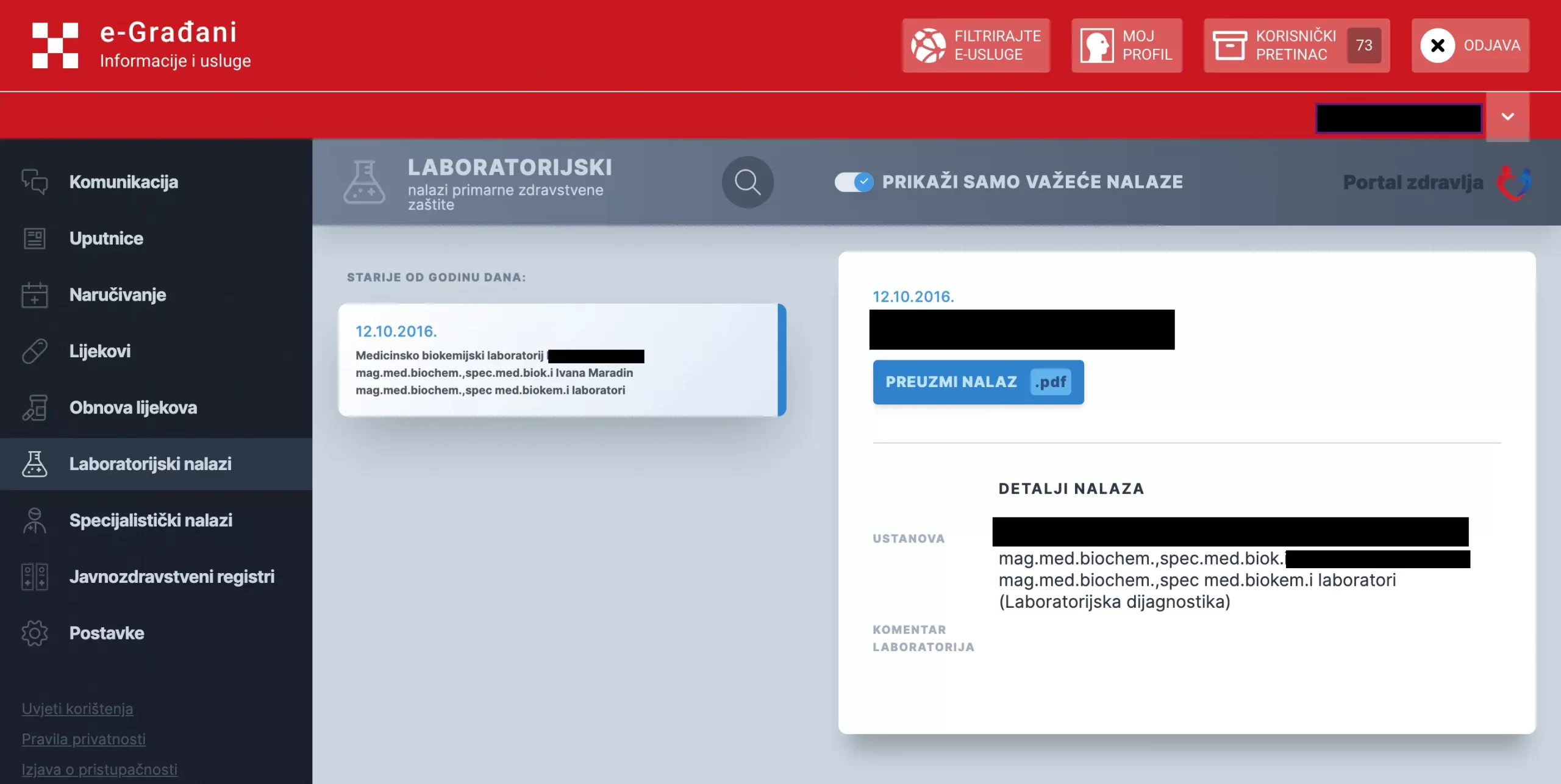
Healthcare: Avoid Tourist Clinics, Use the Local System Smartly
If you’re an american moving to croatia, it’s important to understand how healthcare pricing actually works once you’re here. Health insurance is required for residence applications, but the real question is: how will you access care once you’re here?
Tourist-focused clinics can be expensive – and they often operate on a pricing model that shocks Americans who assume “Europe = automatically cheaper.” Many expats get better outcomes when they rely on local recommendations to find standard providers rather than tourist services.
Croatia’s public healthcare system is comprehensive and can be affordable once you’re properly registered, which is often a relief for Americans used to private insurance complexity. Many expats still choose to supplement with private coverage for:
- Faster access
- English-speaking providers
- Specific specialist preferences
The practical takeaway: your insurance may be “valid,” but how you navigate healthcare locally affects both your costs and your experience.
Lifestyle and Community: How People Actually Integrate
English is widely spoken in Croatia – especially among younger Croatians and in major cities. That said, learning even basic Croatian dramatically improves your experience because it changes how people respond to you in daily life, especially in admin settings and outside tourist zones.
Community is the other unlock. The fastest integration usually isn’t “doing everything alone.” It’s joining real-life social loops:
- WhatsApp expat/community groups
- Interest-based meetups (tennis, running, coworking, coffee)
- Local neighborhood routines (markets, cafés, gyms)
This is where most relocations succeed or fail: not the paperwork, but whether you build a life after the paperwork.
Residence Permits When Moving to Croatia from US
For US citizens, moving to Croatia starts with understanding one key rule: you can stay visa-free for up to 90 days within any 180-day period, but anything longer requires an approved residence permit.
Croatia is welcoming but its immigration system is formal and document-driven. Residence permits are not granted casually. Your purpose of stay must be defined, provable, and compliant from day one. Many applications fail not because Croatia is restrictive, but because applicants arrive without a clear legal structure. Residence rights for third-country nationals are governed by the Croatian Aliens Act (Official Gazette NN 133/20, 114/22), which regulates the conditions for temporary and permanent stay in Croatia.
Check out all Croatia residence permits available here if you need.
Temporary Residence Permit (The Core Legal Foundation)
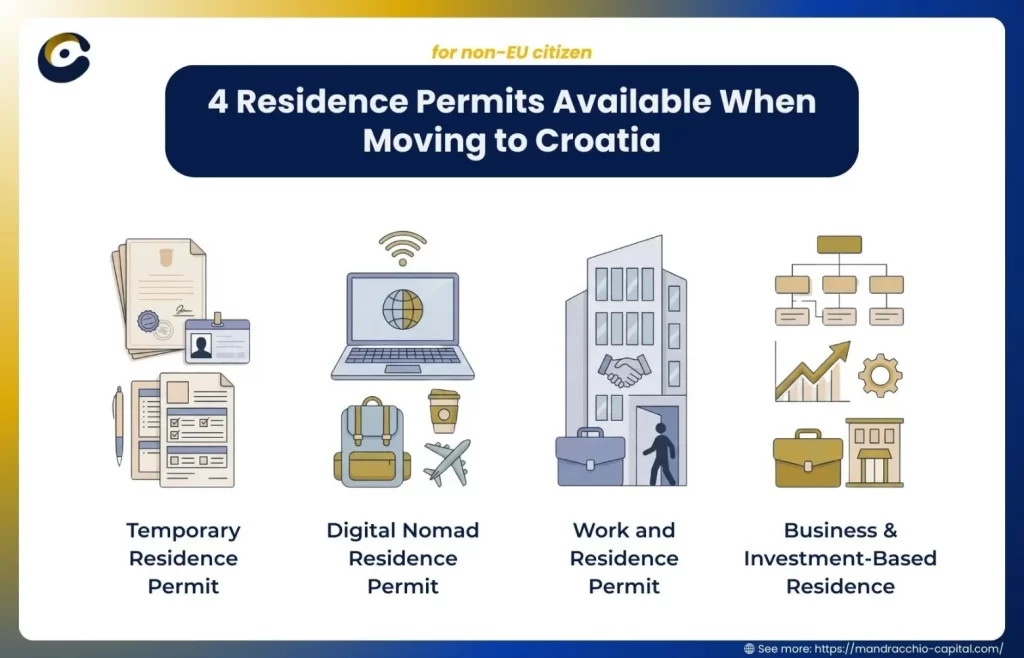
For most Americans, Croatia temporary residence is the correct and necessary starting point. This permit covers multiple legal bases, including employment, business activity, family reunification, study, and other long-term purposes.
Temporary residence is issued for one year at a time and can be renewed as long as the underlying purpose remains valid. While it may sound short-term, this is the standard pathway toward permanent residence in Croatia.
What matters most is consistency. When your residence basis is clear and logical, renewals are generally routine. When the structure changes or appears artificial, complications arise.
Croatia Digital Nomad Visa
Introduced to attract remote professionals, the Croatia Digital Nomad Visa allows US citizens to live in Croatia while working remotely for non-Croatian employers or clients.
This permit can be valid for up to 18 months under current law. However, it comes with important limitations:
- It does not lead directly to permanent residence
- It cannot be renewed indefinitely without a break
- It prohibits work for Croatian companies
For many Americans, it functions best as a trial stay – a way to experience life in Croatia before committing to a long-term immigration structure.
Employment-Based Residence (Croatian Employer)
US citizens employed by a Croatian company may obtain residence tied directly to that role. This route works well in certain industries but carries an important risk: if the employment ends, residence rights typically end shortly afterward.
This dependency is often underestimated. Employment-based residence can be effective, but it requires contingency planning and realistic expectations.
Read more: Working for a Croatian employer – permits, risks, and renewals
Investment Based Residence in Croatia

Another option for Americans is Investment Based Residence in Croatia, typically through company formation or business relocation.
This route is legitimate – but not passive. Croatian authorities expect:
- Genuine economic activity
- Local payroll and tax compliance
- Ongoing corporate administration
A company formed solely to support residency, without real operations, is unlikely to remain stable over time.
When structured correctly, investment-based residence can support long-term presence, business growth, and eventual permanent residence. When approached casually, it often becomes costly and fragile.
Citizenship by Descent (If You Have Croatian Ancestry)
For some Americans, there is a much simpler route to living in Croatia: citizenship by descent.
If you have Croatian ancestry, you may be eligible to apply for Croatian citizenship based on origin. This pathway bypasses residence permits entirely, granting the right to live, work, and move freely within Croatia and the EU.
Eligibility depends on factors such as:
- Your ancestral link (parents, grandparents, or earlier generations)
- Historical citizenship status
- Documentation proving lineage and connection to Croatia
Citizenship by descent can dramatically simplify relocation – but the process is document-heavy and highly technical. Success often depends on how your family history is presented and verified.
Long-Term Residence and US Tax Reality
For most Americans, temporary residence is the practical starting point, not the final destination. In Croatia, temporary permits are typically granted for a limited period and renewed as long as the legal basis of stay remains valid. Over time, what matters is continuity and compliance.
If you live in Croatia legally and continuously for five years, you may become eligible to apply for long-term residence in Croatia, which is the main stability milestone for most third-country nationals. Under official MUP guidance, applicants must generally show uninterrupted legal stay and meet additional conditions, including basic knowledge of the Croatian language and Latin script.
For Americans, there is also a second layer that should never be ignored: U.S. tax filing continues even after you relocate. The IRS states that U.S. citizens living abroad must generally still file U.S. tax returns and report worldwide income. Croatia and the United States have also signed a US-Croatia Double Taxation Agreement, designed to reduce situations where the same income is taxed in both countries. However, this does not eliminate the obligation for Americans to file annual U.S. tax returns while living abroad.
Insight from Amanda, American expat in Split
Amanda moved to Croatia with her mom and two dogs without knowing anyone or speaking Croatian. Her biggest takeaway: Americans can arrive visa-free, but long-term life is paperwork-heavy – OIB, leases, MUP steps, and “one more document” requests are normal. She recommends verifying housing in person before paying large sums, budgeting for upfront costs (deposits + setup), and leaning on community networks (WhatsApp/Facebook groups) to integrate quickly. She also notes that the digital nomad route can be a good first step – but your long-term plan depends on what you do after year one. You can see her Moving to Croatia as an American Citizen: Pros & Cons Expats in Croatia video here
The Ministry of the Interior (MUP) is the authority responsible for processing residence permits and compliance matters. Application procedures and documentation requirements are published through official MUP channels.
Ready to Move to Croatia the Right Way?
Relocating to Croatia is not about finding the fastest permit. It’s about choosing a structure that remains valid, renewable, and defensible over time.
Our role is simple: to help you understand your real options, match you with the right legal pathway, and connect you with the right Croatian lawyer for your situation, before small decisions turn into long-term problems.
What you gain from a short call:
- A clear view of which residence option actually fits your goals
- Early warnings about fragile or misleading routes
- Practical guidance on timing, documents, and next steps
No sales pressure. No generic advice. Just informed direction so you can move to Croatia with confidence. Schedule a free 15-minute clarity call. One conversation now can save months of correction later.
This guide was prepared by a Croatia-based relocation and legal structure advisor working with US citizens and other non-EU nationals seeking long-term residence in Croatia. With experience in immigration pathway planning, corporate structuring, and residence compliance strategy, the advisory focus is on building residence frameworks that remain stable beyond the first year. Collaboration includes licensed Croatian attorneys and tax professionals for case-specific implementation.
FAQ – Move to Croatia from US
Can an American move to Croatia?
Yes. US citizens can move to Croatia, but staying longer than 90 days requires a residence permit. Americans can enter visa-free for up to 90 days within any 180-day period, but long-term stays require a legal basis such as digital nomad status, temporary residence, family reunification, or property-related residence.
Is it hard for an American to move to Croatia?
It is manageable, but it requires planning. The main challenges are documentation, background checks, proof of funds, securing housing, and navigating Croatian bureaucracy through the local police authority (MUP). Preparation and proper structuring make the process significantly smoother.
What visa options are available for Americans moving to Croatia?
Common residence pathways include Digital Nomad residence for remote workers employed outside Croatia, Temporary residence based on work, family reunification, or education, property ownership-supported residence, and retirement-based temporary stay. Each pathway has specific financial and documentation requirements.
What documents do Americans need to move to Croatia?
Typically required documents include a valid US passport, FBI criminal background check (apostilled), proof of health insurance, proof of accommodation such as a lease or property ownership, and proof of sufficient financial means. Many documents must be officially translated into Croatian.
Do Americans have to register with Croatian authorities after arrival?
Yes. Upon arrival, applicants must register with the local police administration (MUP) to initiate or complete their residence permit process. Administrative procedures are formal and document-driven.
Is it cheaper to live in Croatia than in the US?
In many cases, yes. Daily living costs such as groceries, public transport, and dining out can be lower than in the US. However, housing in coastal cities and tourist areas can be more expensive than expected, particularly during peak season.
Can a US citizen retire in Croatia?
Yes. US citizens can apply for temporary residence based on financial independence through pension income or savings. Croatia does not offer a dedicated retirement visa, but retirement-based temporary residence is a common pathway.
Is Croatia a good place for American families?
Croatia is considered safe and family-friendly. It offers a slower pace of life, strong community culture, walkable cities, and access to the EU and Schengen area. However, it is not typically chosen for high local salary potential.
Do Americans need to speak Croatian?
English is widely spoken in major cities and coastal areas, especially among younger people and in tourism. However, official procedures, government offices, and legal documentation are conducted in Croatian. Learning basic Croatian significantly improves long-term integration.
What are common challenges Americans face when moving to Croatia?
Common challenges include slower administrative processes, in-person paperwork requirements, lower local salary levels, seasonal housing fluctuations, and fewer consumer product options compared to the US. Adjusting expectations about pace and bureaucracy is essential.
Is moving to Croatia worth it?
For Americans seeking safety, lifestyle, EU access, and long-term stability rather than rapid income growth, Croatia can be a strong option. It works best for individuals with remote income, retirement funds, or structured international business activity.