Are you planning to Retire in Croatia from the US? Retiring in Croatia from the US requires obtaining a temporary residence permit based on financial independence, as there is no specific “retirement visa”. You must prove sufficient passive income or savings, secure local accommodation, and provide a background check. The permit is valid for one year and must be renewed annually, leading to permanent residency after five years.
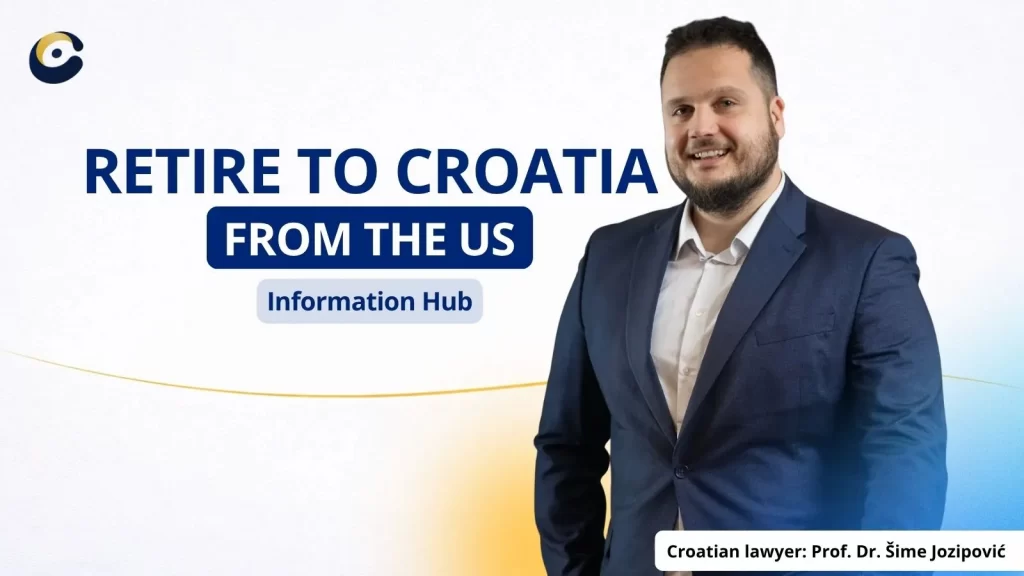
My name is Šime Jozipović, founder and CEO of Mandracchio Capital. I am a Croatian lawyer based in Split, holding an LL.M. in Tax Law from Harvard Law School, with professional experience specializing in international tax planning for expats relocating abroad. Having lived and worked in the United States, I bring a practical understanding of the legal, financial, and relocation challenges Americans face when moving overseas.
For more than 10 years, I have advised foreign individuals on residence permits, tax residency, property transactions, and cross-border financial structuring when moving to Croatia and the European Union.
If you are still comparing costs, lifestyle, and cities, read our overview of retiring in Croatia as an American.
Can US Citizens Live in Croatia Long-Term?
US citizens may enter Croatia visa-free for 90 days within any 180-day period (Schengen rules).
To remain beyond this period, a temporary residence permit must be approved.
There is no special category for retirees. Americans apply under standard third-country residence bases and renew annually.
The main challenge is not eligibility, it is preparing compliant documentation.
Using U.S. Retirement Accounts Abroad
For many Americans relocating to Croatia, retirement savings are held in:
- 401(k) plans
- Traditional IRAs
- Roth IRAs
These funds can generally be used to support residency applications if withdrawals demonstrate sufficient financial means.
Withdrawals from a 401(k) may be treated similarly to pension or investment income when demonstrating financial self-sufficiency, provided the applicant can show regular distributions or sufficient account balance. In practice, many retirees combine 401(k) distributions with Roth IRA withdrawals, which can offer additional flexibility, particularly since qualified Roth IRA withdrawals may be tax-free in the United States.
This financial structure is also relevant to a common question: Can you retire in Europe with $1 million? In Croatia, where the cost of living is relatively moderate, a well-managed combination of retirement accounts can often support a comfortable lifestyle without the need to relocate large amounts of capital upfront.
U.S. taxation
Withdrawals from traditional 401(k) accounts are typically taxable in the United States, while Roth IRA withdrawals may be tax-free if qualification rules are met.
Croatian tax residency
Once you become a Croatian tax resident, Croatia may also assess certain foreign retirement income depending on how it is classified.
Double taxation treaty
The treaty helps determine taxing rights, but does not automatically eliminate taxation in all cases.
Distribution strategy
Carefully structuring withdrawals is often necessary to manage cross-border tax exposure and maintain long-term financial efficiency.
Legal Ways for US Citizens to Retire in Croatia

1. Accommodation-Based Residence (Most Common)
Applicants demonstrate secured housing in Croatia.
This can be:
- Owned residential property
- Prepaid long-term lease (typically 12 months)
Key requirements:
- Registered address in Croatia
- Housing suitable for living (not tourism-zoned)
- Proof of financial support
Typical Financial Thresholds: Around €460 per month for a single retiree (~$500+) is often cited as the minimum income or savings threshold required to qualify for residence based on self-support. About €660 per month for couples (combined). These figures are commonly referenced by immigration-oriented sites but are not always explicitly listed in Croatian immigration law, individual police stations sometimes interpret “sufficient funds” differently.
How You Demonstrate Financial Means: To prove you have sufficient funds, you may need to provide:
- Pension statements or proof of steady passive income
- Bank statements showing savings
- Proof of health insurance
- Proof of accommodation in Croatia (rental, property title, etc.)
Permit duration: 12 months, renewable
2. Financial Independence
Applicants prove they can support themselves without working locally.
Accepted proof:
- Pension income
- Social Security benefits
- Investment or dividend income
- Savings statements
Authorities evaluate sufficiency case-by-case rather than fixed thresholds.
3. Company Formation (Structured Option)
Some applicants establish a Croatian company to hold assets or manage investments.
This route involves:
- Corporate compliance
- Director salary obligations
- Contributions to Croatian systems
It is typically used when property ownership or tax coordination requires a legal structure.
Step by Step Process for Getting a Croatian Residence Permit
The process of obtaining temporary residence in Croatia follows a structured sequence. Below is a simplified step-by-step overview:
- Enter Croatia
Most non-EU nationals, including U.S. citizens, may enter visa-free for short stays. - Secure Accommodation
You must provide proof of address (rental agreement or property ownership). - Prepare Required U.S. Documents
This typically includes:- Birth certificate
- Marriage certificate (if applicable)
- FBI background check
- Legalize and Translate Documents
All foreign documents must be:- Apostilled
- Officially translated into Croatian
- Obtain Private Health Insurance
Coverage must be valid in Croatia for the duration of your stay. - Submit Application at Local Police Administration (MUP)
Applications are filed in person at the competent police station. - Provide Biometrics
Fingerprints and photographs are taken during the application process. - Receive Residence Card
Once approved, you will be issued a temporary residence permit (biometric card).
Cost of Living in Croatia for US Retirees
One of the key reasons Americans consider Croatia is its relatively moderate cost of living compared to the United States.
In practice, many retirees can live comfortably on approximately:
- €1,500–2,000 per month for a single person
- €2,000–3,000 per month for couples, depending on lifestyle and location
Major cost factors include:
- Accommodation (higher in coastal cities like Split or Dubrovnik)
- Healthcare (public + optional private coverage)
- Daily living expenses (food, utilities, transport)
This cost structure is significantly lower than in many U.S. cities, where retirees often spend $3,000–5,000+ per month.
As a result, retirement income from a 401(k), Social Security, or Roth IRA can often stretch further in Croatia, making it a viable destination even for those asking:“Can I retire in Croatia with $1 million?”
Tax Residency in Croatia & Cross-Border Implications
Croatia generally considers an individual a tax resident if one of the following conditions is met:
- Physical presence: You stay in Croatia for more than 183 days within a calendar year, or
- Center of vital interests: Your primary personal and economic ties (e.g. family, home, business activities) are considered to be in Croatia
Key Implications
Becoming a Croatian tax resident carries important cross-border tax consequences:
Risk of dual reporting
Without proper planning, you may face overlapping reporting and compliance obligations in both jurisdictions
U.S. tax obligations remain
U.S. citizens are taxed on their worldwide income, regardless of residence
Croatian taxation applies locally
As a tax resident, Croatia may tax your global income, subject to applicable rules
Tax treaty protection
A US – Croatia double taxation treaty exists to help prevent double taxation
Healthcare Coverage for US Retirees in Croatia
Initial application:
- Private international insurance required
After approval:
- Enrollment into Croatian public system (HZZO)
Additional private coverage may still be used for faster care access.
Common Mistakes Americans Make
- Buying property before confirming purchase eligibility
- Entering as tourist and overstaying during application
- Apostilling documents in wrong order
- Assuming Social Security is automatically tax-exempt
- Applying under the wrong residence basis
Most delays occur due to paperwork issues rather than legal restrictions.
Permanent Residency & Citizenship
After five consecutive years of temporary residence:
- Permanent residence may be requested
Croatian citizenship requires additional legal criteria including language requirements and integration conditions.
Questions We Commonly Receive
Rather than asking if they can move, applicants usually ask:
- Will Croatia tax my US pension?
- Can I live part-time and keep residency?
- Should I buy property before applying?
- How does the 183-day rule affect me?
- Can I maintain US insurance coverage?
These are structuring questions requiring coordination between immigration and tax rules.
Getting Professional Help for Retirement in Croatia
Relocating involves overlapping areas:
- Immigration compliance
- Property acquisition review
- Cross-border taxation
- Corporate structuring (if applicable)
Mandracchio Capital assists non-EU nationals, including US citizens, with:
- Residency applications
- Property structuring
- Tax coordination
- Representation before Croatian authorities
Next Step
Before relocating, determine which legal basis fits your situation and whether your financial and tax profile aligns with Croatian residency rules.
A preliminary consultation typically reviews:
- Eligibility
- Documentation readiness
- Tax exposure
- Timeline
- Property strategy
Understanding this early prevents delays after arrival.
Sources & References (Legal, Tax, and Administrative Guidance)
This guide is based on relocation cases handled by our legal team and questions commonly asked by American retirees during the planning stage, before submitting residency applications.
To ensure accuracy and legal reliability, this guide references official Croatian government publications, EU legal frameworks, and publicly available statistical data.
- Ministry of the Interior (MUP): temporary stay rules for third-country nationals; where/how to submit applications.
- Government portal (gov.hr): overview of temporary residence procedures and required steps.
- Ministry of Foreign and European Affairs (MVEP): consular guidance related to stay/foreigners.
- Croatian Tax Administration: residency determination, including “habitual residence” and the 183-day standard.
- OECD residency reference note (Croatia) summarising the residency approach and core legal framing.
- U.S. Treasury: treaty text (PDF).
- IRS treaty index page (for official treaty listing and references).
- U.S. State Department treaty summary page (high-level overview).
- MUP guidance on what qualifies as proof of health insurance and the post-approval obligation to report to HZZO where applicable.
Important note on thresholds and timelines
Income/means thresholds and processing timelines can vary by case facts and local administrative practice. Where the law uses concepts like “sufficient funds” rather than a single fixed number, applicants should expect case-by-case assessment.
FAQ
Can US citizens retire in Croatia?
Yes. US citizens can retire in Croatia by obtaining a temporary residence permit for retirement or financially independent individuals. You must show that you have enough income or savings to support yourself without working in Croatia.
What are the income requirements for retiring in Croatia?
Croatia requires proof of stable monthly income, usually around €2,200–€2,500 for a single person, or €3,500–€4,000 for a couple. This can come from pensions, investments, or other regular income sources.
Do I need health insurance to retire in Croatia?
Yes. You must have Croatian or international health insurance covering your entire stay. Many retirees use private health insurance, though EU residents may be eligible for the Croatian public health system.
Can I buy property as a US retiree in Croatia?
Yes. US citizens can purchase property in Croatia. Certain restrictions apply in rural areas or for agricultural land. Most retirees buy apartments or homes in coastal towns or cities.
How long is the Croatian retirement visa valid?
Temporary residence permits are usually granted for one year. After renewal, you can apply for long-term residence after five years, eventually qualifying for permanent residence.
Do I need a lawyer to retire in Croatia?
It’s not legally required, but hiring an English-speaking Croatian immigration lawyer is highly recommended. They can help with residency applications, tax planning, and property purchases, making the process smoother.
What taxes will I pay as a retiree in Croatia?
Retirees may be subject to Croatian income tax on local income. Pensions from the US are often taxed under the US–Croatia tax treaty, potentially avoiding double taxation. Consulting a tax professional is advised.
How do I apply for a Croatian retirement visa?
Gather documents such as your passport, proof of income, health insurance, and accommodation proof. Submit the application at the Croatian consulate in the US or the local police station in Croatia, attend an appointment if required, and wait for approval.
Can I travel freely within the EU once I retire in Croatia?
As a Croatian resident, you can travel within the Schengen Area for up to 90 days every 180 days. Permanent residence or citizenship is required for unrestricted EU travel.
What are the best regions for retirees in Croatia?
Popular areas include the Dalmatian coast (Split, Dubrovnik, Zadar), Istria (Pula, Rovinj), and inland cities like Zagreb for an urban lifestyle and amenities.
Conclusion: Planning Your Retirement in Croatia
Retiring in Croatia from the United States is not simply an immigration step, it is a cross-border financial and legal transition that requires careful coordination.
Many Americans underestimate the complexity involved. The most common challenges are not eligibility, but uncertainty around documentation, tax exposure, and financial structuring. Questions such as how 401(k) withdrawals are treated, whether Roth IRA distributions remain efficient, or how ETF and investment income may be taxed after becoming a Croatian tax resident often arise only after relocation has already begun.
Without proper planning, this can lead to avoidable issues such as delayed applications, inefficient withdrawal strategies, or unexpected dual tax exposure.
At Mandracchio Capital, we work with U.S. clients to address these risks early through a structured approach that combines:
- Residency strategy (selecting the correct legal basis and preparing compliant documentation)
- Tax coordination (aligning U.S. and Croatian tax exposure, including retirement accounts, ETFs, and passive income streams)
- Financial structuring (planning how and when to draw from 401(k), IRA, or investment portfolios)
- Property and relocation planning where relevant
Our role is not only to guide the application process, but to ensure that your legal status, financial flows, and long-term objectives are aligned before you move.
If you are considering retiring in Croatia, the most effective next step is to evaluate your situation in advance. A well-structured plan can help you avoid costly mistakes and transition with clarity and confidence.