Retiring in Croatia as an American has quietly shifted from a “hidden gem” idea into a realistic, well-planned retirement strategy for US citizens who want a safer, slower, and more affordable European lifestyle.
This article focuses on everyday life: real monthly costs, where retirees actually settle, healthcare access, and what Americans typically experience after moving.
If you’re already planning the move and want to understand the paperwork, residency rules, and tax implications, see our legal guide on: Retire to Croatia from the US
My name is Šime Jozipović, founder and CEO of Mandracchio Capital. I am a Croatian lawyer based in Split, holding an LL.M. in Tax Law from Harvard Law School, with professional experience specializing in international tax planning for expats relocating abroad. Having lived and worked in the United States, I bring a practical understanding of the legal, financial, and relocation challenges Americans face when moving overseas.
For more than 10 years, I have advised foreign individuals on residence permits, tax residency, property transactions, and cross-border financial structuring when moving to Croatia and the European Union.
This guide is based on relocation cases handled by our legal team and questions commonly asked by American retirees during the planning stage, before submitting residency applications.

Why People Choose to Retire in Croatia
(And Why It’s Increasingly Ranked Among the Best Cities in Europe to Retire)
Lower Cost of Living
Compared with Western Europe and the US, the cost to retire in Croatia is noticeably lower. Many retired couples live comfortably on €1,900–€3,000 per month, depending on location and lifestyle.
Housing, food, public transport, and everyday services remain affordable, particularly when you step slightly outside historic centers or tourist hotspots. This makes Croatian cities attractive alternatives to more expensive European retirement favorites like Spain, France, or Italy.
Mediterranean Climate & Everyday Lifestyle
Coastal areas enjoy mild winters and long, sunny summers, while inland regions offer four clear seasons without extremes. Fresh food, local markets, outdoor walking culture, and clean air naturally support healthier aging.
Life here tends to move outdoors, morning coffees, seaside walks, evening promenades, without feeling rushed or performative. This lifestyle consistency is a big reason retirees rank cities like Split, Istria towns, and Zagreb among the best cities in Europe to retire rather than just seasonal destinations.
For a realistic picture of day-to-day life, beyond retirement planning alone, see our full guide to living in Croatia
Safety & Long-Term Stability
Croatia consistently ranks as low-crime, with a strong sense of personal safety, even in city centers at night. As an EU and Schengen member, it also offers political and legal stability that retirees value when planning decades ahead, not just a few years.
That peace of mind is often cited by retirees who compare Croatia with other popular European retirement destinations.
Central European Location
From Croatia, it’s easy to explore the rest of Europe. Italy, Slovenia, Austria, Hungary, and beyond are all a short flight or drive away. For retirees who enjoy travel but don’t want to constantly relocate, Croatia works as a stable home base with excellent connectivity.
This central positioning quietly strengthens Croatia’s standing among the best cities in Europe to retire, especially for those who want both rootedness and mobility.
Why Split?
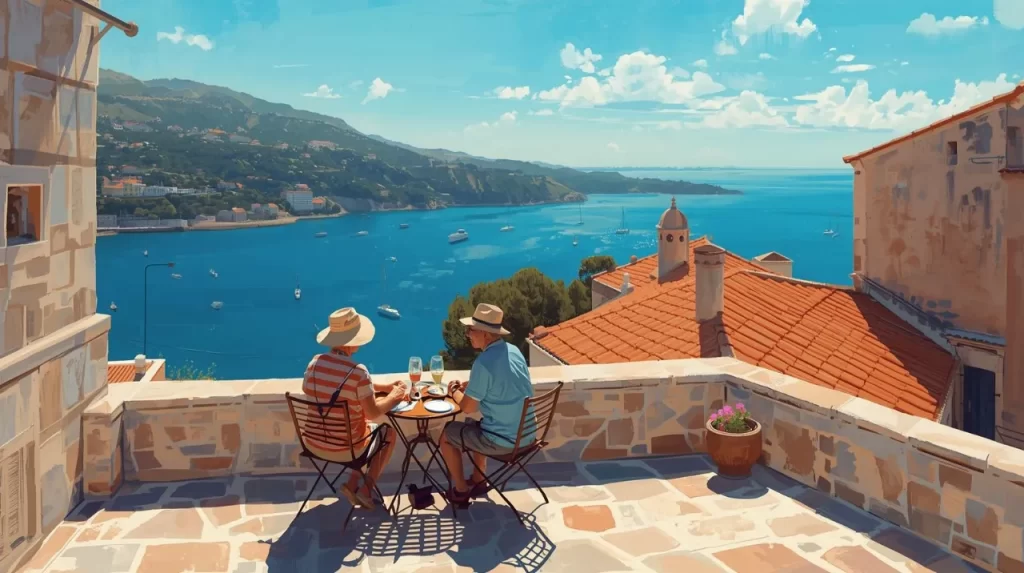
For many Americans, Split hits a rare balance that’s hard to explain until you experience it. It’s a town big enough that everyone doesn’t know everyone, so you still have privacy and variety – but small enough that it never feels like a big city. You can walk most places, recognize familiar faces at cafés without feeling stuck in a bubble, and still access hospitals, ferries, and an international airport.
Nature is woven directly into daily life here. The sea is always close, parks and walking paths are part of the city fabric, and island escapes are a ferry ride away. Many retirees describe Split as the first place where they stopped feeling like they were visiting and started feeling like they were living.
That balance – between anonymity and community, energy and calm, urban comfort and nature – is exactly what draws many Americans to Split when retiring in Croatia.
“We didn’t move to Croatia to live cheaply, we moved to live well.”
— Mark H., former software consultant, Austin, Texas
Residency Basics for Retiring in Croatia as an American
Is there a Croatia Retirement Visa for Croatia?
Croatia does not currently offer a dedicated retirement visa.
Instead, Americans typically live in Croatia using a standard Croatia temporary residence permit available to non-EU citizens.
In simple terms, Croatian authorities are not evaluating your age, they are evaluating whether you can live in the country without relying on local employment or public support.
Most retirees qualify using one of three general bases:
Secured accommodation
Having a registered address in Croatia, either through property ownership or a long-term rental contract.
Financial self-sufficiency
Demonstrating stable income such as pensions, Social Security, investment income, or sufficient savings.
Structured stay (less common)
Some individuals choose to establish a company or investment structure when it aligns with tax or asset planning, though this is not necessary for most retirees.
At Mandracchio Capital, we advise foreign investors, business owners, and retirees on Croatian residency and business law, with a focus on compliant structuring and long-term legal certainty. Our work typically involves reviewing proposed residence paths, assessing regulatory exposure, and aligning business or investment structures with current Croatian requirements, taking into account each client’s specific situation.
Key Requirements (General Overview)
Applicants are normally asked to provide:
- Proof of financial means
- Health insurance coverage
- Registered accommodation
- Clean criminal record
- Officially translated and certified documents
Exact interpretation can vary slightly by local authority, which is why preparation before arrival matters more than the application itself.
“The rules were clear, but the paperwork was intense. Having local guidance saved us months.”
— Linda R., former HR director, Chicago, IL
Cost to Retire in Croatia: What You Actually Spend
One of the most common questions we hear is how much money I need to retire in Croatia. The answer depends heavily on location and lifestyle but Croatia remains one of the most flexible retirement destinations in Europe.
How much money I need to retire in Croatia?
Typical Monthly Cost (Two People):
- Lean but comfortable lifestyle: $1,500–$1,800/month
- Mid-range lifestyle (more comfort, dining out): $2,200–$2,500/month
- Conservative annual target: €18,000–€24,000/year
Healthcare and groceries are affordable across the country; rent is the biggest variable.
“Our monthly spend in Split is about half of what we paid in California and our quality of life is better.”
— Susan & David M., retired teachers, San Diego, CA
Best Places to Retire in Croatia
Croatia offers several strong retirement options depending on your lifestyle, budget, and priorities.
- Istria (Rovinj, Poreč, Pula) – Calm, organized, and ideal for couples seeking a slower pace, good food, and long-term comfort.
- Split – Coastal living with flexibility; vibrant if you want it, relaxed if you don’t. Best when living slightly outside the center.
- Zagreb – Most practical choice for stability, healthcare access, and predictable year-round costs.
For a detailed breakdown of each location, costs, and lifestyle differences, see: best places to retire in Croatia
| Location | Lifestyle | Healthcare | Typical Monthly Cost |
|---|---|---|---|
| Istria | Calm, refined | Very good | €1,600–€2,300 |
| Split | Coastal, social | Excellent | $1,450–$2,500 |
| Zagreb | Practical, stable | Best nationwide | €1,400–€2,000 |
Using U.S. Retirement Accounts Abroad
For many Americans relocating to Croatia, retirement savings are held in:
- 401(k) plans
- Traditional IRAs
- Roth IRAs
These funds can generally be used to support residency applications if withdrawals demonstrate sufficient financial means.
Withdrawals from a 401(k) may be treated similarly to pension or investment income when demonstrating financial self-sufficiency, provided the applicant can show regular distributions or sufficient account balance. In practice, many retirees combine 401(k) distributions with Roth IRA withdrawals, which can offer additional flexibility, particularly since qualified Roth IRA withdrawals may be tax-free in the United States.
This financial structure is also relevant to a common question: Can you retire in Europe with $1 million? In Croatia, where the cost of living is relatively moderate, a well-managed combination of retirement accounts can often support a comfortable lifestyle without the need to relocate large amounts of capital upfront.
U.S. taxation
Withdrawals from traditional 401(k) accounts are typically taxable in the United States, while Roth IRA withdrawals may be tax-free if qualification rules are met.
Croatian tax residency
Once you become a Croatian tax resident, Croatia may also assess certain foreign retirement income depending on how it is classified.
Double taxation treaty
The treaty helps determine taxing rights, but does not automatically eliminate taxation in all cases.
Distribution strategy
Carefully structuring withdrawals is often necessary to manage cross-border tax exposure and maintain long-term financial efficiency.
Pros & Cons of Retiring in Croatia as an American
Pros
- Lower cost of living than most US cities
- Affordable, high-quality private healthcare
- Safe, walkable cities
- EU legal stability
Cons
- Croatian language is challenging
- Bureaucracy is document-heavy
- Coastal areas are busy in summer
Final Takeaway for Americans
Retiring in Croatia as an American isn’t about chasing the cheapest option, it’s about maximizing quality of life with realistic costs. Whether you prefer refined Istria, coastal Split, or practical Zagreb, the cost to retire in Croatia remains one of Europe’s most compelling value propositions for US retirees.
With proper planning, clear budgeting, and the right location, US citizens retiring in Croatia can enjoy a secure, comfortable, and deeply rewarding next chapter, without the financial pressure many experience back home.
FAQ: Retiring in Croatia as an American
Can Americans retire in Croatia if they are not on Social Security yet?
Yes. Retiring in Croatia as an American does not require Social Security income.
US citizens retiring in Croatia can qualify for temporary residence by showing other stable financial means, such as savings, investment income, dividends, rental income, or private pensions. Many Americans retire in Croatia in their 50s or early 60s using portfolio income rather than Social Security.
What sort of extended stay visa is available for Americans retiring in Croatia?
Americans typically apply for a Temporary Residence Permit. US citizens can stay visa-free for 90 days, but long-term retirement in Croatia requires approved temporary residence, which is issued for one year and renewed annually. After five consecutive years, permanent residence may be possible if requirements continue to be met.
What are the financial requirements to retire in Croatia as an American?
To meet the requirements to retire in Croatia, Americans must show proof of sufficient funds to cover living costs without working locally. In practice, this usually aligns with the cost to retire in Croatia, commonly around:
- €1,200–€1,500 per month per person, or
- Equivalent savings covering a full year of expenses
The exact amount can vary slightly by local authority and household size, but the goal is to demonstrate financial independence.
How much money do I need to retire in Croatia comfortably as a US citizen?
Most US citizens retiring in Croatia plan for:
- $1,400–$1,600/month for a lean but comfortable lifestyle
- $2,200–$2,500/month for a mid-range lifestyle with dining out and travel
Location matters significantly living outside tourist centers can reduce costs by 20-40%.
Do Americans need private health insurance when retiring in Croatia?
Yes. Americans must show health insurance coverage when applying for temporary residence. Many retirees use international private insurance initially, then transition to local options once registered. Healthcare costs are generally far lower than in the US, making retire in Croatia a financially sustainable option long term.
What are the best places to retire in Croatia for Americans on a budget?
For Americans prioritizing affordability:
- Zagreb offers the most predictable costs and best hospitals
- Smaller towns near Split (but outside the old town) provide coastal living at lower rents
- Inland regions can reduce living costs significantly, though English use is less common
These locations consistently rank among the best places to retire in Croatia when balancing cost, healthcare, and quality of life.
Sources & References
This guide is based on relocation cases handled by our legal team and questions commonly asked by American retirees during the planning stage, before submitting residency applications.
To ensure accuracy and legal reliability, this guide references official Croatian government publications, EU legal frameworks, and publicly available statistical data.
Primary sources include:
- Ministry of the Interior of the Republic of Croatia (MUP) – Temporary residence regulations for third-country nationals
- Ministry of Foreign and European Affairs of Croatia – Entry requirements and consular procedures
- Croatian Bureau of Statistics – Cost of living and income data
- European Commission – EU residency and Schengen framework
- Eurostat – Comparative EU cost-of-living data
Financial threshold examples reflect publicly cited administrative practice across Croatian police departments and may vary by location and case-specific interpretation.
Cost estimates in this article are based on:
- Recent client relocation cases (2024–2026)
- Rental market data from major Croatian property platforms
- First-hand interviews with American retirees currently residing in Split, Istria, and Zagreb
Because immigration interpretation and local administrative practice can evolve, applicants should verify current requirements directly with Croatian authorities or seek qualified legal guidance before making relocation decisions.