Croatia’s Digital Nomad Visa allows non-EU remote workers to legally live in Croatia for up to 18 months while working for foreign employers or clients. As of 2026, applicants must meet a minimum income requirement of approximately €3,622.50 per month, along with standard documentation such as proof of remote work, accommodation, and health insurance.
Hi, my name is Šime Jozipović, founder and CEO of Mandracchio Capital. As a Croatian immigration lawyer based in Split, with a Master of Laws (LL.M.) from Harvard Law School and a doctorate in international tax planning, I have spent more than a decade advising foreign individuals, international remote professionals, entrepreneurs, and digital nomads relocate to Croatia.
If you’re planning to apply, this guide will help you do it correctly from the start. We explain everything you need to know about the Croatia Digital Nomad Visa, including:
- croatia digital nomad visa requirements 2026
- minimum income for croatia digital nomad visa (update March 2026)
- who is eligible for croatia digital nomad visa
- application process
- documents needed croatia digital nomad visa
- tax treatment for digital nomads
UPDATED Income Requirement Increased in 2026
According to the Croatian Ministry of the Interior, In early 2026, Croatia increased the Digital Nomad Visa income requirement to approximately €3,622.50 per month, up from around €2,870 – €3,295.
This is not a policy change, but the result of a legal formula: the threshold is set at 2.5× the average Croatian net salary. As of January 2026, the average net salary reached about €1,511, which automatically raised the required income.
For hands-on assistance, explore our Residency (VISA) support for digital nomads and expats page.
| Year | Digital Nomad Visa income requirement |
|---|---|
| 2024 | ~€2,539 |
| 2025 | ~€3,295 |
| 2026 | ~€3,622.50 |
What is the Croatia Digital Nomad Visa?
Croatia’s digital nomad visa was introduced to the world on January 1, 2021.
Despite being widely referred to as a “digital nomad visa,” this is not actually a visa under Croatian law. It is a temporary residence permit issued under the Croatian Aliens Act. This distinction is important in practice because:
- It follows residence rules, not short-stay visa rules
- It does not provide a direct path to permanent residency
- It requires a mandatory 6-month break before you can reapply
Many applicants misunderstand this, which can lead to poor long-term planning decisions.
| Category | Details |
|---|---|
| Legal basis | Temporary residence permit for digital nomads under the Croatian Aliens Act |
| Who can apply | Non-EU/EEA nationals working remotely for: – Foreign employers – Foreign clients (freelancers) – Own company registered outside Croatia |
| Work restriction | Not permitted to work for Croatian companies or serve Croatian clients |
| Permit duration | Up to 18 months (depending on approval) |
| Extension | No direct renewal; reapplication possible after a 6-month absence |
| Minimum income (2026) | ~€3,622.50/month OR total savings of – €43,470 (12 months) – €65,205 (18 months) |
| Application cost | Typically €100-€200 total, depending on fees and process. |
| Processing time | Officially 30–60 days; in practice 2-12 months (depending on documentation and workload, with legal assistance potentially helping streamline the process) |
| Family members | Allowed; income requirement increases by ~10% per dependent |
| Minimum stay requirement | None (but real residence is expected in practice) |
Many applicants later transition into:
- Business-based residence (for tax optimization and other purposes)
- Employment permits
- Long-term residency planning
Who Is Croatia Digital Nomad Visa For?
Croatia’s digital nomad visa is aimed at non-EU/EEA nationals who earn income remotely from companies or clients located outside of Croatia. To be eligible, applicants need to demonstrate a minimum monthly income of €3,622.50 from foreign sources.
This visa is a strong fit for you if:
- Remote workers employed by companies based in the US, UK, or other non-EU countries
- Freelancers serving international clients
- Entrepreneurs operating businesses registered outside CroatiaWork remotely for non-Croatian companies or clients
- Want a legal long-term base in Europe while maintaining international mobility
- Plan to spend meaningful time in Croatia during the permit period
- Want to explore whether Croatia fits their long-term lifestyle or business plans
- Are able to maintain registered accommodation in Croatia during the residence period
It is not suitable for:
- Those looking to work for Croatian employers
- Freelancers whose main client base is in Croatia
- Applicants who do not meet the income threshold
Croatia Digital Nomad Visa Requirements 2026

To understand each required document and the full eligibility criteria in detail, check out our complete guide to Croatia digital nomad visa requirements.
According to the Croatian Ministry of the Interior, to qualify for the Croatia Digital Nomad Residence Permit, you must meet the following requirements:
- Application Form 1a: Completed and signed.
- Passport Photos: Generally 35x45mm.
- Valid Passport: Must be valid for at least 3 months longer than the intended stay.
- Proof of Purpose (Remote Work): Contract of employment, client contracts, or owner registration showing you work for a company not registered in Croatia.
- Proof of Income/Funds: Bank statement showing a minimum of €3,622.50 per month, or a lump sum of €43,470.00 for a 12-month stay (or €65,205.00 for the maximum 18-month period). Proof must be provided via bank statements or pay slips from the last 6 months.
- Proof of Accommodation: Lease agreement, hotel booking, or title deed/statement of ownership.
- Criminal Record Certificate: A criminal record check from your last country of residence, issued within the last 6 months.
- Health Insurance: Proof of private health insurance covering the entire duration of your stay in Croatia.
- Translated & Legalized Documents: Documents not in the host country’s language may need official translation and apostille.
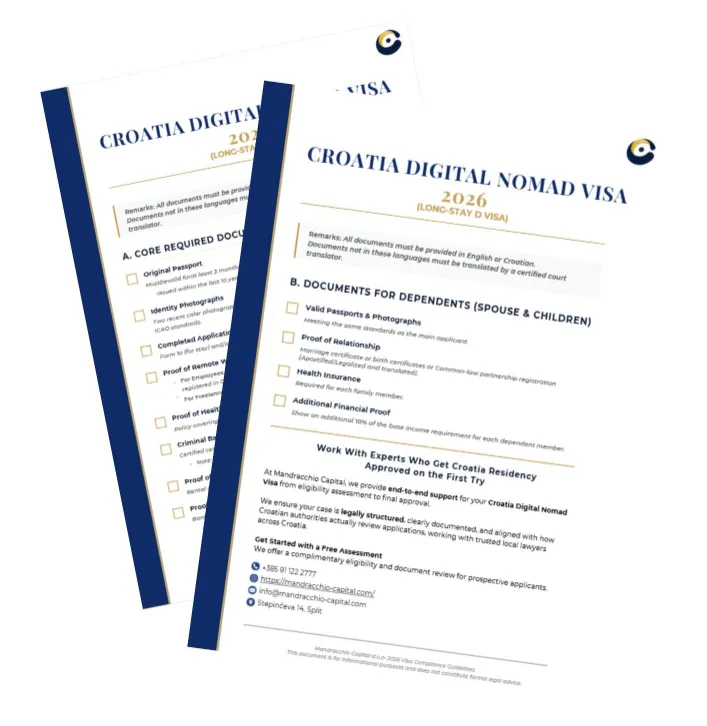
Croatian authorities assess applications individually, and additional documentation may be requested depending on your work structure and income sources.
Who Is Eligible for the Croatia Digital Nomad Visa?
To qualify for the Croatia Digital Nomad Visa, applicants must meet specific legal and practical criteria defined under Croatian immigration law.
You are eligible if you fall into one of the following categories:
Non-EU / EEA / Swiss citizens
The program is designed exclusively for third-country nationals (e.g. US, UK, Canada, Australia, UAE).
EU/EEA citizens do not need this permit due to freedom of movement.
Remote employees working for foreign companies
You must be employed by a company that is registered outside Croatia and perform your work remotely.
Freelancers with foreign clients
Self-employed professionals can apply if they work with clients based outside Croatia and can prove stable income.
Business owners of non-Croatian companies
If you own a company registered outside Croatia and generate income from abroad, you are eligible.
Applicants who meet the income requirement
You must demonstrate sufficient financial means:
- ~€3,622.50/month (2026 requirement), or
- equivalent savings depending on your intended stay ( ~€65,205 for an 18-month stay, ~€43,470 for a 12-month stay)
Applicants with proper documentation
You must be able to provide:
- Proof of remote work
- Valid health insurance
- Clean criminal record
- Accommodation in Croatia
Who the Croatia Digital Nomad Visa Is NOT For
The Croatia Digital Nomad Visa is an excellent option for many remote workers but it is not suitable for everyone.
This permit is not designed for:
- Individuals planning to work for Croatian companies or clients
- Freelancers intending to invoice Croatian businesses
- Applicants seeking a direct or automatic path to permanent residence or citizenship
- Those with unstable or insufficient income
- Individuals who want access to Croatia’s public healthcare system (HZZO) from day one
Understanding these limits early helps avoid wasted time and ensures you choose the right residence strategy from the start.
Croatia Digital Nomad Visa Application Process
For a complete step-by-step guide, see: How to apply for Croatia digital nomad visa, for detail document lists, visit Croatia Digital Nomad Visa Requirements
Practical tip: While the process may seem straightforward, successful applications often come down to how your documents are structured, not just whether they are submitted.
- Income documents should be consistent, clearly labeled, and easy to interpret
- Proof of remote work should directly link your activities to foreign income
- Croatian translations can significantly reduce processing delays
Applicants who present well-structured documentation typically experience faster processing and fewer follow-up requests from authorities.
Step 1 Gather Your Documents
The first step in applying for the Croatia digital nomad visa is preparing a complete and consistent document set in line with current MUP (Ministry of Interior) requirements.
Information based on the latest MUP requirements for applying for the digital nomad residence permit
Step 2 Submit & Wait
Submit your application via:
- The official MUP online portal
- A Croatian embassy or consulate. (List of Embassies of the Republic of Croatia in the world )
- A local police station (if applying from within Croatia)
Step 3 Approval & Residence Card
Once approved, you will be granted temporary residence status.
If you applied from abroad:
- You may receive a visa to enter Croatia
After arrival (or if already in Croatia):
- Complete biometrics at MUP
- Collect your biometric residence card (biometrijska dozvola boravka)
Croatia Digital Nomad Visa Fees
The total government fees for a Croatian digital nomad residence permit are approximately €110 – €180. Costs include the temporary stay application (~€46–€56), administrative fees (~€9), and the biometric residence card (~€31), typical total government fees depending on where you apply and whether expedited processing is used. Fees are paid upon approval when applying within Croatia, or upfront at a consulate.
You can find fee breakdown in this guide Croatia Digital Nomad Visa Fee
Tax for the Croatia Digital Nomad Visa
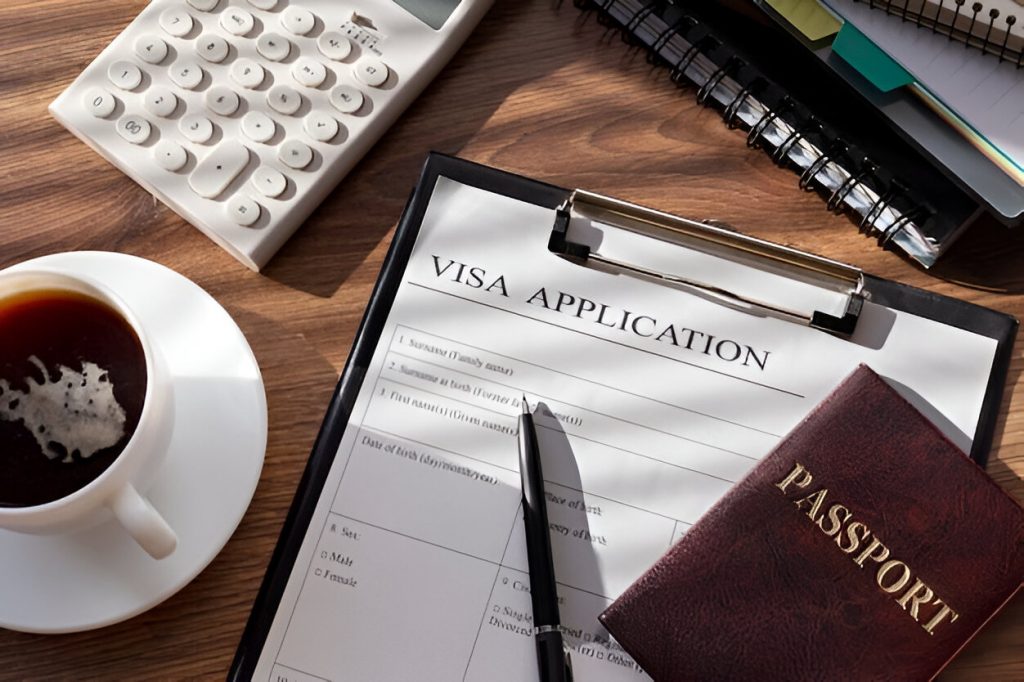
One of the reasons many digital nomads choose Croatia is its tax environment. This exemption:
- Applies only to active working income
- Does not automatically exempt passive income (such as rentals, dividends, or capital gains)
- Does not remove tax reporting obligations in your home country
Croatia offers a specific income tax exemption for qualifying digital nomads working for foreign employers or clients. However, the exemption does not necessarily apply to every type of income, and your tax residence may depend on your individual circumstances.
Want to understand how the Croatian digital nomad tax exemption works? Read our detailed guide on [Croatia Digital Nomad Tax] for an explanation of foreign employment income, freelance income, investment income, tax residence and double taxation treaties.
5 Main Benefits of the Croatia Digital Nomad Visa

Croatia has become one of the most attractive destinations for remote workers relocating to Europe from Dubai. Its digital nomad visa combines legal stability, tax efficiency, and lifestyle advantages—making it a strong entry point into the European Union.
1. Legal Residence in the European Union
With a Croatia digital nomad residence permit, you can legally live in an EU country with access to reliable infrastructure, healthcare, and a high level of safety. Compared to more saturated destinations, Croatia offers a more balanced and less crowded environment.
2. No Local Income Tax on Foreign Earnings
Digital nomads working for non-Croatian companies are generally exempt from Croatian income tax on their foreign income. This creates a highly efficient structure, especially for individuals relocating from Dubai’s tax-free environment.
3. Visa-Free Travel Across the Schengen Area
As part of the Schengen Area, Croatia allows residence permit holders to travel across most European countries without additional visas, ideal for both personal travel and business flexibility.
Residence in Croatia grants visa-free access to 29 European countries within the Schengen Zone. This includes, among others, Slovakia, Slovenia, Spain, Sweden, Switzerland, Austria, Denmark, Finland, France, Germany, Greece, Malta, and the Netherlands.
For the full and most up-to-date list, refer to the official Schengen Area overview provided by the European Commission.
4. Lower Cost of Living Compared to Western Europe
Croatia offers a more affordable lifestyle than countries like Germany, France, or Italy. Housing, food, and everyday expenses are generally lower, making it a practical option for long-term relocation.
5. Access to European Banking and Financial Systems
With legal residence, you can open accounts with Croatian and EU banks, operate in euros, and access broader financial services. This is particularly valuable for entrepreneurs and remote proffessionals managing international income.
Common Mistakes That Lead to Rejection
Many applications are delayed or rejected due to avoidable issues:
- Inconsistent income documentation
- Unclear proof of remote work
- Missing translations into Croatian
- Incorrect accommodation documents
- Applying with insufficient financial proof
Most problems are not eligibility-related but how documents are structured.
Travel & Staying Outside Croatia

Unlike places like Dubai, there is no simple rule allowing you to stay outside the country for 6 months and keep your status. While occasional travel is normal (for example Croatia ↔ UAE), your overall pattern should still reflect that you are genuinely residing in Croatia.
While short and regular travel is allowed, Croatian law sets limits on time spent outside the country.
You should not be absent for more than 90 days in total or 30 days at once. Exceeding these limits may result in the termination of your temporary residence. The safest approach is to maintain a real connection to Croatia (address, presence, lifestyle), while using it as your EU base, not just a paper residency.
If you plan to travel frequently within Europe while holding a Croatia Digital Nomad Residence Permit, it is important to understand how Schengen short-stay rules apply outside Croatia. You can calculate your remaining Schengen travel days using the official EU calculator here: If you plan to travel frequently within Europe while holding a Croatia Digital Nomad Residence Permit, it is important to understand how Schengen short-stay rules apply outside Croatia.
You can calculate your remaining Schengen travel days using the official EU calculator here:
Calculator of travel days remaining under a Schengen short-stay visa
If you applied from a visa-free country, you may remain in Croatia while your application is being processed, allowing your total stay to exceed the standard Schengen tourist period in many cases
Croatia Digital Nomad Visa to Other Digital Nomad Visas
| Country | Income Req. (Monthly) | Initial Stay | Maximum Stay | Tax on Foreign Income | Path to PR? |
|---|---|---|---|---|---|
| Croatia | €3,662.50 | 12 months | 18 months | 0% | No |
| Portugal (D8) | €3,680.00 | 1 year | Renewable (can lead to PR) | Standard (NHR ended) | Yes (5 years) |
| Spain (DNV) | €2,849.00 | 3 years | Up to 5 years | 24% (Beckham Law) | Yes (5 years) |
| Greece | €3,500.00 | 2 years | Up to 4 years | 50% reduction* | Yes (7 years) |
| Italy | €2,700.00* | 1 year | Renewable (no fixed cap yet) | Standard rates | Yes (varies) |
Notes:
- Italy: rules are still evolving depending on the specific visa pathway.
- Croatia: typically issued once; you must leave before reapplying.
- Greece: tax reduction applies for a limited period.
Croatia vs Portugal
- Duration: Up to 18 months (Portugal often requires renewals)
- Tax clarity: Clear exemption for qualifying digital nomad working income
- Path to PR: Not direct, but easy to transition to other residence types
- Cost & bureaucracy: Lower living costs, simpler procedures
Croatia vs Spain
- Cost & bureaucracy: Higher administrative burden, especially in major cities
- Duration: Typically 12 months
- Tax clarity: Spain applies specific tax regimes that can be complex
- Path to PR: Possible, but with higher compliance and tax exposure
Croatia Digital Nomad Visa Permit Duration & Extension
- Permit is granted for up to 18 months
- It may be issued for a shorter period
- If shorter:
- You can apply for an extension of up to 6 additional months
- Extension applications should be submitted at least 60 days before expiry
After expiration, you must leave Croatia for six months before applying again, as the visa is not designed for continuous long-term residency.
Some digital nomads extend their stay by switching to another type of Temporary Residency, such as work, family reunification, or company ownership. Extensions must be filed at least 30 days before your permit expires. You can explore all legal pathways in our guide to Croatia residence permits: All types and income threshold
Is the Digital Nomad Permit a Path to Permanent Residence?
Croatian law also requires a six-month break after the Digital Nomad residence expires before the same permit can be granted again. This break interrupts continuous residence, which is why time spent exclusively on a Digital Nomad permit does not create a direct path to permanent residence.
Because the permit requires a mandatory break between applications, it does not allow for uninterrupted residence. Many digital nomads who decide to stay longer later transition into other temporary residence categories such as business ownership, employment, or family reunification that can be renewed annually and count toward permanent residence.
Croatia Digital Nomad Visa for US Citizens

Tax Treatment for US Citizens
A key benefit is that foreign remote income is generally exempt from Croatian income tax during the permit.
However, this exemption applies only to qualifying foreign-sourced income. It does not cover:
- Local Croatian employment
- Certain passive income (e.g. dividends, rental income)
US-Specific Insight
Unlike most countries, the United States taxes based on citizenship, not residency.
This means US citizens must still:
- File annual US tax returns (Form 1040)
- Report foreign bank accounts (FBAR / FATCA)
- Potentially pay US tax, depending on exclusions
Many digital nomads rely on tools like:
- Foreign Earned Income Exclusion (FEIE)
- Foreign Tax Credit (FTC)
but these require proper structuring and compliance.
If you’re still deciding whether Croatia is the right fit, explore our guide to the Top European Countries for US Remote Professionals (Tax Efficiency and Long-Term Residency) to compare tax treatment, digital nomad visas, and long-term residency options across Europe.
Croatia Digital Nomad Visa for UK Citizens
UK citizens can apply for the Croatia digital nomad visa, allowing remote professionals to live in Croatia while working for non-Croatian employers or clients.
One of the main benefits is that foreign-sourced remote income is generally exempt from Croatian income tax during the permit.
However, UK citizens must carefully assess their UK tax residency status. Under the UK Statutory Residence Test (SRT), you may still be considered UK tax resident depending on:
- Days spent in the UK
- Ties such as property, family, or work
This means you could still be taxable in the UK even while living in Croatia
Croatia Digital Nomad Visa for Dubai Expats and UAE Residents
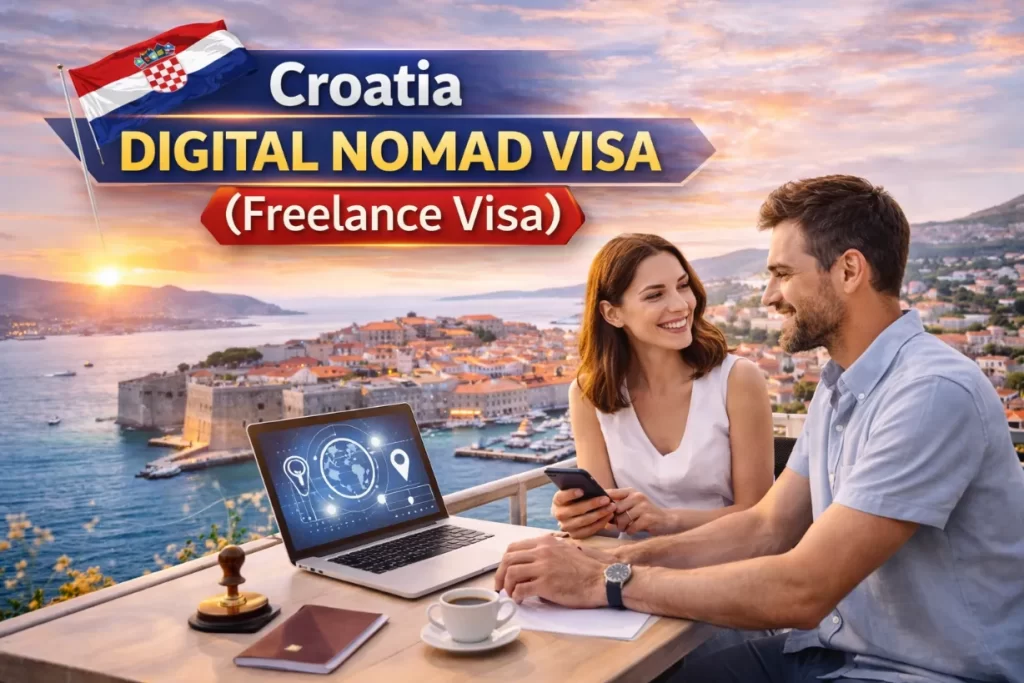
For many Dubai-based professionals, the Croatia digital nomad visa is becoming a popular relocation option. UAE residents who work remotely for foreign companies or run overseas businesses can legally live in Croatia while continuing their global work. See full guide: Move to Croatia from Dubai via Digital Nomad Visa
Tax Benefits for UAE Residents
A key advantage is the Croatia digital nomad tax exemption. Qualifying foreign income is generally not subject to Croatian income tax during the permit period.
Is Croatia a Good Option from Dubai?
For UAE residents seeking remote work flexibility, European residency, and tax efficiency, Croatia is a practical and accessible choice.
If you’re still comparing options, consider how Croatia ranks among the best countries to move to Europe from Dubai, especially in terms of visa flexibility and tax structure.
Case Study: Resolving an Application Stoppage
Before working with us, Martino tried to apply on his own. He was excited to relocate to Split but quickly became overwhelmed by conflicting information and unclear instructions.
His application stalled because his proof of funds came from multiple accounts with different dates, making the documentation appear unreliable. Once our team reviewed everything, we corrected the issue, organized all supporting documents, handled the communication with authorities, and ensured nothing was missed.
“By the time it was done, it felt completely effortless for me.”
If you’re feeling overwhelmed by visa information, worried about missing documents, or unsure how long the process will take, you’re not alone. We can guide you through every step from preparing a complete file to managing timelines, helping you relocate with confidence.
Living in Croatia as a Digital Nomad: Costs, Cities & Lifestyle
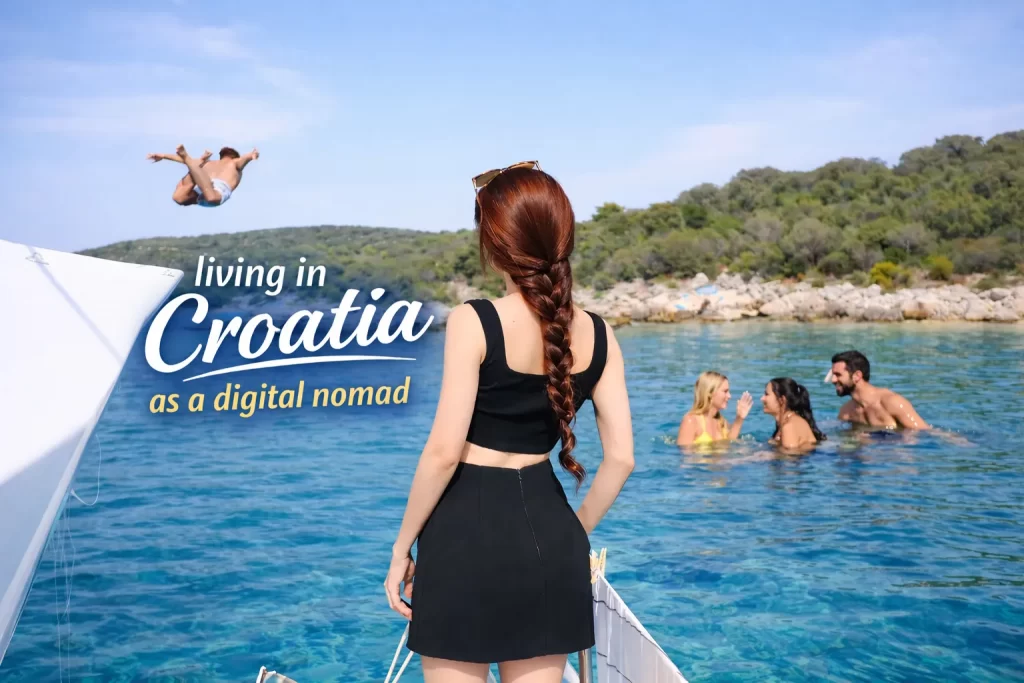
For a more detailed overview, see our full guide on Living in Croatia as a Digital Nomad
| Category | Insight |
|---|---|
| Internet & infrastructure | Stable, typically 50–100 Mbps in major cities (according to Speedtest Global Index by Ookla) |
| Main digital nomad hubs | Zagreb (administrative + year-round), Split (lifestyle + coast), Dubrovnik (premium location). |
| Cost of living (2026) | – Single: €900–€1,500/month– Family: €2,500–€4,000/month |
| Coworking spaces | Approximately €150–€300/month depending on location. Tink Tank is a common one in Split |
| Safety level | High, Croatia ranks among the safest countries in the EU |
| Climate | Mediterranean (coastal areas) + Continental (inland regions) |
| Digital nomad ecosystem | Growing rapidly, with initiatives like Zadar Digital Nomad Valley |
Best Cities for Digital Nomads in Croatia
| City | Why | Monthly Budget |
|---|---|---|
| Zagreb | Capital, best coworking, vibrant cafe culture | €1,400–1,800 |
| Split | Coast + city life, Diocletian’s Palace, ferry hub | €1,300–1,700 |
| Dubrovnik | Stunning but expensive, tourist-heavy | €1,600–2,200 |
Meting the minimum income requirement is one thing, understanding how comfortably that income translates into real life in Croatia is another. Try our Croatia Cost-of-Life Calculator to estimate your monthly lifestyle, rent, health insurance, and visa-related expenses.
Croatia Digital Nomad Visa Services
At Mandracchio Capital, we simplify the process so you can focus on enjoying Croatia while we structure your application to avoid rejection points and reduce unnecessary risk.
Whether your income comes from a startup, freelance work, multiple sources, or is still becoming consistent, we help turn non-standard income into an approvable case.
We also advise on the right timing to apply, which is often critical for approval especially if your income has recently changed or is not yet fully established.
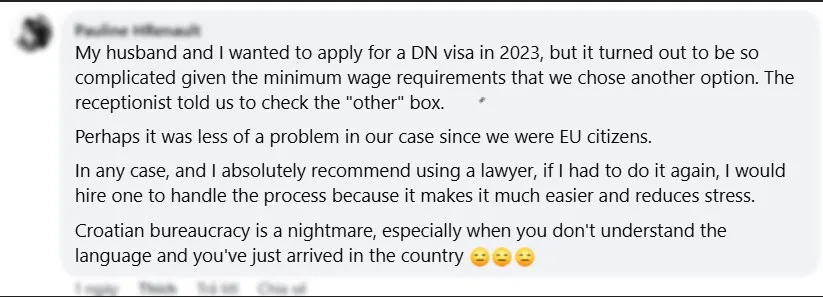
In many cases, professional support doesn’t just save time — it prevents costly mistakes.
We ensure your documents are not only complete, but presented in a way that aligns with how Croatian authorities actually assess applications in practice.
In short, we ensure compliance without unnecessary complexity.
What We Help You With
- Eligibility assessment based on real-world cases (not just theory), especially for: startup founders, freelancers, multi-income applicants
- Income structuring & documentation strategy (we reduce rejection risk from inconsistent or non-traditional income)
- Application timing guidance (applying too early or too late is one of the most common reasons for refusal)
- Document preparation and legal structuring (the #1 reason applications fail is not eligibility but poor presentation)
- Application submission & coordination with Croatian authorities (MUP)
- Accommodation compliance (lease verification, legal requirements, and avoiding common pitfalls)
- Full end-to-end guidance from planning → submission → monitoring → approval
Why Many Applications Get Rejected
Most applicants don’t fail because they are unqualified.
They fail because:
- their income is not clearly structured or explained
- their application is submitted at the wrong time
- documents are incomplete, inconsistent, or misaligned
- they underestimate how strictly small details are reviewed
In some cases:
- you may be rejected without a clear explanation
- small mistakes can cause months of delay or refusal
For More Complex Cases
- We regularly support clients who:
- need a stronger, more structured application strategy
- have non-visa-free passports.
- earn through startups, equity, or variable income
- are transitioning between jobs or income models
Fees
Service fees in the market generally range from €1,300 to €8,500, depending on the complexity of the case and level of support required. Consultation fee starts from €100/hour (The total time depends on the complexity of your situation, some cases require only a short session, while others may need more in-depth guidance.)
Start your Croatia Digital Nomad Visa process here: Croatia Digital Nomad Visa service
Common Questions About Croatia Digital Nomad Visa
Does the Croatia digital nomad visa lead to permanent residence?
No. The Croatia digital nomad residence permit is a temporary stay and does not directly count toward permanent residence. Additionally, the mandatory 6-month break after the permit expires interrupts continuous residence, which is required for long-term residency eligibility.
Do digital nomads pay Croatian tax?
No, digital nomads with the digital nomad visa will not owe taxes in Croatia. This tax benefit is only valid for those with the digital nomad visa.
How long does the Croatia Digital Nomad Visa application process take?

In practice, the processing time usually ranges from 5 to 12 months, depending on where and how you apply. Processing time can vary based on The completeness and clarity of your documents, Whether translations into Croatian are required, The local police station (MUP) handling the case, The time of year (summer months are often slower).
Do I need to book accommodation for the full duration when applying for the Croatia Digital Nomad visa?
There is no official requirement to prove accommodation for the full length of your stay at the application stage. A temporary address, such as a hotel or Airbnb booking, is generally sufficient for the online application form. However, once you arrive in Croatia, you must register your actual address with the police within 3 days of arrival. At that point, you’ll need proper documentation for where you are staying (e.g. landlord statement, lease, or accommodation confirmation). In short: temporary address for the application is fine, formal address registration happens after arrival.
Who can apply for the Croatia digital nomad visa?
The Croatia digital nomad visa is available to non-EU / non-EEA citizens who work remotely for companies or clients located outside Croatia. Applicants must demonstrate that their work is performed online and that they are not providing services to Croatian employers.
The program is commonly used by freelancers, remote employees, entrepreneurs, and location-independent professionals.
Do I have to pay taxes in Croatia as a digital nomad?
Generally no if you work only for non-Croatian clients/employers. However, if you stay over 183 days, you may trigger tax residency. See Croatia Digital Nomad Tax Rules for guidance.
How Much Does the Croatia Digital Nomad Visa Cost?
The Croatia digital nomad visa fees typically range between €100 and €200, depending on where and how you apply.
Can I open a bank account in Croatia as a digital nomad?
Yes, but requirements vary by bank. Most will require an OIB (Croatian tax number), proof of address, and a valid residence permit.
Can I register a company in Croatia while on a digital nomad visa?
No. The digital nomad permit does not allow you to engage in business activities within Croatia. For that, you would need a different residence basis (e.g., business residence).
Do I need to register my address after arriving in Croatia?
Yes. After entering Croatia, you must register your residence address with the police within a few days and provide proper accommodation documentation.
Is Croatia a good base compared to other EU digital nomad destinations?
Croatia is often chosen for its Schengen access, relatively lower cost of living compared to Western Europe, and favorable tax treatment for digital nomads.
Can You Bring Your Family on a Croatia Digital Nomad Visa?
Yes, family reunification is possible under Croatian law, but it is handled through a separate application process.
Eligible family members may include:
- Spouse
- Minor children
- In some cases, unmarried partners (subject to proof of relationship)
Can You Use Croatia’s Digital Nomad Permit While Living Elsewhere in the EU?
One of the most common questions we receive from remote professionals is whether Croatia’s digital nomad residence permit can be used as a “base” while actually living in another EU country, such as Germany or Luxembourg.
The short answer: not safely, and not as intended under Croatian law.
Do Croatia digital nomad visa days count toward Schengen limits?
No, Once your Croatia digital nomad visa (residence permit) is approved, days spent in Croatia do NOT count toward Schengen limits.
However, the 90/180 rule still applies when you travel to other Schengen countries.
Do I still need to register at the MUP if my hostel already registered me through eVisitor?
Many hotels and hostels in Croatia automatically register foreign guests through the eVisitor system within 24 hours of check-in. In practice, this registration is commonly used as proof of temporary accommodation during your stay at that address.
Is there a strict deadline to find a long-term apartment after arriving in Croatia?
After arrival, you must register your address with the police/MUP within a short period after entering Croatia or changing accommodation. In general, your registered address is tied to the place where you are currently staying. For example, if you stay in a hostel for 20 days and the accommodation properly registers your stay, that hostel address would typically be considered your active registered address during that period.
Does Croatia accept SafetyWing or other nomad health insurance plans for the Digital Nomad Visa?
Applicants commonly use international travel or nomad-oriented health insurance plans when applying for the Croatia Digital Nomad temporary stay. However, acceptance can depend on several factors such as coverage duration, policy wording, territorial coverage, and the individual interpretation of the MUP officer reviewing the case.
Conclusion: Croatia Digital Nomad Visa
As a lawyer advising international clients relocating to Croatia for over a decade, I’ve seen a consistent pattern:
successful Croatia digital nomad visa applications are rarely about eligibility alone.
They depend on how clearly your income is documented, how consistent your paperwork is, and how well your application aligns with Croatian administrative practice.
If you are planning to apply for the Croatia digital nomad visa, investing time in understanding the process from the outset can save you months of delays, additional requests, or potential rejection.
Whether you choose to apply independently or with professional support, one factor remains critical:
a well-prepared application is the foundation of a smooth and successful relocation to Croatia.