Considering a move from Dubai to Europe? The journey can seem daunting, filled with questions about visas, taxes, and new lifestyles. This comprehensive guide is designed to demystify the process, offering practical insights and detailed options to help you navigate your relocation smoothly.
I, Prof. Dr. Šime Jozipović, founder of Mandracchio Capital, a Croatia-based legal advisory firm assisting international investors, retirees, and expatriates, have reviewed this article from a legal advisory perspective, drawing on over 10 years of experience guiding clients through complex immigration and residency frameworks.
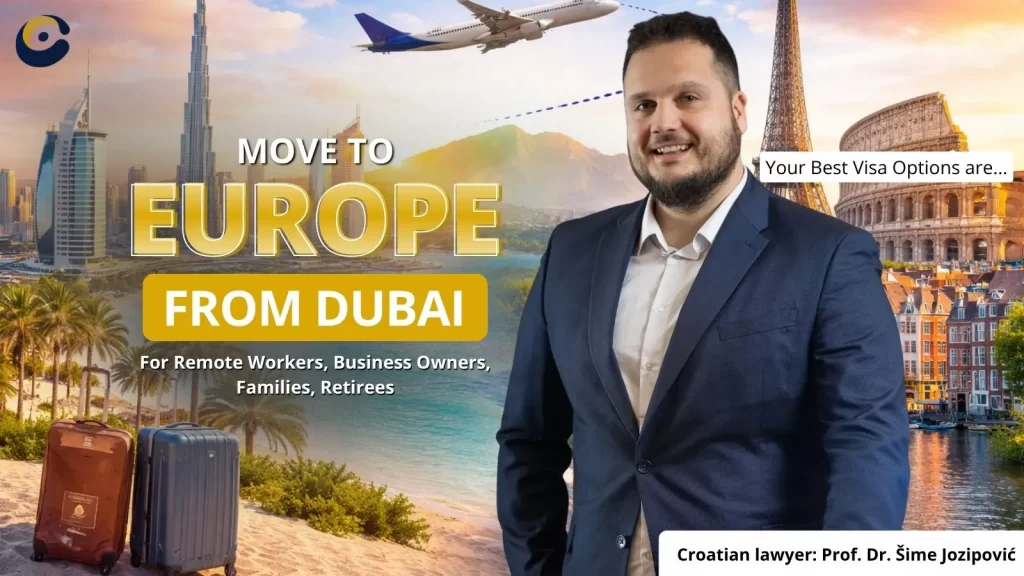
Overview of Moving from Dubai to Europe
Relocating from Dubai to Europe is a major life decision, often driven by the search for better work–life balance, access to high-quality healthcare and education, and long-term residency or citizenship opportunities. For digital nomads, entrepreneurs, and families, Europe offers a stable environment, strong legal systems, and a diverse lifestyle that is difficult to replicate elsewhere.
However, moving to Europe is not just about choosing a destination. Each country has its own visa requirements, tax rules, and administrative procedures. Without proper planning, individuals may face delays, unexpected costs, or legal complications during the relocation process.
This guide brings together the most common and practical pathways for moving from Dubai to Europe, helping you understand your options and choose the route that best fits your personal and professional goals.
Quick Overview of Ways to Move from Dubai to Europe
For those looking for a quick overview of their options, this section highlights the most common avenues for relocating from Dubai to Europe:
Digital Nomad Visas
Ideal for remote workers and freelancers seeking flexibility and a vibrant European lifestyle. Countries like Croatia (Croatia Digital Nomad Visa), Spain, and Portugal offer dedicated programs tailored for location-independent professionals.
Residency by Investment (Golden Visas)
Suitable for investors and high-net-worth individuals looking for a direct path to European residency, often with a route toward citizenship. Popular options include Portugal, Greece, and Malta.
Long-Stay National Visas (D Visa) & Temporary Residence Permits
Best for professionals with secured job offers, students admitted to European institutions, or individuals applying for family reunification. These pathways require purpose-specific applications and supporting documentation.
Define Your Immigration Strategy Before Relocating from Dubai to Europe
Clarifying your needs at the outset can significantly streamline your move from Dubai to Europe. Before choosing a pathway, consider the following:
- Primary motivation: Why are you moving to Europe? (career opportunities, better quality of life, education for your family, investment, or remote work flexibility)
- Financial readiness: Do you have sufficient funds for relocation, initial living expenses, and any required investments?
- Country fit: Which European countries align with your lifestyle preferences, language skills, and professional goals?
- Timeline: When do you plan to relocate, and how flexible is your schedule?
- Family considerations: Are family members relocating with you? Consider schooling, healthcare access, and overall integration.
- Tax implications: Are you prepared for the tax consequences of becoming a European tax resident?
Choosing the right approach based on a clear understanding of your situation will save time, reduce risks, and significantly increase your chances of a successful relocation.
Pre-Relocation Checklist for Dubai Expats Moving to Europe
1. Documentation
Ensure your passport is valid for at least 6 months beyond your intended stay. Prepare and attest all key personal documents, including:
- Birth certificate
- Marriage certificate (if applicable)
- Educational degrees
- Professional licenses
These documents are required for most European visa and residence applications.
2. Financial Planning
Create a clear budget covering:
- Relocation costs (flights, shipping household goods from Dubai to Europe)
- Initial living expenses
- Visa and administrative fees
- Health insurance
You will also need to demonstrate sufficient financial means depending on your visa type.
3. Country & Legal Research
Research your target country carefully, including:
- Immigration laws and visa requirements
- Tax regulations
- Cost of living
Understanding the quality of life in Europe vs Dubai for expats will help you choose the right destination.
4. Professional Guidance
Consulting legal and tax advisors early can help you:
- Choose the right immigration pathway
- Structure your move efficiently
- Stay compliant with tax obligations when relocating from Dubai to Europe
5. Health Insurance
Secure comprehensive health insurance that meets your destination country’s requirements. This is mandatory for most long-stay visas and residence permits.
6. Language & Integration
While English is widely spoken in many European cities, learning basic phrases in the local language can significantly improve:
- Daily communication
- Cultural integration
- Long-term settlement experience
Detailed Guide to Relocating from Dubai to Europe
This section provides detailed guidance on the most effective ways to “move to Europe from Dubai,” catering to different needs and circumstances.
Digital Nomad Visas – Your Gateway to European Remote Work
This option is ideal for remote workers, freelancers, and entrepreneurs whose income is generated outside the destination country. The “digital nomad visa europe for dubai residents” offers a flexible lifestyle.
Who Is This Option For and When Should You Choose It?
If you work remotely for a company outside Europe or are self-employed with international clients, a digital nomad visa provides the flexibility to live and work across various European countries. It is particularly suitable for individuals seeking a digital nomad lifestyle, improved work-life balance, and location independence.
What You Need to Prepare
To apply, you will typically need:
- A valid passport
- Proof of remote work (employment contract or client agreements)
- Comprehensive health insurance
- Evidence of stable monthly income
Minimum income requirements vary by country. For example:
- Croatia: approximately €3,700/month (Official Source: Ministry of the Interior (MUP) – Digital Nomads)
- Spain: approximately €2,268/month (Official Source: Ministry of Foreign Affairs – Digital Nomad Visa)
- Portugal: approximately €3,280/month (Official Source: e-Portugal Government Portal)
Step-by-Step Process
- Research country-specific requirements
Each country has different rules. Croatia introduced its program in 2021 (valid up to one year, usually not immediately renewable). Spain launched its visa in 2023 with extensions up to five years. Portugal allows renewals leading to permanent residency after five years. Germany offers freelance visas extendable up to three years. - Prepare documentation
Gather all required documents, including bank statements to demonstrate financial stability. - Submit your application
Apply through the relevant embassy or consulate in Dubai, or via online systems where available. - Complete biometrics and interviews
Attend any required appointments and provide biometric data. - Wait for approval
Processing times vary depending on the country.
Advantages, Limitations, and Risks
Digital nomad visas offer strong lifestyle flexibility and the opportunity to experience different European cultures. However:
- Income thresholds can be strict
- Some visas (such as Croatia’s) are not immediately renewable
- Tax implications must be carefully assessed
Understanding double taxation agreements (DTAs) and determining your tax residency is essential before relocating.
Residency by Investment (Golden Visas) – A Path for Investors
This path is designed for individuals willing to make a significant financial investment in a European country in exchange for residency rights. It offers a direct route to europe residency by investment from dubai.
You can learn how this works in detail in our Croatia Golden Visa Program guide.
Who Is This Option For and When Should You Choose It?
This option is ideal for high-net-worth individuals, entrepreneurs, and investors seeking long-term residency in Europe. It is particularly suitable if your goal is stability, mobility across Europe, and a structured pathway toward permanent residency or citizenship.
What You Need to Prepare
To apply, you will typically need:
- Substantial investment capital (e.g., real estate, government bonds, or business investment)
- A clean criminal record
- Funds to cover legal, administrative, and government fees
Step-by-Step Process
- Select a country offering a Golden Visa program
Common options include Portugal, Greece, Malta, Hungary, and Latvia. - Complete the qualifying investment
Follow the specific legal requirements set by the country. - Work with a legal advisory firm
Engage experienced professionals to ensure compliance with European immigration laws and avoid costly mistakes. - Submit your application
Provide all required documentation, including proof of investment and background checks. - Complete due diligence procedures
This may include background screening and interviews. - Receive your residence permit
Once approved, you gain legal residency rights in the selected country.
Advantages, Limitations, and Risks
Golden Visa programs offer:
- A direct route to European residency
- Potential eligibility for citizenship
- Freedom of movement within the Schengen Area
However:
- High capital requirements
- Complex legal and compliance procedures
- Regulations may change over time
Long-Stay National Visas (D Visa) & Temporary Residence Permits
This category covers long-term stays in Europe based on a specific purpose, such as employment, education, or family reunification. These are among the most common European visa categories.
Who Is This Option For and When Should You Choose It?
This route is ideal if you:
- Have secured a job offer from a European employer
- Have been accepted into a European educational institution
- Are joining family members who are already residents in Europe
It is the most direct and structured pathway for purpose-based relocation.
What You Need to Prepare
Typical requirements include:
- A valid employment contract, university acceptance letter, or proof of family relationship
- Proof of sufficient financial means
- Comprehensive health insurance
- A clean criminal record
Step-by-Step Process
- Secure your purpose of stay
(e.g., employment, study, or family reunification) - Apply for a Long-Stay National Visa (D Visa)
Submit your application at the embassy or consulate of your chosen country in Dubai. - Travel to Europe after approval
Enter the country using your issued visa. - Apply for a temporary residence permit
Register with local authorities and obtain your residence card.
Advantages, Limitations, and Risks
This pathway offers:
- A clear and structured route to legal residency
- Opportunities for long-term or permanent residency
However:
- Requirements are strict and country-specific
- Your residency may be tied to an employer, institution, or family status
Which Option Should You Choose? And Which Is Most Effective?
Choosing the most effective way to “move from dubai to europe” depends entirely on your individual circumstances and goals. There isn’t a single “best” method; the ideal approach aligns perfectly with your personal and professional aspirations. Consider these criteria:
- Goal: Are you seeking employment, educational opportunities, remote work flexibility, or a long-term investment for residency?
- Budget: How much capital are you willing and able to invest in your relocation?
- Timeline: How quickly do you need to relocate? Some visa processes are faster than others.
- Experience Level: Do you prefer a straightforward process or are you prepared for more complex legal and financial navigation?
Recommended Options:
- Digital Nomads & Remote Workers: Prioritize Digital Nomad Visas, especially in countries like Croatia, Spain, or Portugal, for their clear frameworks and lifestyle benefits. Croatia is often highlighted as an attractive option due to its welcoming policies and lower cost of living.
- Investors: Golden Visa programs offer a robust pathway to residency and potential citizenship for those with significant capital, seeking long-term stability.
- Professionals & Students: Long-Stay National Visas are the most direct route when you have a specific offer or acceptance, providing a clear purpose for your move.
Suggested Strategies
- Fast & Flexible Approach: For remote workers, start with a Digital Nomad Visa in a country known for its welcoming policy and lower cost of living, such as Croatia. This allows you to establish a base while exploring longer-term options, potentially leading to a “dubai to croatia relocation guide” for others.
- Optimal & Secure Strategy: For investors, combining a Golden Visa with expert legal and tax advice ensures a secure and compliant path to long-term residency and financial benefits. This is crucial for navigating “europe residency by investment from dubai.”
Best Countries to Relocate to Europe from Dubai
Croatia: Easiest Entry with Digital Nomad Options
Croatia is often considered one of the easiest entry points into Europe for Dubai residents. Its digital nomad visa allows remote workers to stay legally while working for non-Croatian companies. The process is generally straightforward, making it a practical choice for those seeking a fast and flexible relocation.
You can also review our guide on immigrating from Dubai to Croatia
Portugal: Structured Residency Pathways
Portugal offers well-defined residency programs suitable for different profiles, including passive income earners and professionals. These pathways can lead to permanent residency and eventually citizenship over time. It is a strong option for those planning long-term settlement within the European Union.
Spain: Remote Worker Visa Opportunities
Spain has introduced a remote worker visa that appeals to freelancers and digital professionals. It allows individuals to live in Spain while working for foreign employers or clients. The lifestyle, climate, and infrastructure make it especially attractive for expats from Dubai.
Germany: Strong Job Market for Professionals
Germany is known for its robust economy and demand for skilled workers across multiple industries. It is an ideal destination for those looking to secure employment rather than work remotely. With structured immigration routes and career opportunities, Germany offers long-term stability for professionals.
Why Croatia Is One of the Easiest Entry Points to Europe
- EU + Schengen + Eurozone
- lower cost
- clear digital nomad framework
This aligns with your service page funnel
Important Considerations When Moving from Dubai to Europe
Relocating internationally involves numerous considerations beyond just securing a visa. Being aware of potential pitfalls can help ensure a smoother transition and mitigate “expat challenges europe.”
Avoid Choosing the Wrong Visa Category
Carefully assess your eligibility for each visa type. Applying for a visa that does not match your true intentions or qualifications can lead to rejection and wasted time and money.
Do Not Underestimate the Total Cost
Beyond visa fees, account for shipping household goods from Dubai to Europe, initial accommodation, health insurance, legal fees, and the generally higher cost of living in Europe compared to Dubai. A comprehensive budget for the cost of moving from Dubai to Europe is essential.
Do Not Ignore Tax Implications
Moving from a low-tax environment like Dubai to Europe comes with significant tax implications. Failing to understand tax residency, income tax, capital gains tax, and Double Taxation Agreements (DTAs) can lead to unexpected liabilities. Properly establishing a UAE tax residency certificate can be an important factor.
Language and Cultural Barriers Matter
While English is widely spoken in many European countries, daily life and administrative procedures often require knowledge of the local language. Be prepared for cross-cultural adjustment and differences in work environments and social norms.
Always Verify Legal Requirements
Immigration laws and requirements frequently change. Always confirm the most up-to-date regulations through official government sources or qualified legal advisors.
Do Not Handle Complex Cases Alone
For complex situations such as business relocation, significant investments, or advanced tax planning working with a professional legal advisory firm can help prevent costly mistakes and ensure full compliance with European immigration laws, especially when considering moving a business from Dubai to Europe with tax optimization in mind.
Common Problems When Moving from Dubai to Europe and How to Solve Them
Relocating can present several hurdles. Understanding common issues and their solutions is key to a smoother transition.
Issue 1: Complex Visa Procedures and Documentation Errors
Visa application delays, requests for additional documents, or outright rejection are common signs of issues. These often stem from incomplete application forms, missing supporting documents, outdated information, or incorrect translations and attestations. To address this, double-check all requirements from official sources and consider engaging a legal advisory firm to review your application and documents before submission. If rejected, understand the reasons and address them before reapplying, or explore alternative “european visa categories” that might be a better fit. This helps avoid pitfalls when dealing with “what are the visa requirements to move from dubai to europe.”
Issue 2: Underestimating Costs and Tax Issues
Running out of funds sooner than expected, unexpected tax bills, or penalties from non-compliance are clear indicators of financial missteps. These usually result from inadequate budgeting for all relocation and initial living costs, failure to understand “tax residency europe” rules, or not utilizing Double Taxation Agreements (DTAs). Create a comprehensive financial plan, including a contingency fund. Consult with a tax specialist experienced in international relocation to understand your obligations in both the UAE and your new European country. Explore countries with more favorable tax regimes for your specific income type, especially considering the “tax implications when moving from dubai to europe.”
Issue 3: Cultural and Language Barriers
Feelings of isolation, difficulty communicating in daily situations, or struggling to adapt to new social norms and work environments are common “cross-cultural adjustment europe” challenges. These often arise from a lack of preparation for cultural differences, insufficient effort to learn the local language, or not actively seeking out local connections. Enroll in language courses before or immediately after arriving. Actively seek out expat communities and local groups to build a social network. Be open-minded and patient with the adjustment process, embracing the “european lifestyle benefits.”
Issue 4: Moving and Shipping Logistics
Delays in customs, damaged goods, or unexpected high shipping costs are frequent issues when moving belongings. These problems often stem from poor planning, a lack of understanding of customs regulations in the destination country, or choosing an unreliable “international moving companies dubai to europe.” Engage reputable international moving and freight forwarding companies. Ensure all documentation for customs clearance is accurate and complete, including detailed packing lists and proof of residency. Obtain comprehensive insurance for your belongings to protect against unforeseen circumstances when “shipping household goods from dubai to europe.”
FAQ: Relocating to Europe from Dubai
How much does it typically cost to move from Dubai to Europe?
The cost to relocate from Dubai to Europe typically ranges from €3,000 to €15,000+, depending on the destination country, visa type, and lifestyle. Main expenses include visa fees, legal support, accommodation deposits, health insurance, and initial living costs. Business or investment routes may increase the overall cost.
Which European country offers the easiest path to residency for Dubai residents?
Countries such as Croatia, Portugal, and Greece are often considered accessible for Dubai residents due to flexible residency options. Croatia stands out with pathways like digital nomad residence, business-based residence, and family reunification. The best choice depends on your income source and long-term plans.
Can I transfer my business from Dubai to Europe, and what are the tax benefits?
You cannot directly transfer a UAE company to Europe, but you can establish a new entity and restructure operations. Tax benefits vary, but in Croatia, corporate tax can be 10% for small businesses, with additional optimization opportunities for dividends and capital gains. Proper structuring is essential to avoid double taxation.
What are the quality of life differences between Europe and Dubai for expats?
Europe generally offers more long-term stability, access to public healthcare, education, and pathways to permanent residence or citizenship. Dubai provides high income potential and tax advantages but lacks long-term residency security. Many expats choose Europe for family stability and legal certainty.
Is it necessary to hire a legal advisory firm for the relocation process?
It is not mandatory, but it is highly recommended. Immigration processes in Europe involve detailed documentation and strict compliance requirements. A legal advisory firm can help reduce delays, avoid mistakes, and ensure a smoother application process.
Why is Croatia often highlighted as an attractive option for expats from Dubai?
Croatia is attractive due to its EU membership, relatively simple residence pathways, and favorable tax environment. It offers a safe lifestyle, access to the Schengen Area, and lower living costs compared to Western Europe, making it appealing for digital nomads, entrepreneurs, and families.
What are the essential documents required for moving from Dubai to Europe?
Most applications require a valid passport, proof of income, health insurance, proof of accommodation, a criminal background check, and completed application forms. Additional documents may be needed depending on the residency pathway.
Is it easy to relocate to Europe from Dubai?
Relocating to Europe from Dubai is possible but requires proper planning. The process is structured and documentation-heavy, so preparation and choosing the right pathway are key to success.
Which European country is easiest for Dubai residents?
There is no single easiest country, but Croatia, Portugal, and Greece are commonly considered practical options. Croatia is often preferred for its flexible residence options, clear legal framework, and suitability for remote workers and business owners.
Conclusion and Recommendations
Moving from Dubai to Europe is a transformative journey that, while complex, offers immense opportunities for personal and professional growth, including a better “work-life balance europe” and access to robust “european healthcare system” and “education system europe.”
The key to a successful relocation lies in three core principles: accurately assessing your situation, choosing the right approach tailored to your needs, and diligently monitoring your progress. For those new to this endeavor, we recommend starting with thorough research and perhaps considering a Digital Nomad Visa in a country like Croatia (Check Croatia digital nomad visa) for its flexibility and welcoming policies, allowing you to establish a foothold while exploring more permanent solutions.
Remember to save this guide as a valuable resource, regularly review your status, and do not hesitate to seek expert assistance from legal and financial advisors when navigating the more intricate aspects of your move. Your European adventure awaits!