Good news, many Croatian procedures can be processed without your physical presence in Croatia. To make this possible, you need a properly prepared document. A Croatian power of attorney allows a representative to act on your behalf before notaries, the Tax Administration, and the police administration, making remote company formation and residence applications possible in the first place.
In this article, I will explain what this document is, what it enables you to do, and how to sign one abroad so that Croatian authorities will accept it. Hi, I’m Prof. Dr. Šime Jozipović, founder of Mandracchio Capital. I’m a Croatian lawyer based in Split, with a Master of Laws from Harvard Law School and a doctorate in international tax planning.
Croatian power of attorney at a glance
| Question | Short answer |
|---|---|
| What is it? | A document (punomoć) authorizing another person to act on your behalf, governed by the Croatian Obligations Act and, for dealings with authorities, the General Administrative Procedure Act |
| Can I open a Croatian company remotely? | Yes. Your representative signs the founding act before a Croatian notary under a notarized power of attorney |
| Can someone obtain my OIB for me? | Yes. The Tax Administration accepts applications from a representative and processes them within 8 days |
| Does a power of attorney signed in the US, UK, Australia or other countries work in Croatia? | Yes, once it is notarized locally, apostilled. |
| Can a representative deal with the police administration during my residence application? | Yes, for filing documents and all communication. Biometrics and card collection remain personal |
What is a Croatian power of attorney
A power of attorney authorizes another person, usually your lawyer, to act in your name. Croatian contract law regulates it in Articles 313 to 318 of the Obligations Act (Zakon o obveznim odnosima). The document can be general, covering a broad range of matters, or special, covering one defined procedure. Croatian practice strongly favors the special form: authorities accept it more readily, and you give away exactly as much authority as the task needs.
Two rules shape everything else in this guide. First, Article 314 of the Obligations Act ties the form of the power of attorney to the form of the transaction it serves. If the law requires a notarial act for a contract. Second, for dealings with Croatian authorities, the General Administrative Procedure Act (Zakon o općem upravnom postupku) lets any party act through a representative, and everything the representative does within the granted authority has the same legal effect as if you did it yourself (Article 36).
This is why a well-drafted document starts from the procedure, not from a template. The wording that gets you an OIB in a week is not the wording that transfers shares in a company.
How to sign a Croatian power of attorney abroad
The standard chain has three steps. You sign the document before a notary in your country. The notarization is then confirmed with an apostille under the Hague Convention of 5 October 1961, issued by the designated authority in your country. The document is then translated into Croatian by a certified court interpreter (sudski tumač). The United States, the United Kingdom, Australia and, since January 2024, Canada are all Apostille Convention states, so this chain covers most clients working with Croatia from abroad.
Some countries skip the apostille entirely. Croatia has bilateral legal-assistance treaties with Austria, Italy, France, Czechia, Slovakia, Slovenia, Hungary, Poland, Romania, Greece, Serbia, Montenegro, North Macedonia, Türkiye and Russia, and documents from these countries need no apostille, per the official legalization overview on gov.hr (as of November 2026). For countries outside the Convention, a full legalization through diplomatic channels applies instead.
The practical advice is to settle the wording before you book the notary appointment. We prepare powers of attorney as bilingual Croatian–English documents, so you can read every word you sign and no separate translation of the document itself is needed.
Opening a Croatian company without traveling to Croatia
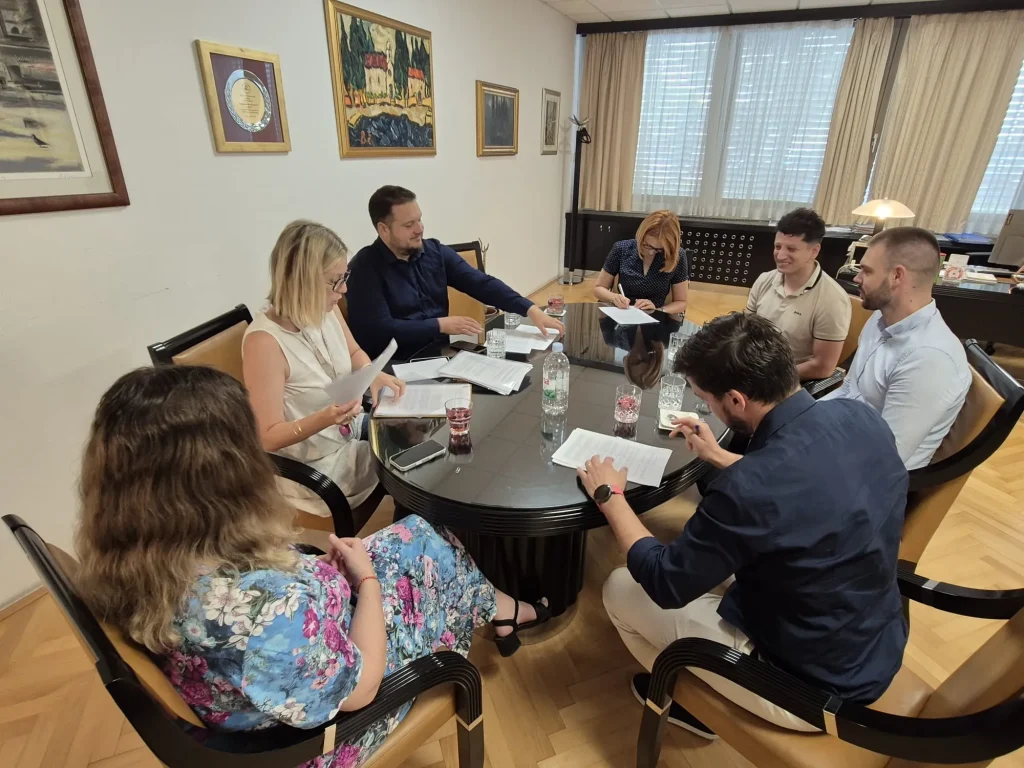
The founding act of a Croatian limited liability company (d.o.o.) must be made as a notarial act or as a private deed certified by a Croatian notary, per the official company formation overview on gov.hr. Croatia’s fully online incorporation channels serve Croatian and European Union citizens with qualifying electronic credentials. For founders from third countries, the notary route is the realistic one, and that route works remotely through representation.
If you’re considering how to start a Croatian company online, a representative can sign the founding act on your behalf under a power of attorney certified by a notary, as provided under the Companies Act (Zakon o trgovačkim društvima).
Please refer to our “start a Croatian company online” article to know how remote sequence looks like.
One step still tends to involve you personally. Croatian banks run their own client onboarding under anti-money-laundering rules, and most want to meet the managing director at least once before activating the company’s account, in person or through the bank’s own video identification where offered. A power of attorney compresses the rest of the process so that this is the only appointment left, and it can wait until a trip that suits you.
Selling or transferring shares
Here the parity-of-form rule bites hardest. A contract transferring shares in a d.o.o. must be made as a notarial act or a notarially certified (solemnized) deed under Article 412(3) of the Companies Act. The High Commercial Court held in case Pž-6739/16 that the power of attorney for such a contract must be given in that same form.
A power of attorney with a merely certified signature is not enough, and a share transfer signed under one is void. Plenty of transfers were done the lighter way before that judgment, so if you are buying into or exiting a Croatian company through a representative, have the power of attorney prepared as a notarial document from the start.
Getting your OIB through a representative
The OIB (osobni identifikacijski broj) is the Croatian personal identification number, and nearly everything in this guide requires it: company formation, property, inheritance, banking, tax filings. It is also the easiest procedure to delegate. The Tax Administration (Porezna uprava) accepts applications submitted in person or through a representative, and processes assignments for foreign persons within 8 days.
The Tax Administration’s rules for foreign applicants ask for a power of attorney issued specifically for the OIB procedure, in Croatian or translated into Croatian, together with a copy of your passport. A useful detail sits in those rules: a power of attorney issued to a lawyer, a notary, a public-law body or a bank needs no certification at all, while one issued to a private individual must be certified. Appointing a lawyer therefore saves you a notarization round for this step.
Croatian POA to support Residence permit application
Residence procedures run before the Ministry of the Interior (MUP), and the deciding body is the police administration for your intended Croatian address. The name unsettles applicants, but for residence matters the police administration is simply the competent office, and the General Administrative Procedure Act applies there as it does before any other authority.
If you would like someone to contact the police administration on your behalf during any phase of the application, a power of attorney is what arranges it: your representative files documents, responds to requests for additional evidence, and follows up on status, all with the same legal effect as if you acted yourself.
For Croatia digital nomads permit, the application itself can be submitted through the official online portal, at a Croatian embassy or consulate, or at the police administration if you are already lawfully in Croatia. With a properly prepared power of attorney, our team can assist you throughout the residence application process, including:
- Application and document management: We prepare and submit your application, organise supporting documents, respond to requests for additional evidence, and follow up with the relevant police administration.
- Lawyer and translator support: When you attend the police administration to collect confirmation letters or your residence card, a lawyer or translator can be available by phone to help you navigate any language or administrative issues.
- Appeal management: If your application is rejected, we can review the decision, assess the available legal remedies, and advise you on possible appeal options.
What a power of attorney cannot replace
Croatian law reserves a short list of steps for you personally: biometric data and residence-card collection, identity verification where a specific law requires your presence, most first-time bank onboarding, and personal appointments at embassies in citizenship matters. Knowing this list at the start sets honest expectations. The goal of a power of attorney is to clear everything else out of your calendar so that one well-planned appointment covers all of it.
Other uses: property, inheritance, tax
The same instrument carries most cross-border legal work in Croatia. Buyers and sellers of Croatian property authorize a lawyer to review contracts, sign before the notary and file the land-registry application. Heirs living abroad authorize representation in inheritance proceedings before Croatian notaries and courts, which matters when one estate has beneficiaries on three continents. And a certified power of attorney lets a tax representative register you or your company with the Tax Administration and handle filings, which is how foreign businesses manage Croatian value added tax obligations without a local office.
A note on something you may read elsewhere: categories like “enduring” or “medical” powers of attorney come from common-law systems. Croatian law does not contain that typology. The distinctions that matter here are general versus special authority, and the form the underlying transaction requires.
Revoking a power of attorney
You can revoke a power of attorney at any time. In administrative procedures, the revocation is made in writing or orally on the record, and it takes effect the moment the authority receives it, under Article 36(6) of the General Administrative Procedure Act. For private transactions, inform the representative and any third party who has relied on the document. Good housekeeping is to revoke and replace rather than leave old powers outstanding, and powers we draft are limited to their procedure, so they expire with the work they were made for.
How Mandracchio Capital works with powers of attorney
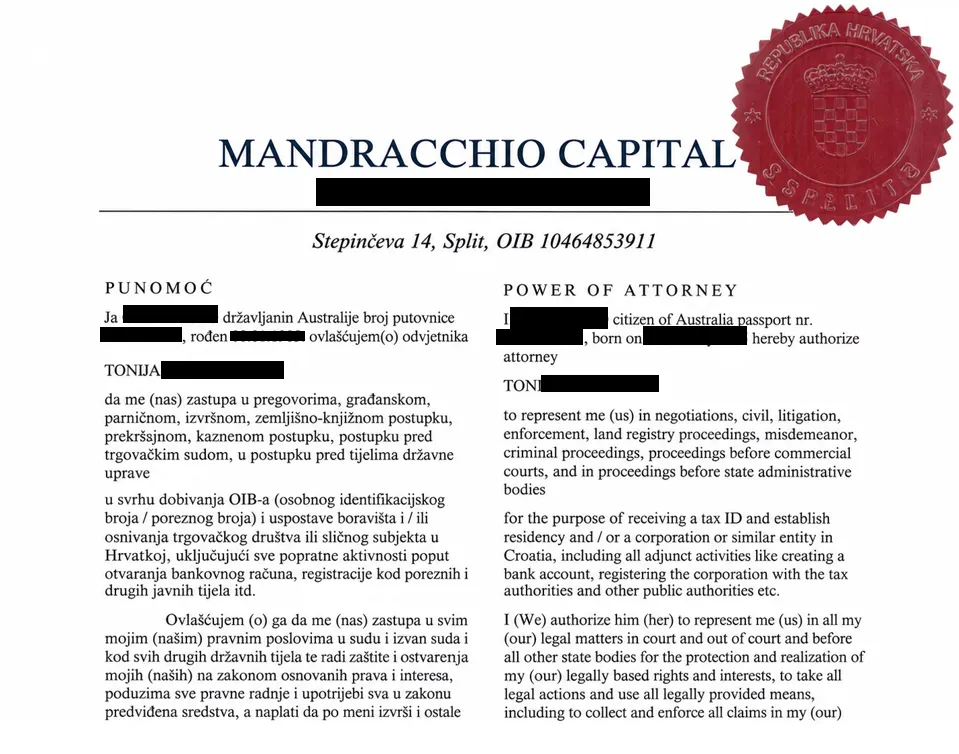
Nearly every remote mandate we run at Mandracchio Capital starts with this document. We draft a bilingual, procedure-specific power of attorney, send you precise signing instructions for your country, including whether you need an apostille at all, and then carry out the Croatian side: obtaining your OIB, incorporating your company before the notary, registering it with the Tax Administration, and communicating with the police administration during a residence application.
If you are planning a Croatian company formation or a expat residency application from abroad, you can send us a short description of your situation and we will tell you which steps can run through a power of attorney and which appointment to plan for.
Frequently asked questions
Do I need a separate Croatian power of attorney for each procedure?
As a rule, yes. The Tax Administration expects one issued specifically for the OIB procedure, a company founding needs a notarized one, and a share transfer needs one in notarial-act form. One broad document rarely satisfies all three, and narrow documents protect you better.
Is a power of attorney written in English valid in Croatia?
Croatian authorities work in Croatian, so an English document needs a certified translation. The cleaner route is a bilingual Croatian–English original, which you can read in full before signing and which authorities accept without a separate translation.
Can my representative apply for my digital nomad permit?
Your representative can prepare the application, file documents and handle all communication with the police administration under a power of attorney. You appear personally for biometrics, to collect your residence card and to register your address.