Choosing the best European country as a US remote professional involves much more than finding the lowest taxes. Visa policies, internet infrastructure, banking, cost of living, healthcare, time zone compatibility, and long-term residency options all play an important role.
Hi, I’m Hannah, Croatia relocation specialist at Mandracchio Capital. Over the past two years, I’ve helped U.S. remote professionals, entrepreneurs, and retirees relocate to Croatia through digital nomad residency, business formation, and long-term residence planning.
For entrepreneurs, consultants, freelancers, and remote business owners, the best destination is usually one that offers a balance of:
- Competitive tax environment
- Clear legal residency options
- Reliable banking and financial services
- Strong infrastructure for remote work
- Access to international markets
- Political and economic stability
- High quality of life
This guide compares Europe’s leading destinations using a consistent evaluation methodology based on visa accessibility, tax friendliness, cost of living, infrastructure, banking, safety, and overall livability. Rather than focusing on a single factor, we assess how each country performs across the areas that matter most to Americans living and working abroad.
Whether you’re looking for a digital nomad visa, establishing tax residency, relocating your remote business, or planning a long-term move to Europe, the countries below represent some of the strongest options for combining tax efficiency, legal certainty, and sustainable international living.

How We Ranked These Countries
Our rankings are based on the factors that matter most to remote professionals, entrepreneurs, freelancers, and digital nomads looking to relocate internationally. Rather than focusing on a single metric like taxes or cost of living, we evaluated each destination across six categories that directly affect your ability to live and work abroad.
Each country received a weighted score based on the following criteria:
| Ranking Criteria | Weight | Why It Matters |
|---|---|---|
| Remote Visa & Residency Options | 20% | Availability of digital nomad visas, residency pathways, processing times, and ease of obtaining legal status. |
| Tax Friendliness | 20% | Income tax rates, tax incentives, territorial taxation, foreign income treatment, and overall tax efficiency. |
| Cost of Living | 15% | Housing, food, transportation, healthcare, and everyday expenses relative to income potential. |
| Infrastructure & Connectivity | 15% | Internet speed, coworking spaces, transportation, healthcare quality, and overall digital infrastructure. |
| Banking & Business Friendliness | 10% | Ease of opening bank accounts, payment systems, company formation, and access to financial services. |
| Safety & Stability | 10% | Crime levels, political stability, healthcare access, and overall security for long-term living. |
| Quality of Life | 10% | Climate, lifestyle, culture, work-life balance, English proficiency, and community for expats and remote workers. |
Our methodology
We combine official government visa requirements, publicly available tax information, cost-of-living data, infrastructure indicators, and practical experience assisting international clients with relocation. Countries are evaluated on their overall suitability not simply on having the lowest taxes or cheapest living costs.
Our goal is to recommend destinations that offer the best balance between legal residency options, financial efficiency, quality of life, and long-term sustainability for remote professionals.
Why US Citizens Face a Unique International Tax Situation
Unlike most countries, the United States taxes its citizens based on citizenship rather than residency alone.
This means that even if you relocate permanently and live entirely outside the US, you generally remain obligated to file US tax returns and report worldwide income to the Internal Revenue Service.
For US remote professionals, relocating abroad rarely eliminates US tax obligations entirely. Instead, international tax planning usually focuses on legally reducing tax exposure through available exclusions, treaty structures, business structuring, and choosing jurisdictions with more favorable foreign tax systems.
5 Top European Countries for US Remote Professionals
| Country | Best For | Tax | Cost of Living | Digital Nomad Visa | Overall |
|---|---|---|---|---|---|
| Croatia | Tax-efficient EU base | ⭐⭐⭐⭐⭐ | ⭐⭐⭐☆☆ | ✅ | 9.8/10 |
| Portugal | Lifestyle | ⭐⭐⭐☆☆ | ⭐⭐⭐☆☆ | ✅ | 9.2/10 |
| Spain | Large economy | ⭐⭐⭐☆☆ | ⭐⭐⭐☆☆ | ✅ | 9.0/10 |
| Estonia | Online businesses | ⭐⭐⭐⭐☆ | ⭐⭐⭐⭐☆ | ❌ | 8.9/10 |
| Malta | High-income entrepreneurs | ⭐⭐⭐⭐☆ | ⭐⭐☆☆☆ | Limited | 8.7/10 |
1. Croatia
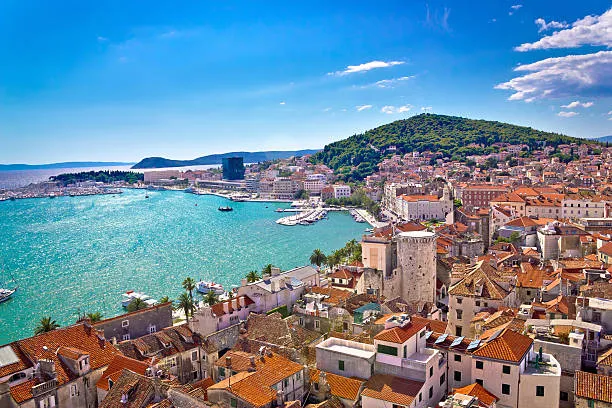
If the goal is lowest lawful host-country tax while living in Europe with a relatively clear remote-worker framework, Croatia comes out first because its digital nomad regime combines a generous temporary-stay route with a specific Croatian tax exemption for qualifying digital nomad income.
That combination is unusually favorable, even though it is often better described as an optimized host-country stay regime than as classic long-term tax residency. Croatia allows temporary stay for digital nomads for up to eighteen months, and Croatia’s tax administration states that residents are ordinarily taxed on worldwide income while the 2021 tax reform specifically introduced an exemption for digital nomad income.
Croatia’s immigration ministry defines a digital nomad as a third-country national who works through communication technology for a company, or their own company, not registered in Croatia and who does not provide services to employers in Croatia.
On the tax side, Croatia’s tax administration states that a resident is taxed on worldwide income, while the 2021 tax reform expressly introduced an exemption for digital nomad income. Ordinary annual income-tax rates are locally determined within a national band, with the official Tax Administration page noting lower annual rates within 15%–23% up to €60,000 and higher annual rates within 25%–33% above €60,000; where no local decision is adopted, the fallback rates are 20% / 30%.
For a U.S. remote professional, Croatia’s special-regime appeal is simple: if the digital-nomad facts are satisfied, the host-country income-tax result can be 0% on qualifying digital nomad income.
If the person instead becomes an ordinary Croatian tax resident outside the digital-nomad exemption, Croatia becomes a standard progressive/wage-tax jurisdiction with local rate variation, so the economics change sharply. That distinction is the core reason Croatia ranks first overall but with an important caveat: it is the best host-country remote-worker tax outcome, not necessarily the best long-run ordinary resident tax system.
Beyond tax advantages, Croatia offers one of the strongest overall lifestyle propositions in Europe for remote professionals. Cities such as Split and Zagreb provide reliable fiber internet, growing coworking communities, relatively affordable living costs compared with Western Europe, and direct access to the Adriatic coast. As both an EU and Schengen member, Croatia also provides convenient travel throughout Europe while maintaining a slower pace of life than many larger European capitals.
Still, the United States does not list Croatia as a current bilateral income-tax treaty partner on the IRS A-to-Z treaty page, and Croatia does not appear in SSA’s list of agreements in force. That means U.S. citizens rely primarily on domestic-law tools such as foreign tax credits and careful residence management rather than a modern bilateral treaty/totalization package. U.S. citizens also still face Form 1040, FBAR, and possibly Form 8938 if they open Croatian accounts.
Bottom line: Croatia is the best pick if you want an EU base and the legal facts fit the digital-nomad exemption. It is less compelling if you intend to settle into ordinary worldwide-tax residency for the long term.
Key advantages include:
- 0% Croatian income tax on qualifying foreign income under the digital nomad regime
- Temporary stay permission for up to 18 months with a clear legal framework designed specifically for remote workers
- Full access to the European Union legal, banking, and financial infrastructure
- Lower living and operational costs compared to most Western European countries
- Ability to legally reside within the EU while maintaining Schengen mobility
- Straightforward pathway to establish an EU company structure if long-term business relocation plans evolve
2. Portugal

Portugal has long been one of Europe’s most popular destinations for remote professionals thanks to its combination of high quality of life, strong digital infrastructure, and established international communities. Cities such as Lisbon, Porto, and Madeira have become well-known hubs for entrepreneurs, freelancers, and location-independent professionals.
Unlike Croatia, however, Portugal’s attractiveness is no longer primarily driven by tax incentives. The country’s former Non-Habitual Resident (NHR) regime made Portugal one of Europe’s most tax-efficient destinations for expatriates for over a decade, but the regime has largely been phased out for new applicants and replaced by a much narrower incentive targeting specific highly qualified professions.
For U.S. citizens, Portugal remains attractive because of its mature expat ecosystem, reliable healthcare, extensive international flight connections, and straightforward residency pathways. Digital nomads can apply for Portugal’s Digital Nomad Visa provided they meet the required income threshold and continue working for employers or clients outside Portugal.
The trade-off is that Portugal generally imposes higher ongoing tax obligations once an individual becomes an ordinary Portuguese tax resident. Worldwide income may become taxable, making professional tax planning particularly important for Americans who remain subject to U.S. tax filing requirements.
Key advantages include:
- Well-established Digital Nomad Visa program
- Large English-speaking international community
- Excellent infrastructure and healthcare
- Strong banking system within the European Union
- Attractive climate and high quality of life
3. Spain
Spain consistently ranks among the best European countries for remote professionals seeking a balance between lifestyle, infrastructure, and long-term residency opportunities. Major cities such as Barcelona, Madrid, Valencia, and Málaga offer world-class transportation, fast internet, and thriving international business communities.
Spain introduced its Digital Nomad Visa under the Startup Act, providing a dedicated legal framework for remote workers employed by foreign companies or operating international businesses. The country also offers the well-known Beckham Law, which may provide favorable tax treatment for certain qualifying individuals relocating for work, although eligibility depends on personal circumstances.
Compared with Croatia, Spain offers a larger economy and broader professional network, making it particularly attractive for entrepreneurs who expect to build long-term commercial relationships within Europe. However, once ordinary Spanish tax residency is established, worldwide income generally becomes subject to Spanish taxation, and overall compliance can become considerably more complex.
Key advantages include:
- Digital Nomad Visa with clear legal framework
- Large international business ecosystem
- Excellent public transportation and healthcare
- Strong startup and technology communities
- High overall quality of life
4. Estonia
Estonia has built a global reputation as one of the world’s most digitally advanced countries. Rather than competing on lifestyle alone, Estonia differentiates itself through its highly efficient digital government, transparent legal framework, and entrepreneur-friendly business environment.
The country’s e-Residency program allows foreign entrepreneurs to establish and manage Estonian companies almost entirely online, making it particularly attractive for SaaS founders, consultants, agencies, and online businesses serving international markets.
While Estonia is not necessarily the lowest-tax jurisdiction for individuals, its corporate tax system remains one of the most competitive in Europe. Retained corporate profits generally remain untaxed until distributed, allowing many business owners to reinvest earnings more efficiently than in traditional corporate tax systems.
For U.S. remote professionals focused on building scalable online businesses, Estonia often represents one of Europe’s strongest operational bases.
Key advantages include:
- World-leading digital government services
- e-Residency for international entrepreneurs
- Transparent legal and regulatory environment
- Efficient company formation and administration
- Strong reputation for technology and innovation
5. Malta
Malta combines European Union membership with an English-speaking business environment, making it an attractive destination for internationally mobile entrepreneurs and professionals. As one of the EU’s major financial and corporate services centers, Malta has developed numerous residence and business structures designed for international investors.
Unlike Croatia, Malta is generally more attractive for higher-income individuals seeking sophisticated international tax planning rather than digital nomads looking for a temporary European base. Its tax system can offer significant advantages depending on residency status, income source, and business structure, although professional advice is essential due to the complexity of the rules.
Malta also benefits from a strategic Mediterranean location, excellent international connectivity, and access to the broader European market. However, the cost of living and property prices have increased substantially in recent years, reducing some of its historical affordability advantages.
Key advantages include:
- English widely spoken in business and government
- Attractive international tax framework for qualifying residents
- Strong financial services sector
- Full access to the European Union
- Excellent international connectivity
Understanding Tax Residency
Choosing the right country is only one part of international relocation. Equally important is understanding tax residency, as it determines which country has the legal right to tax your income.
Many U.S. remote professionals mistakenly assume that relocating abroad automatically reduces or eliminates their tax obligations. In reality, moving to another country may create tax obligations in both the United States and your new country of residence.
Most European countries determine tax residency based on factors such as the amount of time you spend in the country, where your permanent home is located, and where your personal and economic ties are centered. Once you become a tax resident, you may be subject to taxation on your worldwide income unless a specific exemption or special tax regime applies.
For U.S. citizens, the situation is even more complex because the United States taxes its citizens based on citizenship rather than residency. This means Americans generally remain required to file U.S. tax returns regardless of where they live, although mechanisms such as the Foreign Earned Income Exclusion, Foreign Tax Credit, and applicable tax treaties may help reduce double taxation.
This distinction explains why a country with relatively higher headline tax rates can sometimes produce a better overall outcome than a country advertising low taxes. The interaction between local tax law, U.S. tax rules, residency status, and the structure of your income often has a greater impact than the published tax rate alone.
For that reason, before relocating, remote professionals should evaluate not only visa options and quality of life but also how each country’s tax residency rules interact with their existing U.S. tax obligations. Proper planning before establishing residency is generally far more effective than attempting to restructure your affairs after becoming a tax resident.
How to Establish Your Tax Residency Abroad
Establishing tax residency abroad requires careful planning and execution. Following these steps can help you navigate the process effectively.
- Initial Planning and Thorough Research: Begin by thoroughly understanding the tax laws of your chosen country and how they interact with US laws. This initial research is critical for informed decision-making.
- Severing Ties with the US: Taking practical steps to sever ties with the US helps demonstrate a closer connection to your new country. This includes changing your official address, closing US bank accounts, and updating your driver’s license.
- Formalizing Residency in the New Country: This involves navigating administrative processes and gathering necessary documents. You must understand the minimum stay requirements to become a tax resident in your chosen country.
- Seeking Professional International Tax Advice: International tax law is complex, and expert guidance is crucial to avoid pitfalls. Mandracchio Capital can assist by providing tailored legal and tax advisory services for individuals relocating to Croatia.
Thinking about relocating to Croatia?
If you’re considering Croatia as your European base, Mandracchio Capital assists U.S. remote professionals with Digital Nomad Residence Permit applications, business formation, and long-term relocation planning. Our team can help determine the most suitable residency route based on your goals and circumstances.
Common Questions
Many US remote professionals have questions about managing their taxes and establishing tax residency abroad. Here are some common inquiries.
Do I have to give up my US citizenship to avoid US taxes?
No, you do not have to give up your US citizenship to reduce your US tax burden. Strategies like the Foreign Earned Income Exclusion and Foreign Tax Credits allow you to lower your US tax liability while retaining your citizenship.
What are the risks of not properly establishing tax residency abroad?
You could face significant penalties, double taxation on your income, and complex legal complications in both the US and your host country if you do not properly establish tax residency abroad.
Can a Digital Nomad Visa automatically make me a tax resident?
Not always. A Digital Nomad Visa grants you legal stay in a country, but tax residency depends on specific national tax laws and your duration of stay. It does not automatically confer tax resident status or tax exemptions.
How does my tax home differ from my physical residence?
Your tax home is primarily your main place of business or employment, which can be in a foreign country for US expats. Your physical residence is simply where you live.
How often should I review my international tax strategy?
It is advisable to review your international tax strategy annually. Tax laws and your personal circumstances can change, making regular reviews essential to ensure continued tax efficiency.
Final Thoughts and Recommendations
Navigating international tax laws as a US remote professional requires careful planning and adherence to regulations. Embracing tax efficiency can significantly enhance your financial well-being while living abroad.
- The Importance of Compliance and Professional Guidance: Consulting with experienced international tax professionals is highly recommended to ensure compliance and avoid potential pitfalls.
- Embracing Tax Efficiency as a Remote Professional: Strategic tax planning is a powerful tool to optimize your financial situation while enjoying an expat lifestyle.
- Considering Croatia for Your Tax Residency: Croatia offers a unique blend of attractive lifestyle, clear residency pathways, and favorable tax considerations for US remote professionals, making it a compelling option for those seeking to move abroad to save on taxes US citizen.