To obtain Long-Term Residence (Dugotrajno boravište) or Permanent Stay (Stalni boravak) in Croatia, non-EU nationals must complete five years of continuous legal residence under a valid temporary residence permit. During this period, absences must remain within legal limits, and applicants must demonstrate financial stability, health insurance, accommodation, and basic Croatian language knowledge.
Applications are submitted to the Ministry of the Interior (MUP), with processing typically taking 6 to 18 months.
Hi, I’m Šime Jozipović, a Croatian lawyer based in Split and founder of Mandracchio Capital. I hold a Master of Laws (LL.M.) from Harvard Law School and a doctorate in international tax planning, and for more than a decade I’ve advised foreign individuals, founders, and families on Croatia residency, company structuring, and EU citizenship pathways.
I will explain exactly how permanent residency in Croatia works for both EU/EEA citizens and non-EU (third-country) nationals, how to qualify, the documents you need, and the step-by-step process to secure permanent residency in Croatia based on the actual procedure guided by the Croatian Ministry of the Interior (MUP).
Croatia Permanent Residence — Core Legal Conditions
- Five-Year Residence: You must have lived continuously in Croatia for five years under a valid temporary residence permit.
- Financial & Housing Proof: You must show sufficient financial means and secured accommodation in Croatia.
- Language Requirement: Applicants must demonstrate knowledge of the Croatian language and Latin script.
- Clean Criminal Record: Serious criminal history can disqualify an application.
- Genuine Intention: You must prove a real intention to settle in Croatia long term.
- Formal Procedure: The process involves submitting a formal application with documents and usually attending an interview at the Ministry of the Interior (MUP).
How get Permanent Residency in Croatia
In short: To apply for permanent residency in Croatia, a foreign national must complete 5 years of continuous qualifying residence and submit Form 1a in person at the local Ministry of the Interior (MUP) police administration with supporting documents.
Permanent residence is regulated under the Croatian Aliens Act and administered by the Ministry of the Interior (MUP), which evaluates residence continuity, permit eligibility, and integration requirements. Permanent residency in Croatia gives foreign nationals the right to live and work in Croatia indefinitely without annual renewals. It is also the final legal step before eligibility for Croatian citizenship.
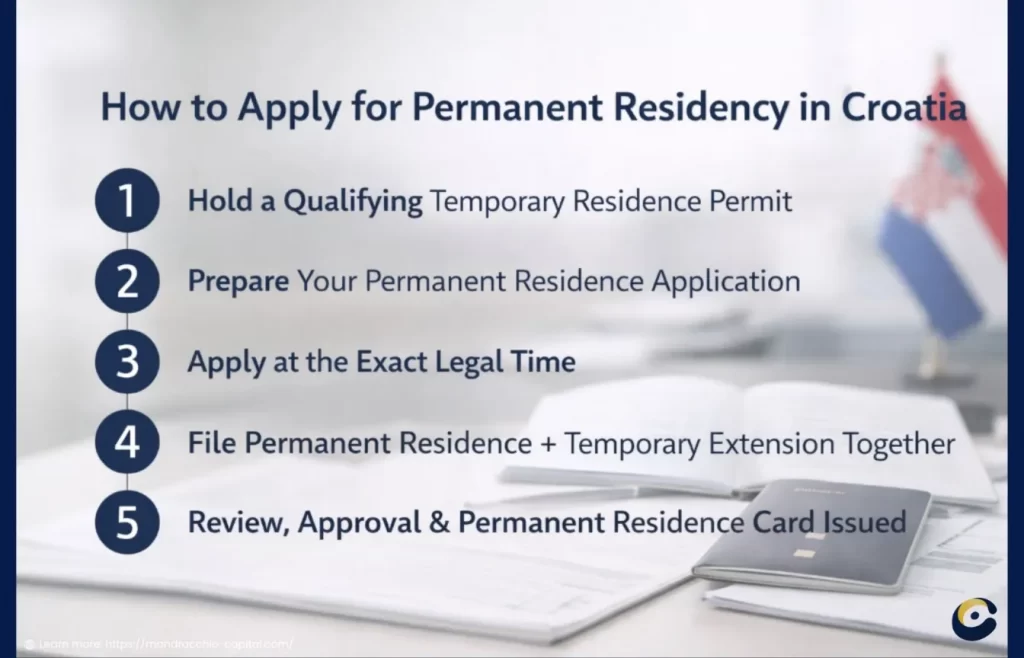
To get permanent residency in Croatia, non-EU nationals must first hold a valid temporary residence permit and meet several legal requirements over time.
Here is the step-by-step process:
1. Complete 5 Years of Continuous Temporary Residence
You must legally reside in Croatia for at least five consecutive years under a valid temporary residence permit (such as work, digital nomad, family reunification, or business).
During this period:
- Total absences must not exceed 10 months
- A single absence cannot exceed 6 consecutive months
This five-year period:
- Starts from the issue date of your first qualifying residence permit
- Does not start from your arrival date
- Does not include tourist or visa-free stays
If your permit type in year one was wrong, permanent residency in Croatia may never arise, even after many years in the country.
2. Maintain Legal Status and Compliance
Throughout the 5-year period, you must:
- Keep your residence permit valid at all times
- Maintain a registered address in Croatia
- Comply with Croatian immigration and tax regulations
3. Prepare Required Documents
Before applying, you will need to gather:
- Valid passport
- Proof of accommodation (registered address or lease/ownership)
- Proof of sufficient financial means
- Health insurance coverage
- Criminal background check from your home country
4. Pass the Croatian Language Requirement
Most applicants must demonstrate basic knowledge of the Croatian language and Latin script (typically at A2–B1 level).
Exemptions may apply for:
- Applicants over a certain age
- Individuals who completed education in Croatia
5. Submit Application at MUP
Applications are submitted using Form 1a at your local police administration office (Ministry of the Interior).
Authorities will review:
- Your continuous residence history
- Your financial and legal status
- Your intent to reside in Croatia long-term
6. Wait for Approval
Processing times vary, but typically take 6 to 18 months.
During this time, you must continue to hold a valid temporary residence permit.
7. Receive Permanent Residence Card
Once approved, you will:
- Pay administrative fees
- Provide biometric data (fingerprints)
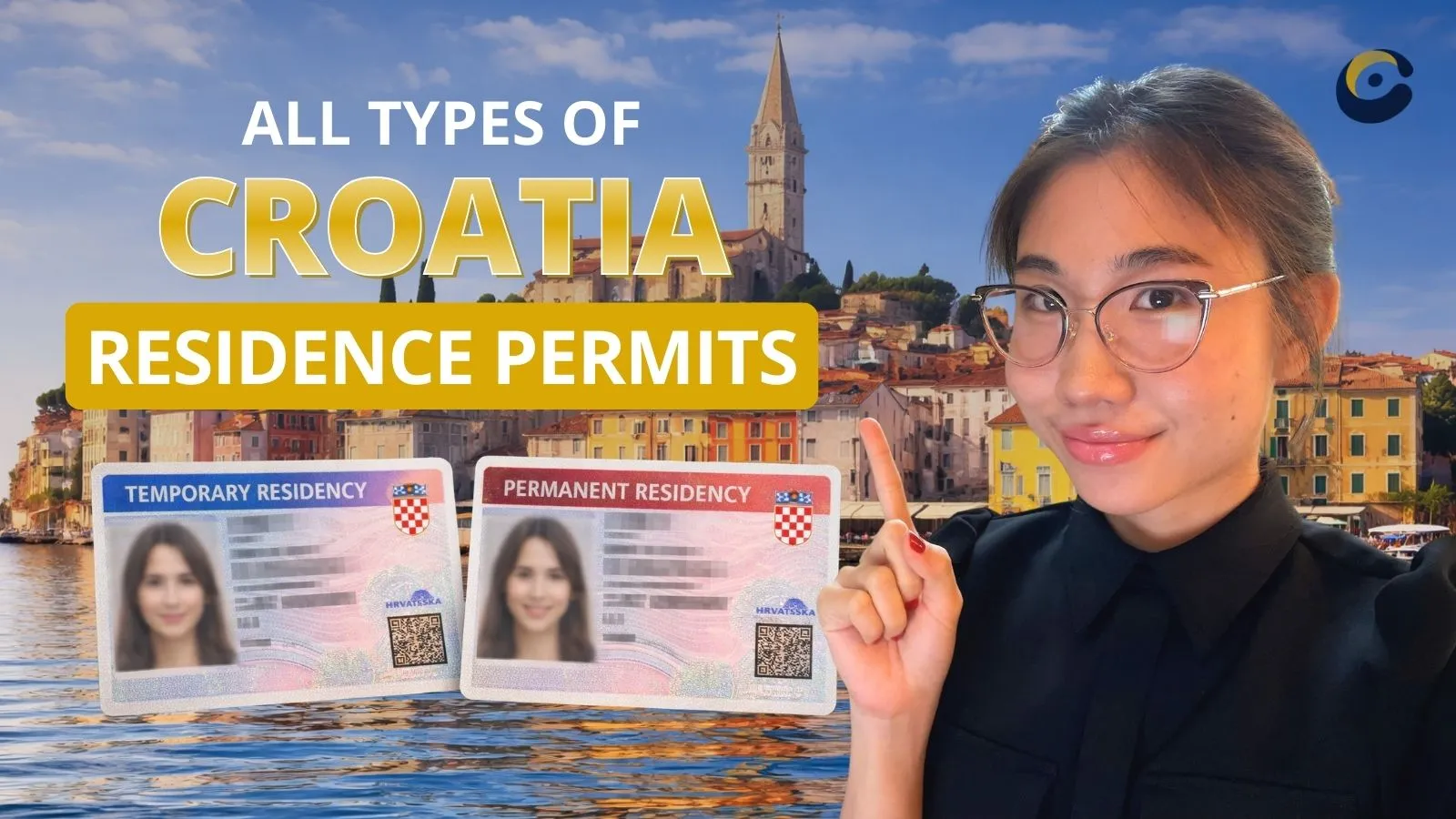
- Receive your permanent residence ID card
Requirements for Permanent Residency in Croatia
To qualify, you must meet the following conditions:
- 5 years of continuous legal residence
- Absences not exceeding 10 months total or 6 months consecutively
- Proof of financial stability and accommodation
- Valid health insurance
- Basic knowledge of the Croatian language
These requirements are assessed by the Ministry of the Interior (MUP) at the time of application.
Some requirements, such as the Croatian language test, are offered only once per month, making advance preparation essential. For a detailed, step-by-step breakdown, see our Croatia permanent residence requirements checklist.
How to apply for Permanent Residency in Croatia for non-EU citizen
This applies to citizens of the US, UK, Canada, Australia, Asia, and most of the world. Once you meet the requirements, you can apply as follows:
Step 1 — Prepare Documents Before Year Five Ends
About two months before your fifth year completes, you must contact your local MUP office. They will:
- Confirm whether your residence periods qualify
- Identify nationality-specific requirements
- Tell you if you must pass the Croatian language & culture exam
Documents for permanent residency in Croatia typically include:
- Passport and biometric photo
- Proof of continuous residence
- Proof of financial means
- Proof of accommodation
- Health insurance
- Criminal record certificate
- Language certificate (if required)
Language testing is done by accredited universities:
Zagreb, Split, Rijeka, Zadar, Osijek, and Pula.
Step 2 — Apply for permanent residency in Croatia the day after your temporary residence permit expires
Not earlier. Not later.
Applying even one day late can result in:
- Loss of legal residence
- Forced status change
- Requirement to leave Croatia
Dual Filing (Form 1a + Extension): On the filing date, two applications are submitted:
- Permanent Residence (Form 1a)
- Temporary Extension (Bridging Permit)
Step 3 — Review & Approval
MUP conducts:
- Background checks
- Residence verification
- Possible interviews
Once approved, you receive a biometric permanent residence card and no longer need annual renewals.
“I’m living in Zagreb with my family, these are the specific Zagreb rules you must follow for filing permanent residence:
- On page 2 of Form 1a, under ‘Purpose of Stay’, you must clearly select Family Reunification. Because you are reuniting with a Croatian citizen (your spouse), the MUP office in Petrinjska applies the four-year rule instead of five.
- On the day I submit Form 1a, I also file an application for a temporary residence extension (bridging permit)
- With 4 children, MUP Zagreb will require proof that my home meets “adequate housing” standards. I ready to provide your lease agreement (Ugovor o najmu)/ property title (Vlasnički list).”
Apply Permanent Residency in Croatia for EU / EEA Citizens
EU/EEA citizens obtain permanent residency in Croatia under EU free-movement law, not the Croatian Aliens Act. After completing five years of continuous legal residence, the right to permanent residence arises automatically but it must still be registered with the police (MUP).
Step 1 — Apply for the EU Permanent Residence Card (Form 3b)
You submit Form 3b at your local police administration (MUP), together with:
- Passport or EU ID card
- Proof of five years of residence (registrations, address records, etc.)
- Photograph and fingerprints
This converts your EU temporary residence into permanent residency in Croatia.
Step 2 — MUP Verification
MUP verifies:
- That you were legally registered for five years
- That your identity is valid
They do not assess income, health insurance, language, or criminal records.
Step 3 — Receive Your Permanent Residence Card
Once approved, you receive an EU permanent residence card.
Your status becomes unlimited, and you no longer have to renew or prove financial means.
Who Qualifies for Long-Term Residence or Permanent Residence in Croatia?
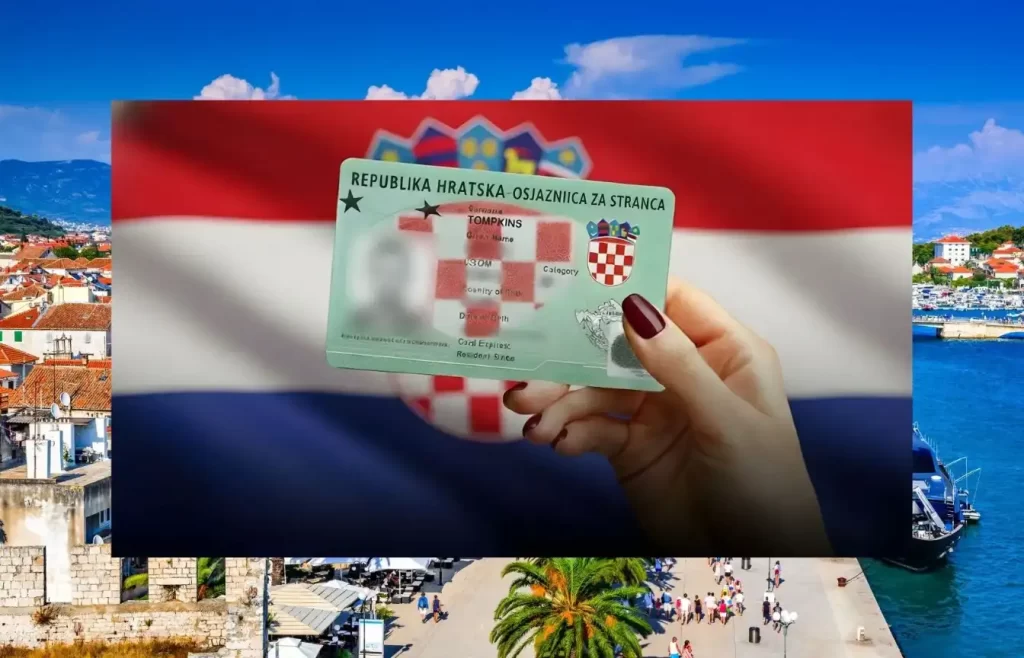
In short: Croatia permanent (long-term) residence generally requires five years of continuous legal stay for third-country nationals, holding valid temporary residence (like work, family, study permits) and proving financial means, accommodation, and basic Croatian language skills (A1 level), with exceptions for EU citizens and specific family members of Croatians.
Key criteria include uninterrupted residency with limited absences (max 10 months total, 6 months continuous over 5 years) and no serious criminal record.
1. Spouses & Life Partners of Croatian Citizens
If you are married to or in a registered partnership with a Croatian citizen, you qualify faster.
You may apply for permanent residence after:
- 4 years of continuous temporary residence
- Based on family reunification
This is Croatia’s fast-track route, but it still requires lawful residence, renewals, and compliance during those four years.
2. Most Expats, Workers & Business Owners
This is the standard path used by:
- Company directors
- Employees
- Self-employed persons
- Most long-term residents
Important:
- Digital Nomad and Student permits often do not fully count
- Some count only 50%, others not at all toward the five-year requirement
This is why residence category selection at the beginning is critical.
3. Ethnic Croatians (Heritage Route)
If you are of Croatian descent, you may qualify faster. You may apply after:
- 3 years of residence in Croatia
- With proof from the Central State Office for Croats Abroad
This pathway is separate from standard expat routes and is based on national affiliation.
4) Minor Children
A child may qualify independently if:
- The child has lived in Croatia for at least 3 years, and
- At least one parent already holds Croatian citizenship or permanent residence
Who Can Apply Earlier?
- Spouses of Croatian citizens
- Individuals of Croatian origin
- Certain protected categories
Residence Periods That Do Not Count Toward Permanent Residence
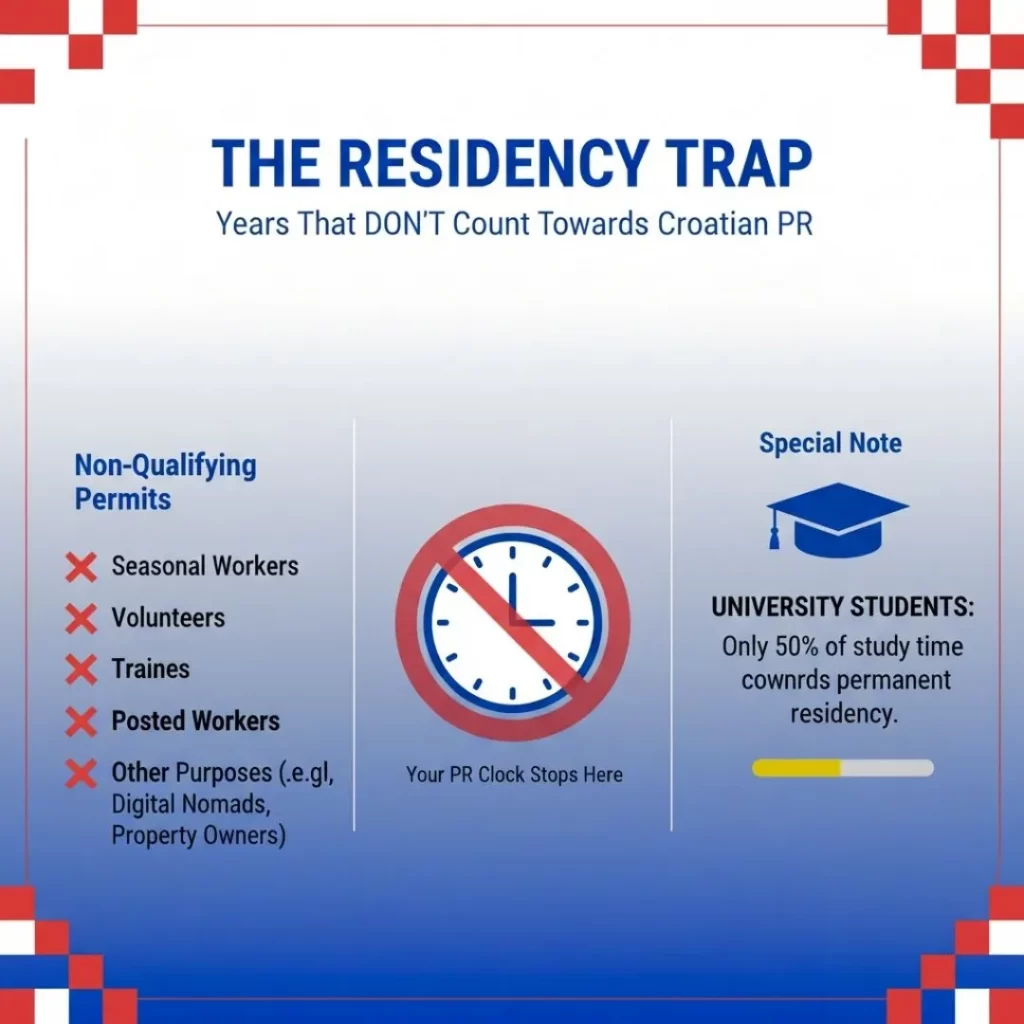
This is where many expats lose years unintentionally and it’s one of the most common reasons people misunderstand how to get permanent residency in Croatia.
The following periods do NOT count toward the 5-year requirement:
• seasonal worker permits
• service provider permits
• posted workers
• volunteers
• trainees
• intra-corporate transferees and their families
• frontier workers
• secondary school education
• “other purposes” permits
• time spent in prison
For university students, only half of the study period counts.
For asylum holders, only part of the pre-approval period may count, depending on duration.
This is why permit type selection from year one is critical if your goal is Croatia permanent residence.
Temporary to Permanent Residence Pathway in Croatia
For non-EU/EEA nationals, the pathway from temporary to permanent residence in Croatia is based on five years of continuous and legal stay in the country. During this period, applicants must maintain a valid temporary residence permit, limit long absences, and demonstrate stable financial means, health insurance, and a registered address.
After meeting the time requirement, applicants must also show basic knowledge of the Croatian language and Latin script, unless exempt, and confirm they do not pose any risk to public order or security.
The application is submitted at the local police administration (MUP), and once approved, then the applicant receives a permanent residence card valid for 10 years.
From Long-Term Residence to Citizenship
After obtaining long-term residence, you may later apply for citizenship.
Standard timeline:
• 5 years → long-term residence
• 8 years total residence → citizenship eligibility
Citizenship requires:
• Croatian language proficiency
• cultural integration
• continuous lawful residence
Why Legal Structuring Matters Early
Many expats lose years of eligibility because they:
- relied on property ownership alone
- held the wrong residence permit type
- misunderstood renewal or bridging rules
- failed to register or transition permits correctly
Croatia permanent residence is not difficult, but it is procedural. The system rewards accuracy, not assumptions.
Practical Note From Our Cases
In practice, most rejections do not happen because of income or documents, but because the residence type in earlier years did not legally qualify toward permanent residence. We regularly see applicants who lived in Croatia for 6–8 years but cannot apply because their first permits were issued under “other purposes”.
MUP evaluates residence history, not physical presence alone.
At Mandracchio Capital, we support expats, entrepreneurs, digital nomads, retirees, and investors navigating the legal side of living and doing business in Croatia. Our work focuses on:
- Residence permits and long-term stay structuring
- Business formation and director residence
- Family reunification applications
- Permanent residency and long-term EU status
- Cross-border compliance and relocation planning
Our guidance is based on direct interaction with Croatian administrative authorities, including the Ministry of the Interior (MUP), and practical case handling, not forum discussions or informal interpretations.
We work with non-EU nationals relocating to Croatia for retirement, remote work, investment, or business expansion.
What about Residency by Investment in Croatia
You’ll often see phrases like Croatia permanent residency by investment online. These terms are not legal categories in Croatian law. Croatia does not operate a formal investor visa or Golden Visa program.
What exists instead is an indirect structure: Investment → qualifying temporary residence → long-term residence → citizenship (optional).
We explain this clearly in our separate article: Croatia Golden Visa Program – What Exists and What Doesn’t
Business Investment: The Only Investment Route That Counts
If you are an entrepreneur or investor, business-based residence is the only investment-related path that can lead to Croatia permanent residence by investment. This pathway is explained in detail in our Starting a Business in Croatia 2026 Investor Handbook for EU and non-EU Entrepreneurs, which focuses on structuring a company not just to operate, but to qualify as a residence basis that counts toward permanent residence.
Typically, this involves:
• company formation in Croatia (most commonly a d.o.o.)
• acting as director or active owner
• employing Croatian staff
• meeting salary, tax, and operational requirements
Read more: Croatia Tax System Explained for Residents and Foreigners
This is why founders and serious expats choose business structures when planning long-term relocation.
Can Buying Property Lead to Permanent Residency in Croatia?
Short answer: no. Property ownership may support a temporary residence application, but it does not lead to Croatia permanent residence. In most cases:
• the permit is limited in duration
• renewal may be restricted
• employment is not allowed
• time spent under this permit does not count toward permanent residency
This route works for:
• second-home owners
• retirees
• lifestyle stays
It does not work if your goal is permanent residency Croatia recognizes.
Exceptions for EU/EEA Citizens (Faster or Alternative Pathways)
While EU/EEA citizens generally qualify for permanent residence in Croatia after five years of continuous legal stay, certain situations allow for earlier eligibility or alternative conditions.
These exceptions apply mainly to specific family, employment, and social protection cases.
Family-Based Exceptions
EU/EEA citizens may qualify sooner if:
- A child resides in Croatia and one parent already holds long-term residence at the time of the child’s birth
- A child resides in Croatia and the second parent is unknown, deceased, legally incapacitated, or deprived of parental rights
Employment & Retirement-Based Exceptions
Certain workers and self-employed individuals may qualify earlier if they stop working under specific conditions:
- You have reached retirement age (or taken early retirement), after at least 12 months of employment and 3 years of residence in Croatia
- You have stopped working due to long-term incapacity, after at least 2 years of continuous residence
- You have become unable to work due to a work-related injury or occupational disease, and receive a disability pension in Croatia (no minimum residence period required)
Cross-Border Workers (EU Mobility Case)
You may still qualify if:
- You work in another EU/EEA country, but
- Previously worked and lived in Croatia for at least 3 continuous years, and
- Continue to maintain residence in Croatia and return regularly (daily or at least weekly)
3 Benefits of Permanent Residence in Croatia
Many people ask: “How is PR better than temporary residence?”
The answer: stability + broader rights + less administrative risk.
1) No more annual permit renewals
Once approved, long-term residence/permanent residence is unlimited, and you stop living on a renewal calendar.
2) Easier life planning (work, change jobs, relocate within Croatia)
Long-term residence gives you durable legal footing in Croatia, which makes it easier to plan employment, housing, and long-term commitments without constant permit uncertainty.
3) EU long-term resident status and mobility options (not “free movement”)
Croatia’s long-term residence framework is aligned with the EU long-term resident concept and can support future mobility within the EU subject to conditions in the destination country (it’s not the same as an EU passport).
FAQ – Permanent Residency in Croatia
How to get permanent residency in Croatia?
To obtain permanent residency, you must:
- Apply at the local MUP office using Form 1a
- Hold a qualifying temporary residence permit
- Complete 5 years of continuous legal residence
- Meet requirements for income, housing, and language
How long do I need to live in Croatia to get permanent residency?
Five continuous years of qualifying legal residence.
How long does permanent residence take for spouses of Croatian citizens?
Spouses of Croatian citizens may apply after 4 years of continuous temporary residence under family reunification.
Processing typically takes 3 to 12 months, depending on the case and MUP workload.
How long does it take to get permanent residency in Croatia?
Permanent residency in Croatia typically requires:
- 5 years of legal residence, and
- An additional 6 to 24 months for processing, depending on the case
What are the main conditions for obtaining permanent residence in Croatia?
To qualify, you must:
- Have no serious criminal record
- Complete 5 years of continuous legal residence (or 4 years for spouses)
- Prove sufficient income and accommodation
- Hold valid health insurance
- Demonstrate basic Croatian language knowledge
Does time as a tourist count toward permanent residency in Croatia?
No. Tourist and visa-free stays never count.
Can digital nomads get permanent residency in Croatia?
Not directly. Digital nomad permits do not count unless you change to a qualifying residence type.
Do EU citizens need to pass a language test?
No. Only non-EU applicants must pass the language and culture exam.
Is Croatia permanent residence the same as permanent stay?
No. These are two different legal statuses under Croatian law.
Most expats qualify for long-term residence, while permanent stay (Stalni boravak) applies to limited family or humanitarian situations.
Can I get Croatia permanent residence by investment (Croatia residency by investment)?
There is no direct permanent residence by investment program in Croatia. However, setting up a business or company can lead to permanent residence over time if all legal requirements are met.
Does buying property in Croatia lead to permanent residence?
No. Property ownership can support temporary residence, but it does not count toward permanent residence.
This route is suitable for lifestyle stays, not immigration planning.
What documents are required for Croatia permanent residence?
You’ll typically need a valid passport, proof of income, health insurance, language certification, and evidence of lawful residence. Authorities also assess your criminal record and whether you pose any risk to public order or security.
Do I need to speak Croatian to get permanent residence?
Yes. Knowledge of the Croatian language and Latin script is required for long-term residence.
Some applicants are exempt, but most expats must pass an official language test.
Can I work in Croatia with permanent residence?
Yes. Permanent residents have full access to employment and self-employment without needing a work permit.
This is one of the key benefits compared to temporary residence.
Does permanent residence lead to Croatian citizenship?
Yes, but only over time.
After holding permanent residence and completing eight years of total lawful residence, you may apply for citizenship if language and integration criteria are met.
Why do expats work with a lawyer or law firm in Croatia?
Because the rules are technical and time-based, mistakes in permit selection or renewals can reset the five-year eligibility period.
Me, my wife, and our children are family members of a Croatian citizen. Are we eligible to apply for permanent residency (Stalni Boravak)?
Yes, Croatia has a special rule allowing certain family members of Croatian citizens to apply for permanent residence sooner than the standard five-year rule that applies to most other foreigners. Permanent residence may be granted after 4 years of continuous temporary residence granted for the purpose of family reunification or life partnership with a Croatian citizen (for example, spouses, children, and other qualifying close family members). To qualify, you must meet the following conditions:: Continuous Temporary Stay, Valid Status, and Clean Record and Security.
Can I lose permanent residence in Croatia?
Permanent residence may be revoked if you leave Croatia for an extended period or pose a risk to public security or public order.
How long can I stay outside Croatia without losing eligibility?
To maintain eligibility for permanent residency, your absences from Croatia must not exceed:
- 10 months in total over the 5-year period, and
- 6 consecutive months for any single absence
Exceeding these limits may break the continuity of residence and reset your eligibility period.
Can I apply for permanent residency in Croatia from outside the country?
No. Permanent residency applications must be submitted in person in Croatia at the local police administration (MUP).
You must hold a valid temporary residence permit at the time of application, which generally requires you to be physically present in Croatia.
Legal Disclaimer: This article explains the administrative procedure based on current Croatian immigration regulations. Individual cases may vary depending on nationality and residence history. Always confirm requirements with the competent MUP police administration before filing.