If you are considering moving, working, or settling in Croatia, one of the first challenges you will face is understanding how Croatian immigration law actually works in practice. While the country offers attractive lifestyle and business opportunities, the legal framework governing visas, residence permits, and long-term stay can be complex and often unclear from official sources alone.
My name is Šime Jozipović, and as a Croatian lawyer and founder of Mandracchio Capital, I have spent more than a decade advising international clients on immigration, residence permits, and relocation within Croatia and the European Union.
Through this experience, I have seen where foreign applicants most often encounter confusion, particularly when interpreting legal requirements, preparing documentation, and navigating administrative procedures.
This guide is structured as a practical, Q&A-style overview of Croatia immigration laws in 2025–2026, covering:
- the main visa and residence permit options
- the application process and required documents
- typical costs, timelines, and administrative steps
- common mistakes and how to avoid delays
My goal is to provide clear, legally grounded, and practical guidance so you can approach your move to Croatia with confidence and avoid unnecessary complications.
Is there a Croatia relocation program for foreigners?
There is no single official “Croatia relocation program.”
Instead, relocation happens through different residence permit pathways, depending on your situation:
- employment
- business or company ownership
- digital nomad status
- family reunification
- study
Understanding which pathway applies to you is the most important step in planning your move.
What are Croatian Immigration Laws?
Croatian immigration laws are the legal framework that regulates the conditions for foreign nationals, especially non-EU/EEA/Swiss citizens, to legally enter, reside, and work in the Republic of Croatia. This legal framework is governed by Croatian national law and European Union (EU) regulations, relating to residence permits, work permits, and visa requirements.
Types of Croatian Residence Permits
There are four main types of residence permits in Croatia that foreigners need to know to determine the path suitable for them.
1. Short-term stay: The Schengen 90/180 day rule
Short-term stay allows non-EU/EEA citizens to remain in Croatia for a maximum of 90 days within any 180-day period in the Schengen area. This Schengen 90/180 day rule applies to the entire Schengen area, meaning that time spent in other Schengen countries is also counted toward this 90-day limit.
2. Temporary residence (privremeni boravak)
Temporary residence is a permit for those who want to stay in Croatia for more than 90 days but less than 5 years. This is the most common type of permit for purposes such as working, studying, family reunification, or being a digital nomad Croatia.
3. Permanent residence (stalni boravak)
Permanent residence is granted to those who have legally resided continuously in Croatia for a long period, usually 5 years or more. This is an important step on the path to Croatian citizenship.
4. Long-term residence
Long-term residence is similar to permanent residence, granted to third-country nationals who have legally resided continuously for 5 years in Croatia. This type provides many rights equivalent to EU citizens in certain areas.
Why do you need to thoroughly understand Croatian immigration laws?
Thoroughly understanding croatia immigration laws is extremely necessary to ensure your immigration journey goes smoothly and successfully.
Understand immigration pathways suitable for yourself
Understanding the law helps you identify the most suitable immigration pathways Croatia for your qualifications, purposes, and personal circumstances. This includes choosing the right Croatian visa types or Croatian residence permits.
Avoid mistakes in the process and save time and costs
Mastering the requirements and processes helps you prepare complete and accurate documents, avoiding unnecessary mistakes. This significantly saves processing time and costs arising from having to supplement or resubmit documents.
Ensure rights and obligations when living in Croatia
When you clearly understand immigration laws, you will know your rights and obligations when living in Croatia, from the right to work, study, access healthcare services to tax regulations and social integration.
Croatian Immigration Policy: Key Trends and Government Strategy
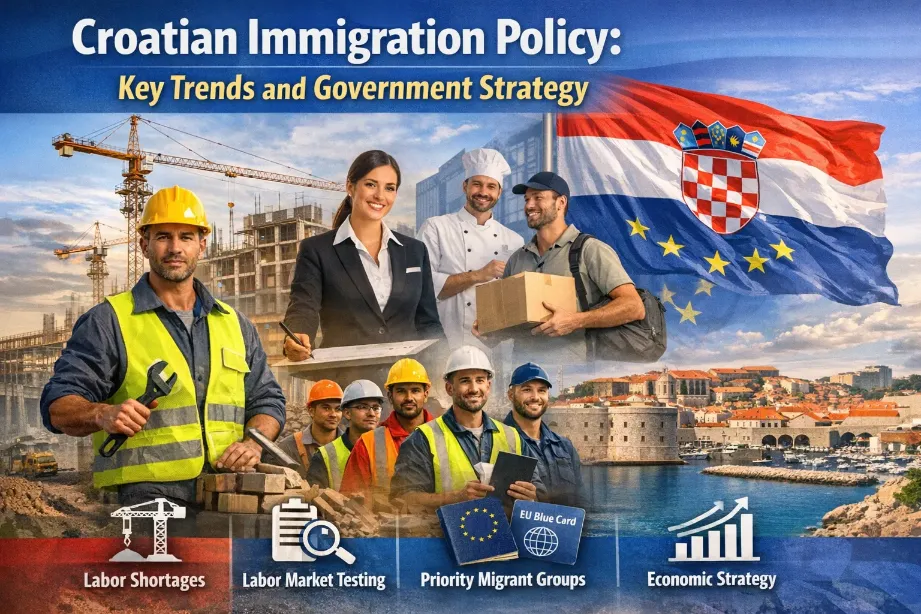
Croatia’s immigration policy has undergone significant changes in recent years, largely driven by labor shortages, demographic decline, and economic restructuring.
Labor shortages and economic demand
Croatia is currently facing a growing shortage of workers, particularly in sectors such as construction, tourism, hospitality, and transportation. This shortage has intensified due to emigration of local workers to other EU countries and an aging population.
As a result, the government has increasingly relied on foreign workers to fill critical gaps in the labor market.
Shift from quota system to labor market testing
Previously, Croatia operated under a quota-based immigration system that limited the number of foreign workers allowed each year. This system has now been replaced by a more flexible labor market testing model.
Under this system:
- Employers must demonstrate that no suitable local or EU candidate is available
- If the position cannot be filled domestically, hiring foreign workers becomes easier and faster
This shift reflects a more demand-driven immigration strategy aligned with EU standards.
Priority groups in Croatian immigration policy
Croatia’s current immigration policy prioritizes specific categories of migrants:
- EU/EEA citizens: Free movement rights with minimal restrictions
- Workers in shortage occupations: Faster permit processing and fewer barriers
- Highly qualified professionals (EU Blue Card holders)
- Digital nomads: Encouraged through special residence permits and tax incentives
These priorities aim to balance economic needs with regulatory control.
Government objectives and long-term strategy
At a strategic level, Croatian immigration policy is designed to:
- Support economic growth by addressing labor shortages
- Stabilize population decline and demographic challenges
- Attract international talent and remote workers
- Align with broader European Union migration frameworks
Overall, Croatia is gradually transitioning from a restrictive system to a more open, economically driven immigration model.
Immigration Pathways to Croatia for Non-EU Citizens
Croatia offers various immigration pathways for non-EU citizens, each with its own conditions and benefits. Check out our detailed guide: How to Immigrate to Croatia: The Ultimate Guide for Expats
Stay and Work Permit
The employer in Croatia must apply for a work permit on behalf of the foreign worker. In most cases, the employer must request the Croatian Employment Service (HZZ) to conduct a labor market test to prove that no Croatian or EU/EEA citizen is qualified for that position.
Digital Nomad Visa Croatia: Remote work in Europe
The Digital Nomad Visa Croatia is an attractive option for remote workers who want to experience expat life in Croatia. The purpose of this visa is to attract non-EU/EEA citizens working remotely for companies or clients outside Croatia. The outstanding benefit is tax exemption on all foreign-sourced income.
Family Reunification Visa
The family reunification visa helps family members live together in Croatia. Eligible applicants include spouses, minor children, and sometimes dependent parents of Croatian citizens or foreigners with valid residence permits in Croatia. The sponsor must have sufficient financial means to support family members, have valid accommodation, and have stable legal status in Croatia.
EU Blue Card Croatia: Opportunity for highly qualified workers
The purpose of the EU Blue Card is to attract highly qualified third-country nationals. Application conditions include having a valid employment contract for at least one year with a company registered in Croatia, proof of higher education qualifications (university degree or equivalent), and minimum salary must be higher than 1.5 times the average annual gross salary in Croatia.
Study Residence Permit
The study residence permit is for international students. Registration conditions include being admitted to a recognized university or school in Croatia, proving sufficient means of subsistence, and having valid health insurance.
Residency by Investment
The Croatia residency by investment program is an option for investors. Conditions include establishing a company with minimum registered capital of €27,000.
Additionally, investors need to hire at least three full-time Croatian citizens and pay themselves a salary 1.5 times the national average.
Croatia Visa Requirements for Short-Term and Long-Term Stay
Visa requirements vary depending on your nationality, purpose of stay, and duration:
- Short-term stays (tourism/business):
Many nationalities (including US, UK, Canada, and Australia) can enter Croatia visa-free for up to 90 days within a 180-day period under Schengen rules - Long-term stays (work, study, family reunification):
A visa or temporary residence permit is required before staying longer than 90 days - Non-EU/EEA citizens:
Must meet requirements such as valid passport, proof of funds, health insurance, and purpose of stay
For a detailed breakdown of eligibility, visa-free countries, and application steps, see our full guide: Do I need a visa to enter Croatia?
Application Process and General Requirements
To succeed in immigrating to Croatia, understanding the application process and general requirements is very important.
Mandatory personal documents
Valid passport (at least 3 months beyond stay), passport photos, and a legalized/translated criminal record.
Proof of residence purpose
Employment contract, admission letter, or marriage certificate, depending on your visa type.
Financial proof & health insurance
Bank statements or payslips, plus valid Croatian health insurance.
Temporary residence permit documents
Passport, photos, accommodation proof, financial proof, insurance, criminal record, and purpose of stay.
Want a step-by-step breakdown (with common mistakes to avoid)? Read the full guide: Croatia residence permits: Process and Requirement
Where to submit applications and step-by-step process
The application process may differ depending on whether you are inside or outside Croatia.
Alternatively, if a visa is not required for your entry into Croatia (e.g., for citizens of certain countries who can enter visa-free for short stays), applications can be submitted directly within Croatia.
In such cases, you would apply at the local police administration or police station (MUP) corresponding to your intended place of residence. It is crucial to confirm the specific requirements based on your nationality and entry status.
Read the full guide: Application Process for Temporary Residence Permits
Permanent Residence and Croatian Citizenship: The Long-term Journey
For those who want to commit long-term to Croatia, understanding permanent residence and citizenship is necessary.
Conditions and Process for Permanent Residency
Croatia permanent residence is an important step to integrate deeper into Croatian society.
Continuous legal residence requirement (5 years)
You need to legally reside continuously in Croatia for 5 years with a temporary residence permit to be eligible for permanent residence.
Requirements for income, accommodation, health insurance
Other requirements include proving stable income or financial means, having valid accommodation, and health insurance.
Basic knowledge of Croatian language and culture
Having basic knowledge of Croatian language and culture is also an important requirement for permanent residence.
Croatia permanent residency requirements
Croatia permanent residency requirements include residence period, financial capacity, accommodation, health insurance, and knowledge of language and culture.
Pathways to Croatian Citizenship
There are multiple pathways to get Croatian citizenship, depending on personal circumstances. For example:
Naturalization: Conditions and residence period (8 years)
Naturalization is the most common pathway, requiring continuous legal residence in Croatia for a total of 8 years (5 years temporary residence + 3 years permanent residence).
Citizenship through marriage or ancestry (Croatian diaspora)
You can also obtain citizenship through marriage to a Croatian citizen or through ancestry, especially if you belong to the Croatian diaspora.
Croatia Diaspora Return Incentives
If you have Croatian roots, you may benefit from special return programs designed to attract the diaspora back to Croatia.
These incentives can include simplified administrative procedures, potential tax benefits, and support for integration into the local labor market.
Explore eligibility, benefits, and how to apply: Croatian Diaspora Return Incentives Guide
Other Important Regulations to Know
Besides visa and residence permit regulations, there are other important regulations that foreigners need to understand.
The Schengen 90/180 day rule and Croatia
The Schengen 90/180 day rule is a basic regulation for short-term stays.
What is the 90/180 day rule in Croatia Schengen? This rule means non-EU/EEA citizens can stay for a maximum of 90 days within any 180-day period in the Schengen area. Time spent in other Schengen countries is also counted toward this limit.
This rule directly affects travel and short-term stay plans of non-EU citizens, requiring them to carefully calculate time to avoid violating Schengen visa rules Croatia.
Relevant Government Agencies and their roles
Many government agencies play important roles in the immigration process.
Ministry of the Interior (MUP)
The Ministry of Interior Croatia (MUP) is the main agency handling immigration matters, including issuing residence permits and citizenship.
Croatian Employment Service (HZZ)
The Croatian Employment Service (HZZ) conducts labor market testing for work permits, ensuring priority for Croatian and EU citizens.
Croatian Embassy/Consulate abroad
Croatian Embassy/Consulate abroad processes visa and residence permit applications for applicants from abroad.
Croatian government immigration website
To find official information, you should visit the Croatian government immigration website or MUP pages.
Croatia immigration costs: Important fees to note
Fees are an integral part of the immigration process. Source: Croatian Ministry of the Interior (MUP), Work of third-country nationals; Stay and work of highly-qualified third-country nationals (EU Blue Card).
Administrative fees for residence and work permits
Administrative fees for residence and work permits are typically around €74.32 EUR.
Biometric residence card issuance fee (regular and expedited procedures)
The biometric residence card issuance fee is approximately €31.85 EUR for regular procedures or €59.73 EUR for expedited procedures.
Visa fee exemption cases
Family members of Croatian, EU/EEA, and Swiss citizens are usually exempt from visa fees.
Latest Croatia Immigration Law Updates 2025-2026
Croatia is having significant changes in immigration law, especially new immigration laws Croatia 2025-2026.
Main changes in the Foreigners Act
Amendments to the Croatian Foreigners Act took effect on March 14, 2025, aimed at implementing the EU Blue Card Directive and reducing administrative burden.
Source: European Commission – EU Blue Card Directive (EU) 2021/1883; Croatian Ministry of the Interior (MUP), Foreigners Act updates.
Objective to implement EU Blue Card Directive and reduce administrative burden
The main objective is to fully implement the EU Blue Card Directive, attract highly qualified workers, and simplify administrative procedures related to immigration.
Relaxed permit validity and easier job changes
These changes bring more flexibility for foreigners.
Residence/work permits and EU Blue Cards have longer validity
Residence/work permits and EU Blue Cards can be issued with longer validity, specifically EU Blue Cards up to 4 years and work permits up to 3 years.
Easier to change employers after initial six months of work
EU Blue Card holders and workers in general will find it easier to change employers after the initial six months of work, increasing flexibility in the Croatian labor market.
Croatian language requirements and employer financial guarantees
New language and financial requirements are also introduced.
Proposed A1.1 level Croatian language exam after one year of residence
There is a proposal requiring foreign residents to take an A1.1 level Croatian language exam after one year of residence, with state co-financing, to promote integration requirements Croatia.
Financial guarantee requirement for each foreign employee
Employers are now required to provide financial guarantees in the form of promissory notes worth one average monthly gross salary for each foreign employee requiring a visa to enter Croatia.
Border control and ETIAS System
Border control measures and new systems are being implemented.
New border control law against illegal immigration
Croatia has adopted new border control laws to combat illegal immigration and organized human trafficking, in line with EU Regulation 2024/1717.
European Travel Information and Authorization System (ETIAS) expected launch
The European Travel Information and Authorization System (ETIAS) is expected to launch in Q4 2026, adding pre-digital screening for non-EU travelers, affecting short-term entrants.
Frequently Asked Questions about Croatian Immigration Laws (FAQs)
Do I need to hire a Croatia immigration lawyer?
Hiring a Croatia immigration lawyer is not mandatory, but it can significantly reduce risks and delays—especially for non-EU applicants.
Professional assistance is particularly useful if:
- your case involves business ownership, relocation structuring, or tax considerations
- you are applying with family members
- your documents require legalization, translation, or cross-border coordination
An experienced lawyer helps you choose the correct residence pathway, prepare compliant documentation, and avoid common mistakes that lead to rejection or delays.
What do US, UK, Dubai, or Indian citizens need to apply for a Croatian visa or residence permit?
Croatia visa requirements depend on your nationality, purpose of stay, and duration.
For US, UK, UAE (Dubai residents), and Indian citizens, the general requirements for long-term stay include:
- a valid passport
- proof of financial means
- valid health insurance in Croatia
- proof of purpose of stay (employment, remote work, study, family, or business)
- accommodation in Croatia
Visa-free nationals (e.g. US, UK) can often enter Croatia first and apply locally, while others may need to apply through a Croatian embassy before arrival.
How long does it take to get a Croatian visa or residence permit?
Processing times vary depending on the permit type and application quality.
Typical timelines:
- temporary residence permit: 1 to 3 months
- work and residence permits: several weeks to a few months
- permanent residence: 6 to 18 months
Delays are usually caused by incomplete documentation, missing translations, or additional verification requests from authorities.
Can I move to Croatia from the UK after Brexit to work?
Yes, but UK citizens are now treated as non-EU (third-country) nationals.
To work and live in Croatia after Brexit, UK applicants must:
- obtain a work and residence permit
- meet employer sponsorship or eligibility requirements
- comply with Croatian immigration and labor rules
The process is similar to other non-EU applicants, although certain professions may benefit from simplified procedures.
Are there any special restrictions for non-EU citizens when immigrating to Croatia?
Yes. Compared to EU citizens, non-EU nationals must meet stricter legal requirements.
Key restrictions include:
- requirement to obtain a residence permit for stays longer than 90 days
- work permits often subject to labor market testing (unless exempt, e.g. EU Blue Card)
- stricter documentation and financial proof requirements
- longer pathway to permanent residence and citizenship
However, Croatia offers multiple structured pathways for non-EU applicants, making relocation achievable with proper planning.
Where can I check the latest legal or immigration policy updates for Croatia?
For the latest legal and immigration policy updates, please visit the official portal of the Government of Croatia at gov.hr
Conclusion
I hope this detailed Q&A handbook on Croatian immigration laws has provided you with the most comprehensive and clear overview. Thoroughly understanding legal regulations is the first and most important step on your immigration journey.
If you are considering options, please refer to our in-depth articles on immigrate to croatia, move to croatia from us, move to croatia from uk, and immigrate from dubai to croatia, Croatia relocation program for more detailed information and best preparation for your plan!