A Croatia temporary residence permit is the legal foundation for anyone who wants to stay in Croatia longer than 90 days. Whether you are moving for work, family, study, retirement planning, or remote income, this permit is what allows you to live legally, register your address, access services, and plan long-term.
Many people underestimate this step, not because it’s difficult, but because it’s procedural. Croatia does not offer “open-ended” stays. Your right to remain in the country is always tied to a clear legal purpose, documented and renewed over time.
My name is Šime Jozipović, founder and CEO of Mandracchio Capital. As a Croatian lawyer based in Split, with a Master of Laws (LL.M.) from Harvard Law School and a doctorate in international tax planning, I have spent more than a decade advising foreign individuals, entrepreneurs, and families on obtaining residence permits and structuring their move to Croatia and the European Union.
In practice, many applicants underestimate this step, not because it is inherently difficult, but because it is procedural and must be approached correctly. Croatia does not offer “open-ended” stays. Your legal right to remain in the country is always tied to a specific residence basis, properly documented and renewed over time.
In this guide, I explain how to obtain temporary residence in Croatia, what rights and benefits it provides, and how different nationalities typically approach the process in real-world situations.
Key Takeaways: Croatia Temporary Residence Permit
- Purpose-Driven: Croatia grants residence based on a specific legal reason—not lifestyle preference.
- Time-Bound: Most permits are issued for one year and must be renewed annually.
- Document-Heavy: Apostilles, translations, and consistency matter more than speed.
- Pathway-Based: Five years of legal temporary residence can lead to permanent residence.
- Predictable: When structured correctly, renewals are calm and manageable.
What Is a Croatia Temporary Residence Permit?
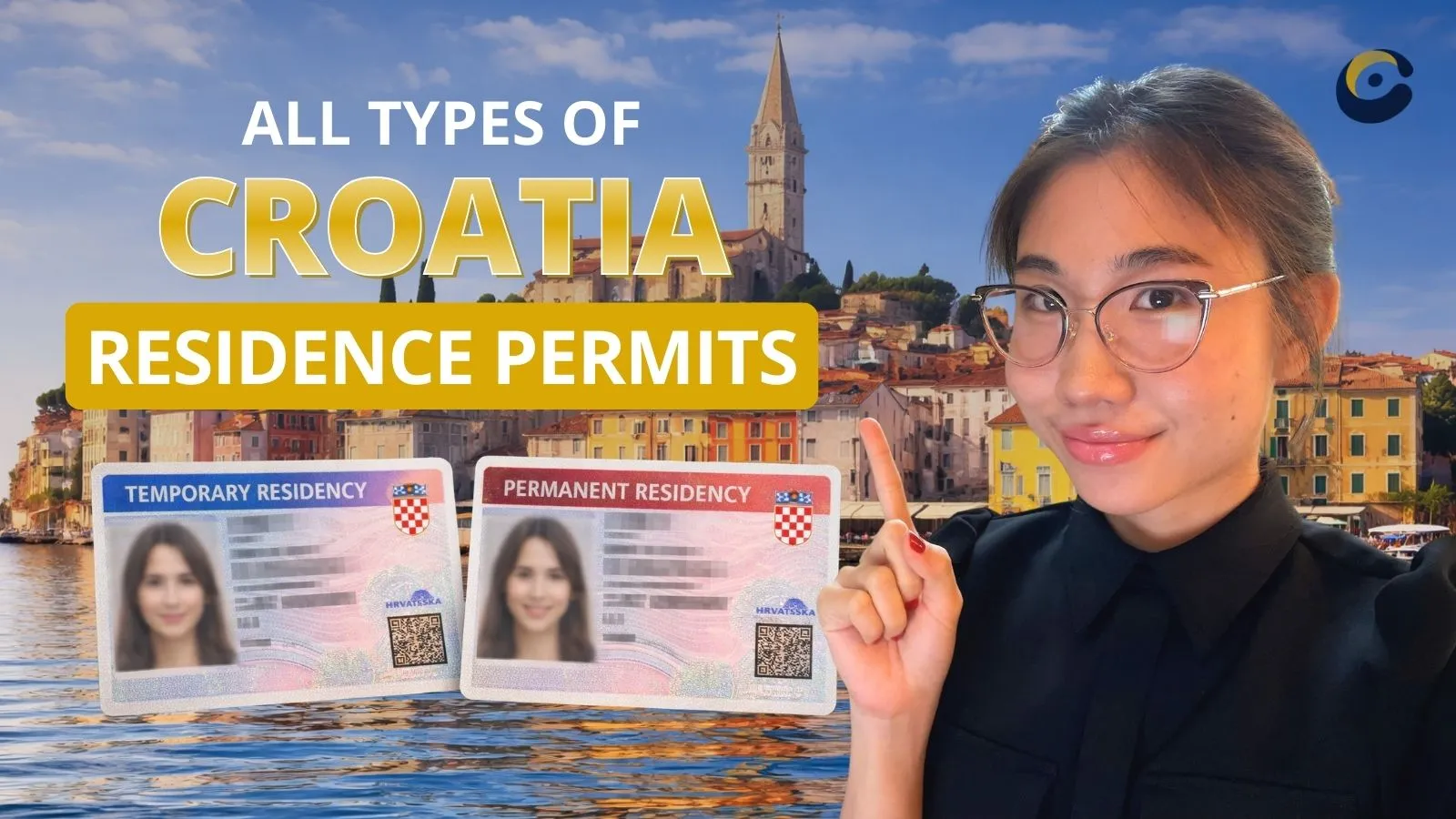
A Croatia temporary residence permit allows non-EU/EEA citizens to stay in Croatia for more than 90 days for a specific reason approved by law. It is usually granted for up to one year and can be renewed if the original purpose remains valid.
This permit applies to:
- Work or employment
- Family reunification (including marriage)
- Secondary education
- Higher education
- Research
- Business or self-employment
- Retirement or long-term living based on financial means
- Digital nomad status (special category)
- Residence of a person with long-term residence in another EEA member state
- Humanitarian reasons
- Other purposes (retiree)
Main types of Temporary Residence
- Employment/Work: Requires a signed contract and sometimes proof of qualifications.
- Digital Nomad: For non-EU citizens working remotely for companies outside Croatia.
- Family Reunification: For spouses or children of residents.
- Property Owners: Based on ownership of residential property.
For a complete breakdown of all permit types, requirements, and income thresholds, see Croatia residence permits: All types and income threshold
Key Croatia Temporary Residence Permit Benefits
For Digital Nomads
A digital nomad permit allows you to live in Croatia while working for a foreign employer or running a foreign business.
It gives you:
- Legal stay
- Address registration
- Banking access
- Rental contracts
- Healthcare (usually private insurance)
However:
- Digital Nomad time often does not fully count toward permanent residence
- In many cases, it counts 50% or not at all
This makes it ideal for lifestyle flexibility but not for those planning EU permanent residence.
For Retirees & Financially Independent Residents
Financially independent residence is designed for:
- Retirees
- Passive-income holders
- Long-term lifestyle migrants
It allows you to:
- Live in Croatia year-round
- Register your address
- Use private healthcare
- Renew annually
- Build lawful residence history
In most cases, this category does count toward permanent residence, making it one of the best routes for retirees planning to settle long-term.
Discover the step-by-step path to retiring in Croatia with confidence, including visa options, healthcare, taxes, and legal compliance: Retire in Croatia: 5 Things to Consider Before You Move
For Founders, Business Owners & Investors
Temporary residence based on:
- Company ownership
- Directorship
- Employment in your own Croatian company
is the most powerful route for permanent residence.
It gives you:
- Legal right to live and work in Croatia
- Access to the public healthcare system (HZZO)
- Salary history and tax footprint
- A residence category that fully counts toward permanent residence
After five compliant years, this route leads directly to:
- Permanent residence
- And later, Croatian citizenship
How to Get Temporary Residency in Croatia
While details vary by purpose, most applications for temporary residence Croatia require the same foundation.
1. Proof of Purpose
You must clearly show why you are staying in Croatia. Common examples include:
- Employment contract
- Marriage or family documents
- University enrollment confirmation
- Business registration documents
- Proof of remote work (for digital nomads)
- Proof of sufficient funds (for retirees)
2. Required Documents
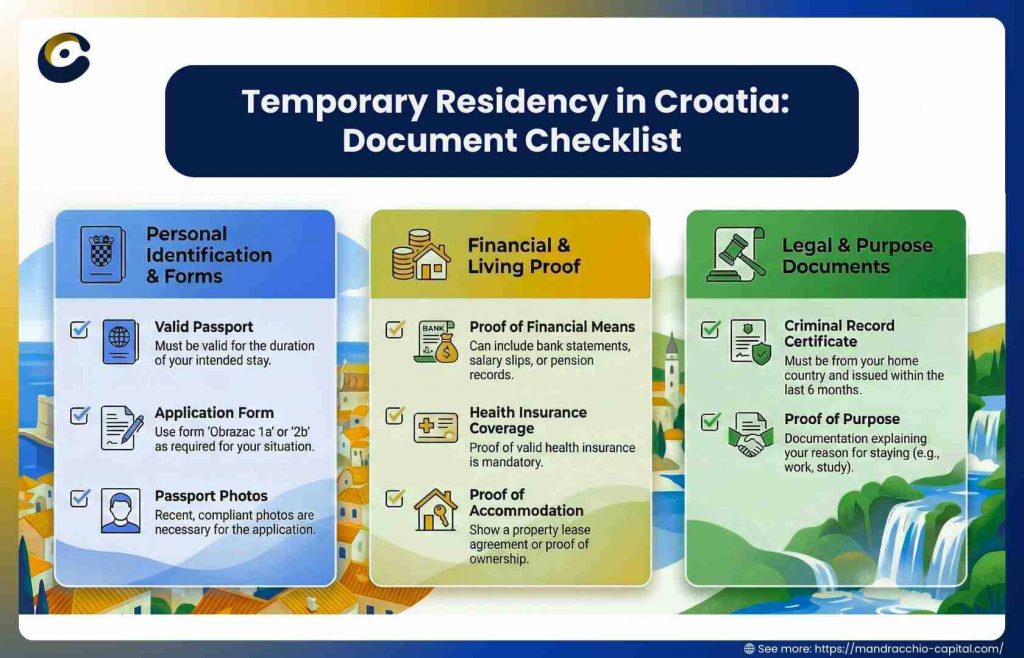
Most applicants must submit:
- Valid passport
- Application form (Obrazac 1a or 2b)
- Passport photos
- Proof of financial means (bank statements, salary, pension)
- Health insurance coverage
- Criminal record certificate from your home country (usually issued within the last 6 months)
- Proof of accommodation (lease or ownership)
All foreign documents typically require apostille and certified Croatian translation.
3. Financial Means
You must show that you can support yourself without becoming a burden on the Croatian system. This can include:
- Salary or business income
- Pension or retirement income
- Savings
4. Health Insurance
Private or travel health insurance is usually required at the start. Some residents later enter the Croatian public healthcare system after approval.
5. Criminal Background Check
A clean criminal record from your country of residence is mandatory for first-time applicants.
Temporary Residency in Croatia Application Process
Required Documents for Temporary Residency
Click here to explore the step-by-step process, all required documents, application locations, and even the fee breakdown for obtaining your temporary residency in Croatia: How to Get Temporary Residency in Croatia: Application Process & Fee
Where to Apply
- Croatian Embassy or Consulate abroad (for visa-required nationals)
- Local police administration (MUP) in Croatia (for visa-exempt nationals or specific cases like family reunification or study)
The Process
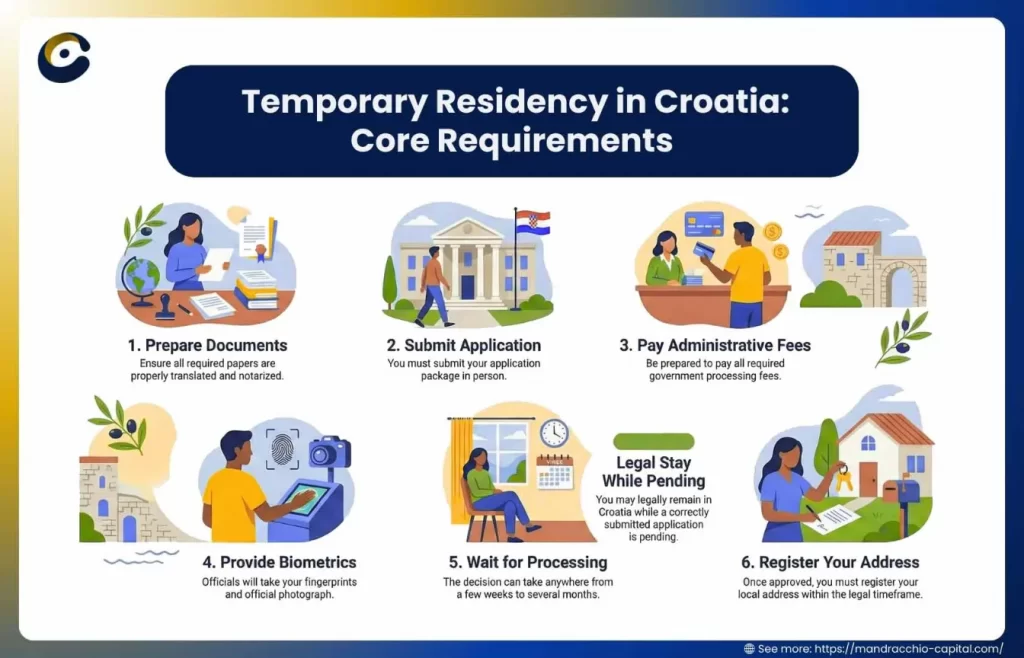
- Prepare documents (including translations and notarizations)
- Submit application in person
- Pay administrative fees
- Provide fingerprints and photo
- Wait for processing (weeks to several months)
- Register your address within the legal timeframe once approved
You may legally stay in Croatia while your application is pending if submitted correctly.
Cost and Duration
Costs: The biometric permit costs approximately €31.85 for regular processing or €59.73 for accelerated, plus a €9.29 administrative fee.
Duration: Temporary permits are generally issued for one year and must be renewed.
How the Application Process Differs for EU vs Non-EU Citizens
Croatia applies two completely different legal systems depending on whether you are an EU/EEA citizen or a third-country national (US, UK, Vietnam, Canada, Australia, etc.).
Understanding which system you fall under determines where you apply, what documents you need, and how complex your case will be.
EU / EEA / Swiss Citizens
EU citizens do not apply for residence under the Aliens Act.
They use EU free-movement law, which is far simpler.
In practice:
- You enter Croatia freely
- You register your address and residence at the police
- You receive an EU Registration Certificate
- No income test
- No criminal record certificate
- No health-insurance screening
- No annual re-approval risk
EU citizens gain permanent residence automatically after five years of registered stay.
Non-EU (Third-Country) Citizens
All non-EU nationals (including US, UK, Vietnam, Canada, Australia, etc.) must apply under Croatia’s Aliens Act for a temporary residence permit.
This means:
- You must qualify under a legal purpose (work, business, family, retirement, study, etc.)
- You must submit:
- Proof of income
- Health insurance
- Criminal background check
- Apostilled and translated documents
- Your permit is time-limited (usually 12 months) and must be renewed
- Your residence must remain continuously valid to count toward permanent residence
This is the system described in the rest of this guide.
For full legal bases, renewal rules, and PR timelines, see: Croatia Temporary Residence Rules for Third-Country Nationals
What Are the Most Common Mistakes With the Croatia Temporary Residence Permit?
Most applicants fail or face delays not because they are ineligible, but because they misunderstand procedure, timing, or long-term consequences.
- Confusing short stay with temporary residence.
- Assuming the first permit must be issued for 30–90 days.
- Missing mandatory address registration deadlines.
- Applying too late to extend a temporary residence permit.
Explore more at: 8 Croatia Temporary Residence Permit Common Mistakes
Temporary Residence Requirements by Nationality
Vietnamese Citizens (Third-Country Nationals)
Vietnamese citizens typically apply through Croatian embassies abroad. Marriage, family reunification, study, and business are the most common legal bases. Document preparation (apostille and translation) is especially important. Vietnamese citizens require a visa to enter the Schengen Area, which significantly impacts the application location.
| Feature | Details for Vietnamese Citizens |
| Visa Requirement | Required. Must obtain a Type D (Long-stay) Visa after residence approval. |
| Application Location | Abroad. Must apply at a Croatian Embassy (e.g., in Kuala Lumpur) before travel. |
| Background Check | Must be from Vietnam, apostilled/legalized, and translated. |
| Entry to Croatia | Cannot enter “visa-free.” Must have the approved permit/visa first. |
| Split Registration | Must visit the MUP (Police) in Split within 3 days of arrival. |
US Citizens (Visa-Free Entry)
US citizens are visa-exempt for entry and often apply directly in Croatia. Proof of income, health insurance, and criminal record checks are essential. Popular routes include retirement-style residence, family reunification, and digital nomad permits.
| Feature | Details for US Citizens |
| Visa Requirement | Not required for initial 90-day entry (Schengen rules). |
| Application Location | In Croatia. Can apply directly at the police station in Split while on a tourist stay. |
| Background Check | FBI Identity History Summary. Must be apostilled (US State Dept). |
| Pending Status | If applied before the 90-day tourist limit ends, stay is legal while pending. |
| Digital Nomad Option | Very common route; can apply via the online government portal. |
UK Citizens (Post-Brexit / Third-Country)
UK nationals follow non-EU rules post-Brexit. Applications are commonly submitted in Croatia if eligible. Long-term residence planning is essential, especially for retirees and property owners.
| Feature | Details for UK Citizens |
| Visa Requirement | Not required for initial 90-day entry (Schengen rules). |
| Application Location | In Croatia. Usually applied for at the police station in Split. |
| Background Check | ACRO Police Certificate. Needs to be apostilled and translated. |
| Health Insurance | Can often use GHIC/EHIC for the initial application phase. |
| Withdrawal Agreement | If resident before Jan 1, 2021, different “Article 50” rules apply. |
Common Legal Bases for Temporary Residence
Croatia does not issue residence permits without purpose. Below are the most common legal bases used by expats.
1. Marriage to a Croatian Citizen
If you are married to a Croatian citizen, you may apply for temporary residence based on family reunification. The permit is typically issued for one year and is renewable as long as the marriage remains genuine and documented.
Authorities usually verify:
- Apostilled and translated marriage certificate
- Shared registered address
- Health insurance
- Financial means
This route counts toward permanent residence but requires strict documentation.
2. Employment with a Croatian Company
Residence is tied to your job and employer.
Important considerations:
- Permit is employer-specific
- Loss of employment affects residence status
- Best suited for skilled professionals
This route is valid long-term but less flexible.
3. Family Reunification (Non-Spouse)
Applicable when joining a spouse, parent, or dependent child already residing in Croatia.
You must show:
- Proof of family relationship
- Financial support by the sponsor
- Shared accommodation
4. Study or Education
Temporary residence may be granted for university, language school, or research programs.
Limitations include:
- Restricted work rights
- Partial counting toward permanent residence
Often used as a transitional option.
5. Business or Self-Employment
You may qualify by opening or managing a Croatian company.
Authorities expect:
- Real economic activity
- Tax compliance
- Ongoing reporting
When structured properly, this is one of the most powerful long-term residence routes.
Digital Nomad Residence Permit (Special Category)

The digital nomad permit is legally a form of Croatia temporary residence permit, but it works differently.
Key points:
- Valid up to 12 months (sometimes extended to 18)
- Not renewable back-to-back
- Does not count toward permanent residence
- No work allowed for Croatian companies
Many people use this as a trial stay, then transition into another residence route. Refer to this guide on Croatia digital nomad visa for full requirements.
Renewal and Permanent Residence
A Croatia temporary residence permit is usually issued for one year and can be renewed annually if conditions remain valid.
After five years of continuous legal temporary residence, you may become eligible for permanent residence, provided you meet integration and residency requirements.
Read more:
To file a temporary residence extension (often called a “bridging permit”) while your permanent residence application is being processed, you must follow a very strict timeline. Croatia does not issue an automatic bridging visa. You are responsible for ensuring that your legal stay remains continuous while your permanent residence case is under review.
Learn how this works in practice: How Do I Extend My Temporary Residence (Bridging Permit) in Croatia?
Important Notes Before You Apply
- Professional guidance can prevent costly mistakes
- These rules apply mainly to non-EU/EEA citizens
- EU citizens follow simpler registration procedures
- Incomplete or inconsistent documentation causes delays
Croatia Residency Planning for Expats
Most residency issues do not begin when an application is submitted. They begin earlier when the wrong residency path is chosen from the start.
Whether you are applying for temporary stay in Croatia, considering the Croatia Digital Nomad Visa, or planning a broader relocation strategy, the key is to structure your legal position correctly from day one.
At Mandracchio Capital, we help expats and international clients build the right residency path based on their goals, documents, and long-term plans in Croatia. Our legal support covers digital nomad applications, temporary residence planning, and expat residency strategy in Croatia.
Learn more about our Expat Residency in Croatia service or reach out to our team directly through the Mandracchio Capital page.
FAQ
Is a Croatia temporary residence permit easy to get?
Yes, if your legal purpose is clear and documented.
Croatia does not limit permits arbitrarily, but it requires consistency between your purpose, documents, and address registration. Most rejections happen due to incomplete or mismatched paperwork, not eligibility.
Practical guidance: Prepare apostilled documents early and avoid changing your legal basis mid-application.
How long does a Croatia temporary residence permit last?
Most permits are issued for one year.
They can be renewed annually as long as the original legal basis remains valid and uninterrupted.
Practical guidance: Apply for renewal 30-60 days before expiry to avoid status gaps.
Does temporary residence in Croatia lead to permanent residence?
Yes, after five years of continuous legal stay.
Only qualifying residence types count toward permanent residency, so route selection matters.
Practical guidance: Avoid permits that “pause” your residency clock if long-term settlement is your goal.
Can I work in Croatia with a temporary residence permit?
Only if your permit explicitly allows it.
Employment-based permits allow work, while others (such as digital nomad residence) prohibit Croatian employment.
Practical guidance: Never assume work rights, check permit conditions before signing contracts.
How long does family reunification temporary residence usually take?
For non-EU spouses of EU citizens (for example, an Italian or German spouse), the legal processing time for temporary residence in Croatia is typically 30 to 60 days from the moment the application is accepted by the Croatian Ministry of the Interior (MUP).
Applications filed through a Croatian consulate abroad (such as Dubai, Istanbul) usually add 1–3 additional weeks for diplomatic transmission and registration in Croatia.
Can I get PR in Croatia?
Yes, it is possible to obtain permanent residence (PR) in Croatia, but it requires several years of legal stay. In most cases, foreigners can apply for permanent residence after five years of continuous temporary residence in Croatia. During this period, you must maintain a valid residence permit through categories such as employment, business ownership, family reunification, or digital nomad residence (if later converted to another residence type).
Applicants must typically demonstrate stable income, health insurance, registered address in Croatia, and basic knowledge of the Croatian language and culture. Once approved, permanent residence allows you to live and work in Croatia without renewing temporary permits every year.
Can I get residency in Croatia if I buy a house?
No, buying property in Croatia does not automatically grant residency. Croatia does not offer a “golden visa” or residency-by-property-investment program. Foreigners are allowed to purchase real estate in Croatia in many cases, but property ownership alone does not give the right to live in the country long term.
However, owning property may support certain residence applications, such as proving accommodation when applying for a temporary residence permit. To legally live in Croatia, you must still qualify under an official residence category, such as employment, starting a company, family reunification, retirement with sufficient income, or other approved residence programs.
How much is a residence permit in Croatia?
The cost of a Croatian residence permit is relatively modest compared to many other EU countries. Government fees generally include an application processing fee and the issuance of a biometric residence card.
Typical costs include: Temporary residence application fee: approximately €55–€75, Biometric residence permit card: approximately €30–€35, Administrative stamps or small processing fees: usually €10–€20
In total, most applicants pay around €90–€130 depending on the specific permit type and administrative requirements. Additional costs may arise if documents require translation, notarization, or legalization.