Yes, foreigners can legally start a business in Croatia, whether they are EU or non-EU citizens. However, the legal process, residency requirements, tax obligations, and administrative steps differ depending on your nationality and long-term plans.
For EU nationals, company formation is relatively straightforward. For non-EU founders, business registration may also involve residence permits, compliance under the Law on Foreigners, and additional documentation.
This guide explains how to start a business in Croatia step by step, including company types, costs, legal requirements, tax considerations, and what foreign entrepreneurs should know before incorporating.
Quick Overview – How to Start a Company in Croatia
- Choose a business structure: d.o.o. (standard LLC with EUR 2,500.00 capital) or j.d.o.o. (simplified LLC starting from €1).
- Obtain OIB numbers (Croatian tax identification numbers) for all founders and directors.
- Reserve and verify the company name before submitting incorporation documents.
- Notarise the company formation documents with a Croatian public notary.
- Deposit the required share capital into a provisional bank account.
- Register the company with the Croatian Commercial Court.
- Open a corporate bank account for operational transactions.
- Complete mandatory registrations for tax, pension (HZMO), and health insurance (HZZO).
- The full company formation process typically takes 2–4 weeks if documentation is prepared correctly.

How to Set Up an Entity in Croatia
Setting up an entity in Croatia typically involves establishing a limited liability company (d.o.o.) or a simplified LLC (j.d.o.o.). The process begins with obtaining a Croatian tax identification number (OIB) for all founders and directors, reserving a company name, and preparing incorporation documents before a Croatian public notary.
After the documents are notarised, the required share capital is deposited into a temporary bank account and the company is registered with the Commercial Court Register. Once registration is approved, the company completes tax registration with the Tax Administration and social security registration with HZMO and HZZO. In most cases, the full incorporation process takes approximately 2–4 weeks.
How to start a company in Croatia
Important Information
- Remote Setup: You can form a company remotely via a power of attorney, although personal presence for notary acts can speed things up.
- Translation: All foreign documents must be translated by a court-certified interpreter.
- Local Director: A local director is not mandatory, but you will need a tax representative.
- Costs: Costs include notary fees (approx. €200-€500) and minimum share capital.
- Documentation: You will need a valid passport, and if a company is the founder, an extract from the foreign company register (not older than 30 days).
Can Foreigners Start a Business in Croatia?
Yes. Foreigners can legally start and fully own a company in Croatia, including holding 100% ownership of a Croatian limited liability company (d.o.o.), simple limited liability company (j.d.o.o.), or other Croatian company forms, subject to the same general corporate law rules that apply to domestic founders.
Under official Croatian rules, the minimum share capital is:
- €25,000 for a joint stock company (d.d.)
- €2,500 for a limited liability company (d.o.o.)
- €1 for a simple limited liability company (j.d.o.o.)
For a standard d.o.o., each founder must pay in at least one quarter of the subscribed share capital in cash before registration, and the total cash contributions must amount to at least one quarter of the company’s share capital. For a j.d.o.o., the company may be established in a simplified form, with a maximum of five members and one management board member, using notarial incorporation minutes that form part of the constitutional documents.
Both EU and non-EU nationals may establish Croatian companies. However, the practical requirements can differ depending on whether the founder intends to live in Croatia, apply for residence based on the business, or operate the company remotely from abroad.
For international founders, the process generally involves company incorporation, tax registration, bank setup, and compliance with Croatian administrative procedures.
Required documents to start a company in Croatia
This guide explains exactly which documents required to start a company in Croatia, how they differ for EU and non-EU founders, and how to prepare them properly so you don’t lose time, money, or business momentum: Required documents to open a limited liability company in Croatia
Step-by-Step: Registering a company in Croatia
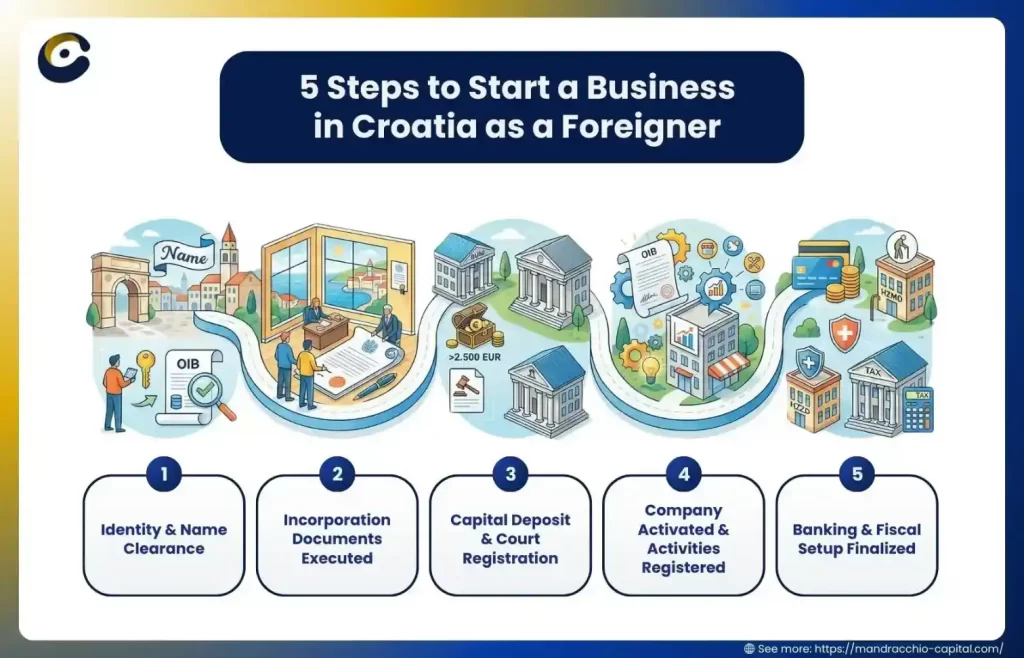
1. OIB & Name Clearance
Obtain Croatian tax numbers (Croatia OIB number) for founders and verify that the company name is available and compliant. Early clearance avoids delays later.
Using Croatia’s NKD (National Classification of Activities) system, you’ll select the business activities your company will perform.
2. Incorporation Documents Prepared
Articles of Association and related documents are drafted. Power of attorney, notarisation, apostilles, and translations are arranged if founders are abroad.
3. Documents Executed Before a Notary
Founders formally sign incorporation documents before a Croatian public notary, with certified interpretation if required.
4. Share Capital Deposited
Share capital is deposited into a temporary account or via FINA. Bank confirmation is issued for court filing.
5. Commercial Court Registration
The incorporation application is submitted to the Commercial Court. Upon approval, the company is legally created and receives its registration decision and OIB.
6. Activities Registered (NKD)
The company’s business activities are registered with the Croatian Bureau of Statistics, formally defining its operational scope. Within 15 days, the company must register with the Croatian Bureau of Statistics (DZS) to confirm its primary NKD activity code.
7. Banking & Tax Setup Completed
A permanent corporate bank account is opened, and the company is registered with the Tax Authority, pension (HZMO), and health insurance (HZZO). VAT registration is handled if applicable. At incorporation stage, banks open a temporary capital account used solely for share capital deposit; after court registration, this is converted into the company’s permanent operational account.
Our insight: Croatian authorities are strict about paperwork accuracy. Even one missing item or untranslated document can slow down approval which is why working with the right local team makes the process significantly smoother.
Key Service Providers
- Public Notaries: Essential for notarizing documents.
- HITRO.HR: A one-stop shop for submitting documents and paying fees.
Optional (online route): If you’re eligible, you may /j.d.o.o. online via Croatia’s START system. Otherwise, the standard route runs through a notary + HITRO.HR (FINA). Read more: How to Start a Croatian Company Online with the START System
Business Environment in Croatia: What Foreign Investors Should Know
Before doing business in Croatia, foreign founders should understand that doing business in Croatia is less about legal permission and more about operational structure.
Croatia allows 100% foreign ownership and equal treatment of domestic and international investors. However, the country operates within a rules-driven administrative system where procedures must be followed in the correct order. The challenge for most foreign entrepreneurs is not eligibility, but navigation.
Because Croatian business law involves multiple institutions and regulatory procedures, many founders work with professional legal advisors. If you are evaluating legal support, see our guide to best business lawyers in Croatia.
Market Position inside the EU
A Croatian company operates as an EU entity within the Eurozone and Schengen Area. This enables cross-border trade, access to EU banking infrastructure, and the ability to invoice clients across Europe without customs barriers.
For this reason, many founders use Croatia not only as a local market, but as an operational base for EU activity.
Costs vs Administration
Operating costs remain significantly lower than Western Europe, especially for salaries, office space, and professional services.
At the same time, administrative processes can be slower and more document-oriented. Notaries, banks, and authorities typically require complete documentation before action rather than allowing corrections afterward.
In practice, this means Croatia is predictable, but only when structured correctly from the beginning.
Investment Incentives That Make Croatia Attractive to Foreign Founders
Beyond market access and cost advantages, Croatia offers targeted investment incentives for foreign-owned businesses, particularly those creating jobs, investing in innovation, or establishing long-term operational presence: Investment Incentives in Croatia: What Investors Can Actually Access
How difficult is opening a business in Croatia?
Opening a business in Croatia is procedural rather than intuitive. Most foreign founders do not struggle with eligibility or legal permission, but with the pace and structure of the process. This is why many foreign founders choose to work with a local lawyer, not to bypass rules, but to navigate them efficiently.
For foreign nationals, difficulties most often arise from: Sequential paperwork, Local administrative formalities that vary slightly by city, Documentation standards, Waiting times especially during peak periods or holiday seasons
Is Croatia a good country to start a business for foreigners?
For both EU and non-EU founders, Croatia stands out for its combination of stable legal framework, 100% foreign ownership, competitive corporate tax rates, investment incentives, strong English-speaking STEM talent, and high quality of life. These advantages are especially valuable for founders who plan to hire locally, scale gradually, and live where they operate.
Choosing the Right Business Structure in Croatia
When starting a business in Croatia, your choice of legal structure directly affects taxation, personal liability, credibility, and how easily you can grow or bring in partners later. Many investors start by comparing obrt vs d.o.o. (“obrt ili doo?”), and quickly realize that only d.o.o. fully supports foreign investment goals.
For a structured overview of all available options, read our full guide: Company Formation in Croatia: 4 Types of Business Entities Explained for Foreign Investors
| Structure | Best For | Liability | Capital | Suitable for Foreigners |
|---|---|---|---|---|
| d.o.o. Croatia (LLC) | Most investors | Limited | €2,500 | Yes |
| Obrt Croatia | EU resident tradespeople | Personal | €0 | Risky for liability |
| j.d.o.o. | Micro businesses | Limited | Low | Limited scalability |
| Branch Office | Expanding companies | Parent liable | €0 | Yes |
| Rep. Office | Non-commercial market presence | N/A | €0 | Cannot generate revenue |
d.o.o. – Limited Liability Company (LLC)
A d.o.o. is the most common structure for foreign-owned businesses in Croatia.
It allows 100% foreign ownership, offers limited liability protection, and is flexible enough for startups and growing companies.
To understand this structure more deeply, visit our article on d.o.o. limited liability company formation in Croatia and see what the process involves.
j.d.o.o. – Simple LLC
A j.d.o.o. is a simplified version of the standard LLC, often chosen by very small businesses or new founders testing a business model.
If you’re unsure whether a d.o.o. or j.d.o.o. is a better fit for your plans, you can explore our comparison guide on d.o.o. vs. j.d.o.o. for a clearer decision.
Obrt – Sole Proprietorship
Obrt is the simplest way to operate a small business in Croatia.
Both local residents and foreign nationals with legal stay can register it.
Branch Office
A branch allows a foreign company to operate directly in Croatia without forming a separate legal entity.
No minimum share capital is required.
The parent company remains fully responsible for all obligations, making this a practical option for expanding an existing business into the Croatian market.
Alternative Market Entry Structures in Croatia (Branch vs Subsidiary)
Foreign companies expanding into Croatia do not always need to create a new Croatian company. In some cases, operating through a branch office (permanent establishment) of an existing foreign company may be more efficient.
Under Croatian tax law (Articles 4 and 15 of the Corporate Profit Tax Act – Zakon o porezu na dobit), a permanent establishment is defined as a fixed place of business through which a foreign company carries out activities in Croatia.
Typical examples include:
- Branch offices
- Administrative offices
- Production facilities
- Workshops or operational locations
Unlike a Croatian subsidiary, a branch is not a separate legal entity. The foreign parent company remains legally responsible for the branch’s obligations.
For some businesses, especially those testing the Croatian market or expanding an existing EU operation — a branch structure may reduce initial complexity.
However, subsidiaries (such as a d.o.o.) often provide clearer liability separation, stronger credibility with banks, and more flexibility for long-term growth.
Because tax treatment and legal exposure differ between structures, founders should evaluate these options carefully before incorporation.
Costs of Opening a Company in Croatia
Total costs vary depending on structure, director role, and whether the company will support tax residency.
If you are from the US, UK, Canada, Australia, New Zealand, or other non-EU countries and intend to relocate, additional onboarding support and compliance planning will be required to ensure the company remains aligned with residency obligations.
Read the detail break down: Cost of Opening a Company in Croatia: A Complete Breakdown
| Cost Category | Typical Amount | Notes |
|---|---|---|
| Total Official Registration Fees | €500+ | May vary depending on documentation, translation, or additional filings. |
| Professional Services (Legal / Accounting) | Varies | Foreign founders often hire professionals to manage documentation, compliance, and communication with authorities. Pricing depends on complexity. |
| Share Capital – d.o.o. | ~€2,500 | Standard Croatian limited liability company (d.o.o.). The capital remains company funds after registration. |
| Share Capital – j.d.o.o. | €1 | Simplified limited liability company (j.d.o.o.), designed for small startups with minimal capital. |
Owners vs Directors: Foreign Founders Must Understand

| Role | Operational Rights | Salary Required | Tax Exposure |
|---|---|---|---|
| Owner only | No | No | Dividends only |
| Director | Yes | Yes | Income + contributions |
In Croatia, owning a company is not the same as running it.
Only the Director can legally operate and represent the company including signing contracts, invoicing clients, and fulfilling compliance obligations.
If you are an EU citizen, you generally have the right to live and work in Croatia without holding a separate residence permit. If you already contribute to social security in another EU country, presenting an A1 certificate may allow you to serve as Director while avoiding double contributions in Croatia.
Croatia VAT System (PDV)
When starting a business in Croatia for non-resident owners, Croatia VAT system is referred to as PDV. Registration can be done immediately or once your company reaches the mandatory revenue threshold. The best timing depends on where your clients are located and how your business model works.
Standard PDV rules when starting a business in Croatia include:
- Standard rate: 25%
If you are an EU citizen building a client base gradually or serving mostly international customers, you may choose to delay PDV registration to protect early cash flow.
For founders from the US, UK, Canada, Australia, New Zealand, or other non-EU jurisdictions, starting a business in Croatia, especially when linked to a residence or work permit, requires a more robust compliance approach. Even if most clients are international, Croatian authorities expect proper invoicing, consistent reporting, and a credible commercial plan to support both tax compliance and immigration status.
To understand how VAT interacts with other obligations such as corporate tax, income tax, and social contributions, see our full guide to the Croatia tax system.
Accounting and Compliance
When starting a business in Croatia for foreigner, accounting and compliance obligations apply from the moment the company is registered. All Croatian limited liability companies must maintain accurate, timely, and legally compliant financial reporting in line with Croatian and EU regulations. Key obligations when starting a business in Croatia typically include:
• Payroll and social contributions if a working Director is appointed
• Corporate income tax filings
• PDV filings if the company is registered for VAT
• Annual financial statements publicly submitted via the Court Register
Accounting support usually ranges €150 – €300 per month, with additional annual reporting obligations depending on company activity.
Banking, Payment Gateways & Fiscalization (How Money Flows Are Regulated)
When starting a business in Croatia for foreigner, banking, payment acceptance, and fiscalization should be understood as one connected compliance framework, not separate steps.
Corporate Banking Reality
Opening a Croatian corporate bank account is mandatory and often underestimated. Croatian banks do not treat account opening as a formality, they assess the ownership structure, business purpose, expected transaction flows, and regulatory exposure before approving an account.
In practice, banks typically require:
- Identification of shareholders and directors
- Notarized incorporation documents
- A clear description of the company’s activities
- Evidence of economic substance and business rationale
While remote onboarding is sometimes possible, it is not guaranteed and depends on the bank, the company structure, and the risk profile of the founders.
EU vs Non-EU Compliance Differences
For EU citizens with complete documentation and a straightforward activity description, banking reviews are generally more predictable and processing timelines tend to be shorter.
For founders from the US, UK, Canada, Australia, New Zealand, or other non-EU jurisdictions, banks usually apply enhanced compliance checks, which may include:
- Apostilled and translated documents
- Source-of-funds verification
- Detailed explanations of planned business activities and client profiles
As a result, account opening may involve additional review rounds and longer timelines.
Accepting Payments & Fiscalization Obligations
Once a company is operational, accepting money from customers triggers additional legal requirements.
If the business accepts card or cash payments, fiscalization must be activated before the first transaction. Fiscalization is a real-time reporting system that:
- Registers each invoice or receipt with the Croatian Tax Authority
- Applies regardless of company size once commercial activity begins
- Is mandatory for retail, hospitality, and many service businesses
Payment gateways and POS systems must be properly integrated with the fiscalization framework to ensure every transaction is reported correctly from day one.
Entrepreneurs starting a business in Croatia should also be aware of broader EU monetary developments, including the upcoming Digital Euro in the EU, which may influence digital payment systems across the Eurozone
Ongoing Tax & Reporting Alignment
Once operational, Croatian companies must remain aligned with:
- Corporate income tax obligations (rates depend on revenue thresholds)
- VAT registration and reporting where applicable
- Annual financial statements and tax filings
- Accounting prepared in accordance with IFRS standards
These requirements apply across company types and are not usually decisive when choosing a structure, but they directly affect banking stability, compliance reviews, and long-term operability.
Learn about: Croatia Tax System: Master Guide for Individuals (Foreigners included) and Companies
Residency Linked to Business Ownership
Owning a company can support residency when you take on an active role in daily operations – not if you only hold shares on paper.
If you are an EU citizen, you have the right to live and work in Croatia but must still register your stay after 90 days and document your activity.
Croatia residency by investment
For non-EU nationals including founders from the US, UK, Canada, Australia, New Zealand, and other third countries – starting a business in Croatia alone does not grant the right to work or reside in Croatia. To qualify for residency through business activity (often referred to as residency by investment), you must:
- Act as a working Director of the Croatian company
- Receive a qualifying salary in line with local regulations
- Pay mandatory social security contributions
- Ensure the company is properly registered, operational, and compliant
In practice, many international founders adopt a phased setup strategy. A local Director is appointed during the initial incorporation and operational phase, allowing the business to function immediately. Once relocation plans and residence permits are secured, founders often transition into the Director role themselves. This approach balances compliance, flexibility, and long-term residency planning.
Not all “investment routes” in Croatia lead to real residency. Here’s what actually works and what doesn’t when it comes to business-based residence: Croatia Residency by Investment: What’s Possible for Third-Country Nationals?

Benefits vs. Downsides: Foreign Founders Should Know Upfront
Starting a business in Croatia offers clear advantages but it also comes with practical trade-offs. For founders who plan carefully and work with local guidance, these downsides are manageable. For those expecting a quick or hands-off setup, Croatia can feel unnecessarily complex.
For a deeper, unfiltered look at both sides of the equation, see:
→ The Benefits of Doing Business in Croatia for Foreigners
→ The Downsides of Doing Business in Croatia (Real Talk from a Foreign Founder)
Foreign entrepreneurs should be aware of operational rules not common elsewhere:
• Standard receipts are not deductible; R1 invoices required
• Payment acceptance requires approved fiscalization
• Banks can freeze onboarding for incomplete compliance
• Financial statements are public business records
Avoiding these issues early is essential when starting a business in Croatia for foreigner, as corrections later can be costly and time-consuming.
Read more: 8 Common Mistakes Foreigners Make When Starting a Company in Croatia
Mandracchio Capital – Your Legal Partner for Doing Business in Croatia
Mandracchio Capital, founded by Prof. Dr. Šime Jozipović, supports international investors, founders, and companies entering the Croatian and broader European Union market. With 500+ projects supervised and over €500 million in company value established, the firm helps foreign businesses start and operate in Croatia with regulatory clarity and confidence.
Our advisory work focuses on company formation, tax and VAT compliance, cross-border structuring, and EU market entry strategies, coordinating experienced Croatian lawyers and tax consultants to ensure every stage of your business setup is legally sound.
For founders looking for a structured, fully compliant company setup process, explore our comprehensive legal services for starting a company in Croatia, where we coordinate documentation, incorporation filings, bank onboarding, and tax registration so your business enters Croatia correctly from day one.
Based in Split, Croatia, Mandracchio Capital works with clients from the United States, United Kingdom, Canada, Australia, and across the EU, helping them build compliant and scalable operations within the Croatian and European legal framework.
FAQ
How long does company registration take in Croatia?
Company registration in Croatia typically takes 2–4 weeks from the moment all documents are prepared.
Court registration itself can be relatively fast, but additional steps often extend the timeline, including:
- opening a Croatian business bank account
- registering with the Croatian Tax Administration (Porezna uprava)
- completing director and social security compliance
When starting a business in Croatia as a foreigner, delays are most commonly caused by bank compliance checks, document apostilles, or administrative processing times.
Do I need to live in Croatia to run my company?
No. Foreigners can own and operate a Croatian company remotely and receive dividends without living in Croatia.
However, if you act as the company director, you must be legally allowed to work in Croatia and pay the required social security contributions. For this reason, many foreign owners appoint a Croatian-based director if they do not intend to apply for residency.
Can I start a business in Croatia without citizenship?
Yes. You do not need Croatian or EU citizenship to start a business in Croatia.
Foreign founders from countries such as the United States, United Kingdom, Canada, Australia, and New Zealand commonly establish a Croatian d.o.o. (limited liability company) and operate the business either remotely or while living in Croatia.
Can I stay in Croatia if I start a business?
Possibly. Starting a company in Croatia can support an application for a temporary residence permit, particularly for non-EU nationals.
However, residency is not automatic. Croatian immigration authorities usually require evidence of:
- genuine business activity
- financial capacity
- compliance with employment and tax regulations
Active company operations are generally considered a valid basis for a residence permit application.
Can foreigners do business in Croatia?
Yes. Foreigners can open and operate businesses in Croatia without ownership restrictions.
Both EU and non-EU investors can:
- establish companies in Croatia
- own 100% of company shares
- conduct commercial activities under the same legal framework as Croatian citizens
Croatian corporate law allows foreign investors to participate fully in the local business environment.
Can I set up a self-employed stock trading company in Croatia for immigration purposes?
Yes, but it must be properly structured.
Croatia allows foreign nationals to establish companies involved in securities trading or investment-related services, but the business must demonstrate a legitimate commercial activity beyond personal investing.
Pure “self-trading” companies created only to justify residence are often rejected. In practice, acceptable structures typically include:
- financial advisory services
- portfolio analysis or fintech services
- other value-adding financial activities consistent with Croatian company law
Professional legal and tax planning is strongly recommended before using a trading-based business model as the basis for a Croatian residence permit.
How can non-EU citizens start a business in Croatia?
Non-EU citizens can legally start and own a company in Croatia, but the process involves additional immigration considerations.
Most foreign founders establish a Croatian limited liability company (d.o.o.) and then apply for temporary residence based on business ownership. This allows them to live in Croatia and actively manage their company.
However, company formation alone is not enough. Authorities typically require:
- adequate share capital and business activity
- proper payroll and tax compliance
- in some cases, employment of Croatian staff
Because corporate law and immigration rules intersect in this process, professional legal and tax planning is highly recommended before starting a business in Croatia as a non-EU founder.
How to Set Up an Entity in Croatia?
To set up an entity in Croatia, founders usually establish a limited liability company (d.o.o.) or a simple LLC (j.d.o.o.). The process involves obtaining an OIB tax number, reserving a company name, notarising formation documents, depositing share capital, and registering the company with the Commercial Court. After incorporation, the business must register for tax, pension (HZMO), and health insurance (HZZO). The entire procedure typically takes 2-4 weeks.
How do I open a branch office in Croatia?
A foreign company can open a branch office (podružnica) in Croatia without creating a separate legal entity. The branch operates as an extension of the parent company and conducts business in Croatia under the parent company’s legal responsibility.
To register a branch office, the foreign company must submit documentation to the Croatian Commercial Court, including proof of the parent company’s registration, a decision to establish the branch, and the appointment of a branch representative in Croatia. All foreign documents typically need to be apostilled and translated into Croatian by a certified court translator.
Although a branch does not have its own legal personality, it must still register for tax purposes, obtain an OIB number, and maintain accounting records in Croatia. The branch may also need to register for VAT or corporate tax depending on its activities.
Legal Basis & Official Sources
Croatia allows full foreign ownership of companies under its Company Act (Zakon o trgovačkim društvima). There is no legal requirement for a Croatian partner or shareholder, and both EU and non-EU nationals may establish and own Croatian companies under the same corporate framework.
However, residency and work rights are regulated separately under the Law on Foreigners (Zakon o strancima), administered by the Ministry of the Interior (MUP). Non-EU nationals who wish to actively manage and work in their Croatian company must obtain an appropriate residence and work permit.
Key official references include:
- Croatian Company Act (Zakon o trgovačkim društvima)
- Law on Foreigners (Zakon o strancima)
- Ministry of the Interior (MUP) – Temporary residence and work permits
- Croatian Commercial Court (Sudski registar)
- Tax Administration (Porezna uprava)
- HITRO.HR / FINA company registration system
For official guidance, see:
- Ministry of the Interior: https://mup.gov.hr
- Commercial Court Register: https://sudreg.pravosudje.hr
- Tax Administration: https://www.porezna-uprava.hr