
Among all digital nomad tax free countries, only a small number offer explicit, legally grounded exemptions rather than relying on silence, loopholes, or non-enforcement.
For higher-income digital nomads, especially those earning €3,000 to €10,000+ per month, the real issue is not how low the tax rate looks on paper, but how defensible that outcome is if questioned by banks, immigration authorities, or your home tax authority.
Below are the three strongest jurisdictions in 2026 for you where tax treatment is clear, structured, and predictable.
Key Takeaways for Digital Nomad Tax Planning
- Clarity matters more than rates: The best digital nomad tax free countries clearly separate residence permits from tax residency.
- 0% tax is conditional: Most exemptions apply only to foreign-sourced income and specific visa categories.
- Croatia stands out: It explicitly exempts qualifying foreign income under its digital nomad regime.
- High earners face higher scrutiny: Above €3,000/month, documentation, consistency, and structure matter.
- Home-country taxes still apply: Tax-free locally does not mean tax-free globally.
How Do Taxes Work for Digital Nomads?
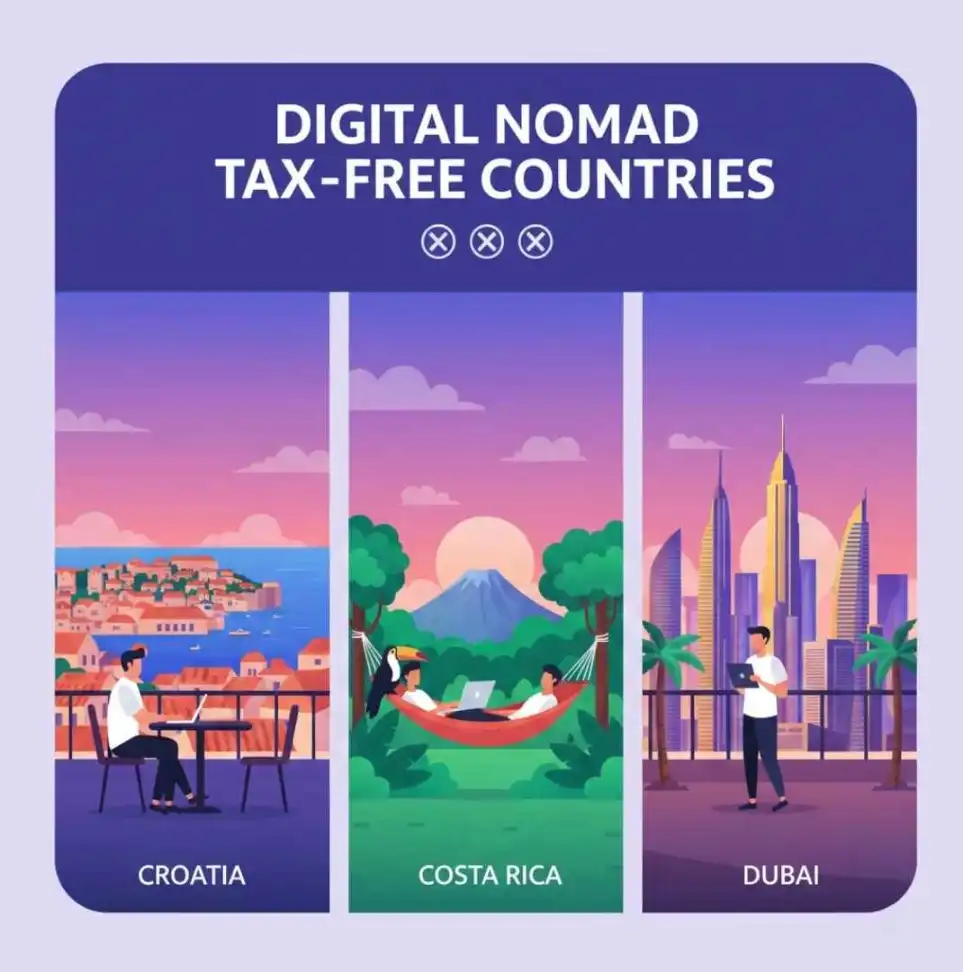
This is the question most nomads ask too late. They depend on three overlapping systems, and problems arise when these are confused:
- Immigration status (your visa or residence permit)
- Tax residency rules (where a country considers you taxable)
- Home-country obligations (especially for US citizens)
Many countries allow digital nomads to live legally without automatically making them tax residents. That distinction is the foundation of legitimate low tax countries for digital nomads. The mistake high earners often make is assuming:
- A residence permit = tax residency
- Or worse, “no one will notice”
At €3,000 – €8,000 per month, authorities do notice, especially when banking, renewals, or audits are involved.
Top 3 digital nomad tax free countries 2026
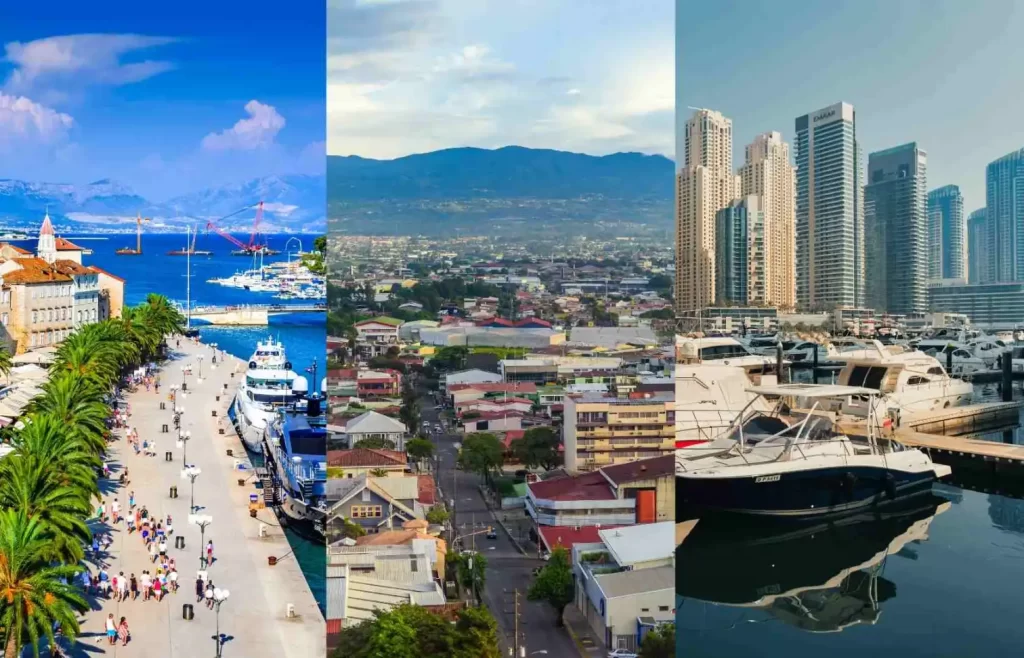
1. Croatia
Croatia (#CroatiaFullOfLife) remains the most legally precise digital nomad tax-free country in Europe.
IMPORTANT: While you are tax-exempt in Croatia, you are likely still a tax resident of your home country (e.g., the US, UK, or Canada). Croatia’s 0% rate only applies to your liability within Croatia.
Learn how to apply for Croatia Digital Nomad Visa and understand whether you qualify under the current legal framework.
Does Croatia Tax Foreign Income for Digital Nomads?
No, qualifying foreign income is explicitly exempt.
Under Croatia Digital Nomad Visa, income earned from non-Croatian employers or clients is not subject to Croatian income tax for the duration of the permit.
This directly answers two of the most searched questions globally:
- Does Croatia tax foreign income?
- What is the tax in Croatia for foreigners under the digital nomad permit?
The Answer: qualifying foreign income is not taxed locally. This is not implied. It is written into the legal framework governing the permit. The status is governed by the Aliens Act (Zakon o strancima). The tax exemption is codified in the Income Tax Act, which provides the specific legal “shield” for nomad income
Croatia Digital Nomad Tax – How It Actually Works
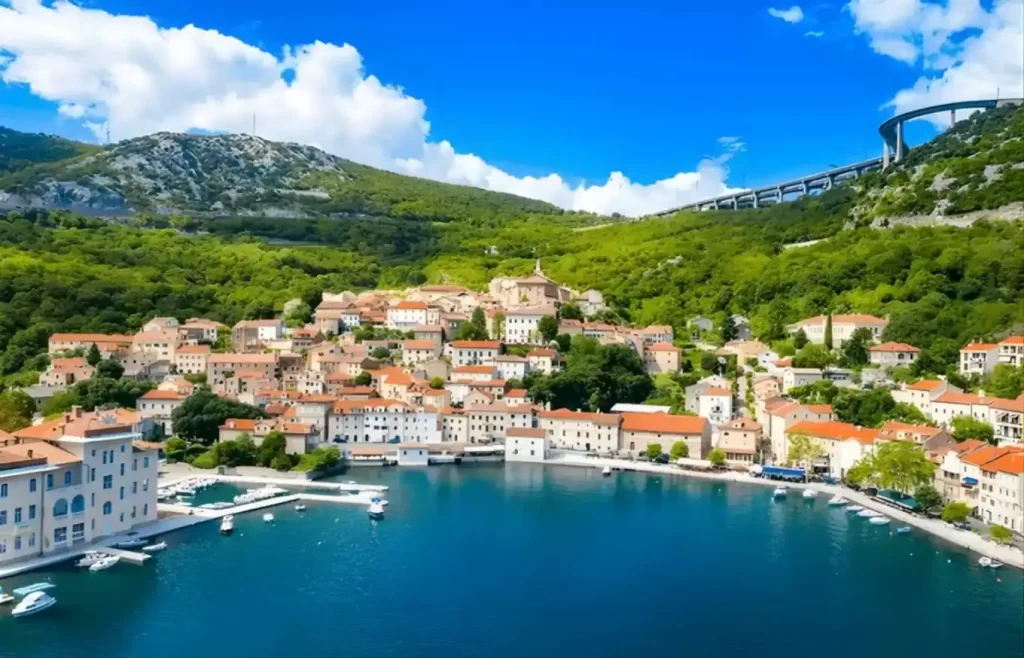
- Tax rate: 0% on qualifying foreign income
- Legal basis: Explicit exemption under the Aliens Act and tax guidance
- Duration: Previously, it was 12 months with a 6-month extension. Now, you can apply for an initial stay of up to 18 months
- Condition: You may not work for Croatian companies or clients
This makes Croatia one of the few digital nomad tax free countries where the tax outcome is not dependent on interpretation. Even if you stay longer than 183 days (the usual threshold for tax residency), you remain a non-resident for tax purposes under this specific status.
Why High-Income Nomads Prefer Croatia
For nomads earning €3,000 – €10,000+ per month, Croatia’s advantage is not just the rate, it’s risk containment.
- You generally do not become a Croatian tax resident
- Banking and compliance are simpler
- Healthcare access and EU infrastructure are available
- Lifestyle quality remains high without Western Europe price pressure
This combination is why Croatia consistently ranks among the top low tax countries for digital nomads in Europe.
2. Costa Rica

Costa Rica is frequently mentioned alongside digital nomad tax free countries, but its position is often misunderstood.
Costa Rica operates under a territorial tax system – meaning foreign-sourced income is generally not taxed, provided it is not remitted or locally generated.
Costa Rica Digital Nomad Tax Overview
- Tax on foreign income: Generally none
- Local income: Taxable
- Digital Nomad Visa: Up to 18 months, extendable
- Income requirement: ~US$3,000/month (or US$4,000 for families)
Costa Rica is attractive for:
- Nature-oriented lifestyles
- North & South American proximity
- Lower administrative complexity
However, its tax framework relies more on interpretation and enforcement practice than explicit exemptions.
3. Dubai

Dubai does not market itself as a digital nomad tax haven, it simply has no personal income tax.
That alone keeps it permanently in any discussion of which countries have the lowest tax rate.
Dubai Digital Nomad Tax Reality
- Personal income tax: 0%
- Capital gains tax: 0%
- Dividend tax: 0%
- Visa: Remote Work / Virtual Working Program
- Duration: Renewable annually
Unlike Europe, Dubai does not need special exemptions, there is no income tax to exempt you from.
Why Dubai Works for High Earners
Dubai tends to attract:
- Nomads earning €6,000-€15,000+ per month
- Entrepreneurs and consultants with international clients
- Individuals prioritizing tax certainty over lifestyle softness
That said, Dubai is not for everyone:
- Cost of living is high
- Climate is extreme
- Cultural fit varies
- No EU residency or long-term integration pathway
Dubai is excellent for pure tax optimization, but weaker for those seeking long-term European residence or lifestyle balance.
Why “0% Tax” Fails Without Structure
Many high-income nomads lose tax benefits because their story doesn’t match their paperwork.
If your:
- Lease,
- Address registration,
- Bank accounts,
- And visa purpose
tell different stories, exemptions become fragile. In countries like Croatia, the digital nomad tax benefit works because the structure is coherent, not because authorities are lenient.
Digital Nomad Taxes in Europe: What Most Lists Don’t Tell You
Europe is attractive for lifestyle and stability, but digital nomad taxes in Europe are often misunderstood.
Key realities:
- Most EU countries tax worldwide income once you become resident
- DN visas are designed to delay or avoid tax residency, not eliminate taxes forever
- High earners attract scrutiny faster
That’s why digital nomad tax free countries with explicit exemptions (like Croatia) outperform countries relying on gray zones.
Important Tax Disclaimer (You Should Actually Understand)
Even in digital nomad tax free countries, you may still owe taxes elsewhere.
- US citizens must file US taxes regardless of residence
- Double Taxation Treaties (DTTs) determine allocation, not marketing articles
- FEIE, credits, and exclusions require planning
Ready to Structure This Properly?
If you’re earning €3,000+ per month and considering Croatia or other low tax countries for digital nomads, the real value is not choosing a country, it’s choosing the right structure inside that country.
We help digital nomads:
- Compare tax exposure across jurisdictions
- Match visa type to income reality
- Coordinate immigration and tax positioning correctly from day one
Book a 20-minute free strategy call and make sure your move works on paper – not just on Instagram.
Other Notable Low Tax Countries For Digital Nomads
| Country | Digital Nomad Tax Treatment |
|---|---|
| Antigua and Barbuda | No local income tax on foreign-sourced income while on the digital nomad visa |
| Barbados | Welcome Stamp allows tax-free remote work income during the visa period |
| Curaçao | Digital nomad visa exempts holders from local income tax for the visa duration |
| Dominica | No local income tax applied to digital nomads under the visa scheme |
| Ecuador | Foreign-sourced income not taxed for digital nomad visa holders |
| Seychelles | Workcation program exempts income tax and capital gains tax |
| Grenada | No tax on foreign-sourced income under the digital nomad visa |
| Malta | Digital Nomad Residence Permit generally taxes only Malta-sourced income; foreign income typically not taxed if not remitted |
FAQ
What is the minimum income required to qualify as a digital nomad?
Most digital nomad tax-free countries require proof of stable monthly income between €2,300 and €3,500.
For example, Croatia requires sufficient income from foreign sources to support yourself without local employment, while Malta’s threshold is higher at around €3,500 per month. The purpose is to ensure you won’t rely on local labor markets or public assistance.
Practical guidance: Always document income clearly (contracts, invoices, bank statements) for at least the previous 6–12 months, fluctuating income is acceptable if well explained.
Is Croatia easy to move to as a digital nomad?
Yes, Croatia is considered one of the easier digital nomad tax-free countries to relocate to legally.
You can enter visa-free for up to 90 days and apply for the digital nomad residence permit from within the country. The process is structured, document-based, and predictable if prepared properly.
Practical guidance: Secure accommodation early, prepare apostilled documents in advance, and expect at least one follow-up request, Croatian bureaucracy is procedural, not hostile.
Does Croatia tax foreign income earned by digital nomads?
No. Qualifying foreign income is exempt under the Croatia digital nomad tax regime.
As long as you work exclusively for non-Croatian employers or clients, your income used to qualify for the permit is not subject to Croatian income tax during the permit period.
Practical guidance: Avoid any Croatian-sourced income, including local clients or payroll, as this can invalidate the exemption.
Do I become a tax resident in Croatia as a digital nomad?
In most cases, no. The digital nomad permit is designed to prevent automatic tax residency.
Croatia separates temporary residence for digital nomads from standard tax residency rules, which is why it consistently ranks among legitimate digital nomad tax-free countries.
Practical guidance: Maintain clear ties to your home country and avoid indicators of permanent establishment (local employment, long-term business activity).
Is English widely spoken in Croatia?
Yes. English is widely spoken, especially in cities, coastal areas, and among professionals.
You can comfortably manage daily life, healthcare, and administration in English, though official documents are issued in Croatian.
Practical guidance: Learning basic Croatian improves integration and makes bureaucratic interactions smoother, but it’s not required for daily life.
Is there a strong digital nomad and expat community in Croatia?
Yes. Croatia has one of the most established digital nomad communities in Europe.
Cities like Split, Zagreb, Zadar, and Dubrovnik host active expat networks, coworking spaces, and informal communities via WhatsApp, Facebook, and local meetups.
Practical guidance: Joining community groups early helps with housing leads, healthcare recommendations, and navigating local systems faster.
How long can I stay in Croatia as a digital nomad?
Up to 18 months under current regulations, but not indefinitely. After the permit expires, a cooling-off period applies before reapplying under the same category.
Practical guidance: If you plan long-term settlement, use the digital nomad period as a trial phase and transition into another residence basis later.
Are digital nomad tax-free countries truly “tax free”
Locally, yes – globally, not necessarily.
Most digital nomad tax-free countries exempt local taxation but do not override your home country’s tax obligations.
Practical guidance: US citizens must still file US taxes; others should check double taxation treaties and residency thresholds carefully.
Is Croatia suitable for high-earning digital nomads (€3,000+/month)?
Yes. Croatia is particularly attractive for higher-income remote professionals.
Its combination of zero local tax on foreign income, EU infrastructure, and predictable administration makes it one of the most defensible low-tax countries for digital nomads.
Practical guidance: Higher income means higher scrutiny, consistency and documentation matter more than clever workarounds.
What is the biggest mistake digital nomads make when choosing a tax-free country?
Confusing a low tax rate with a stable legal structure.
Many countries advertise low taxes but lack clear rules separating residence from tax residency, creating risk over time.
Practical guidance: Prioritize countries where tax exemptions are written into law, not inferred from loopholes, this is where Croatia stands out.