Permanent residency in Croatia is not granted automatically. It is a legal status earned after 5years of continuous, qualifying residence under very specific rules.
We will explain exactly how permanent residency in Croatia works for both EU/EEA citizens and non-EU (third-country) nationals, based on the actual procedure guided by the Croatian Ministry of the Interior (MUP).
How to Apply for Permanent Residency in Croatia (MUP Procedure Explained)
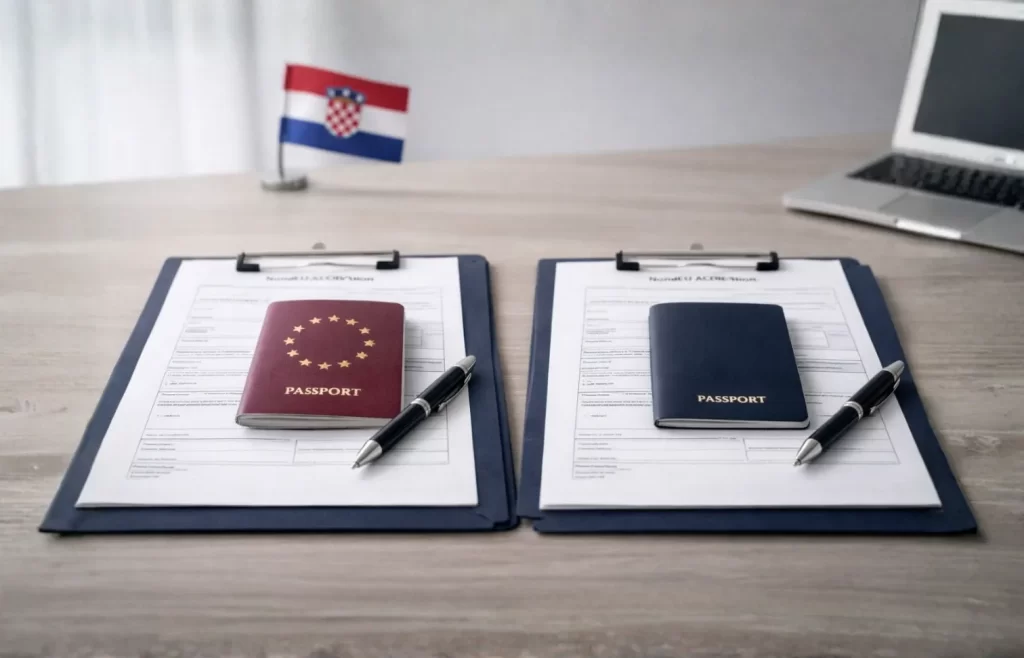
Quick Answer: To apply for permanent residency in Croatia, a foreign national must complete 5 years of continuous qualifying residence and submit Form 1a in person at the local Ministry of the Interior (MUP) police administration with supporting documents.
Processing usually takes 6–18 months.
How to get Permanent Residency in Croatia
Permanent residency in Croatia gives foreign nationals the right to live and work in Croatia indefinitely without annual renewals. It is also the final legal step before eligibility for Croatian citizenship.
Permanent residency in Croatia is:
- Granted only after qualifying long-term residence
- Based on residence history, not just current status
- Processed by the Croatian Ministry of the Interior (MUP)
If you want to understand what permanent residence in Croatia actually means, including the rights it gives you, how it differs from temporary residence, and why it matters for citizenship and long-term EU status, read this first: How to Get Permanent Residency in Croatia
The 5 Years Rule for Permanent Residency in Croatia
At the center of all permanent residency in Croatia rules is one requirement:
You must complete five continuous years of legal residence that counts toward permanent residence.
This five-year period:
- Starts from the issue date of your first qualifying residence permit
- Does not start from your arrival date
- Does not include tourist or visa-free stays
If your permit type in year one was wrong, permanent residency in Croatia may never arise — even after many years in the country.
Permanent residence is regulated under the Croatian Aliens Act and administered by the Ministry of the Interior (MUP), which evaluates residence continuity, permit eligibility, and integration requirements.
How to apply for Permanent Residency in Croatia: Non-EU Citizens
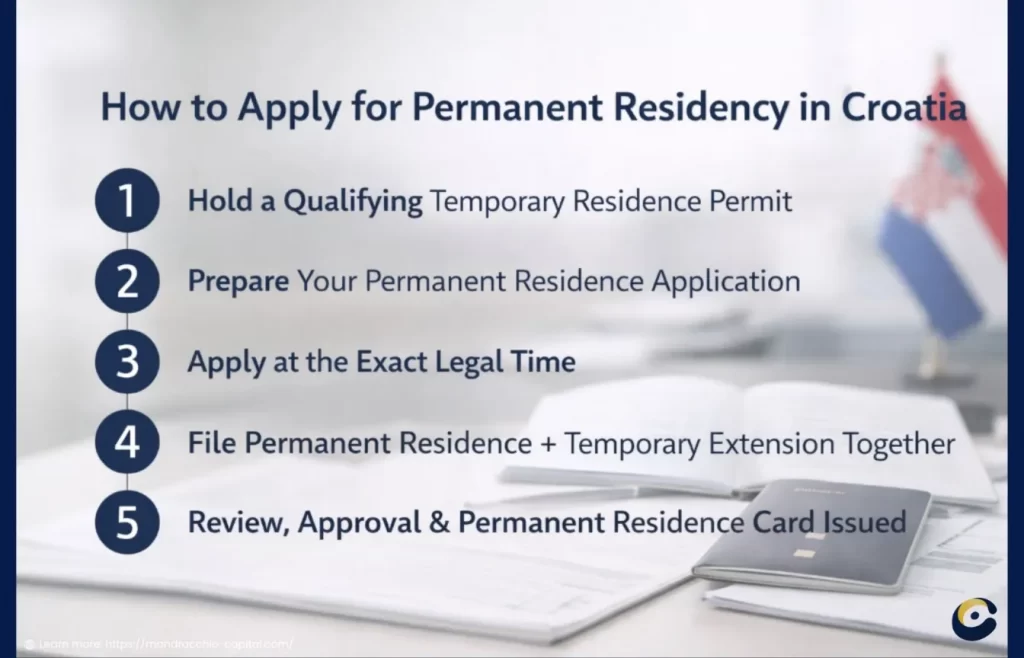
This applies to citizens of the US, UK, Canada, Australia, Asia, and most of the world.
Step 1 — You Must Hold a Qualifying Permit
Permanent residency in Croatia is not a standalone application.
You must already hold a temporary residence permit that counts toward the five-year rule, such as:
- Work permit
- Family reunification
- Business or company director permit
- Study (only partially counts)
The following do not count:
- Seasonal work
- Posted workers
- Volunteers
- Trainees
- Service providers
- “Other purposes” permits
Step 2 — Prepare Documents Before Year Five Ends
About two months before your fifth year completes, you must contact your local MUP office. They will:
- Confirm whether your residence periods qualify
- Identify nationality-specific requirements
- Tell you if you must pass the Croatian language & culture exam
Documents for permanent residency in Croatia typically include:
- Passport and biometric photo
- Proof of continuous residence
- Proof of financial means
- Proof of accommodation
- Health insurance
- Criminal record certificate
- Language certificate (if required)
Language testing is done by accredited universities:
Zagreb, Split, Rijeka, Zadar, Osijek, and Pula.
Step 3 — Timing Is Strict
You must apply for permanent residency in Croatia:
The day after your temporary residence permit expires
Not earlier. Not later.
Applying even one day late can result in:
- Loss of legal residence
- Forced status change
- Requirement to leave Croatia
Step 4 — Dual Filing (Form 1a + Extension)
On the filing date, two applications are submitted:
- Permanent Residence (Form 1a)
- Temporary Extension (Bridging Permit)
This keeps you legally resident while permanent residency in Croatia is being processed (often 12–18 months).
Step 5 — Review & Approval
MUP conducts:
- Background checks
- Residence verification
- Possible interviews
Once approved, you receive a biometric permanent residence card and no longer need annual renewals.
“I’m living in Zagreb with my family, these are the specific Zagreb rules you must follow for filing permanent residence:
- On page 2 of Form 1a, under ‘Purpose of Stay’, you must clearly select Family Reunification. Because you are reuniting with a Croatian citizen (your spouse), the MUP office in Petrinjska applies the four-year rule instead of five.
- On the day I submit Form 1a, I also file an application for a temporary residence extension (bridging permit)
- With 4 children, MUP Zagreb will require proof that my home meets “adequate housing” standards. I ready to provide your lease agreement (Ugovor o najmu)/ property title (Vlasnički list).”
Permanent Residency in Croatia for EU / EEA Citizens: Application Process
EU/EEA citizens obtain permanent residency in Croatia under EU free-movement law, not the Croatian Aliens Act. After completing five years of continuous legal residence, the right to permanent residence arises automatically but it must still be registered with the police (MUP).
Step 1 — Complete Five Years of Legal EU Residence
You must have been registered in Croatia as an EU resident for five continuous years (working, self-employed, studying, or financially independent). This includes:
- Registered address
- OIB
- Health insurance during the first five years
Once five years are completed, no income or insurance checks apply.
Step 2 — Apply for the EU Permanent Residence Card (Form 3b)
You submit Form 3b at your local police administration (MUP), together with:
- Passport or EU ID card
- Proof of five years of residence (registrations, address records, etc.)
- Photograph and fingerprints
This converts your EU temporary residence into permanent residency in Croatia.
Step 3 — MUP Verification
MUP verifies:
- That you were legally registered for five years
- That your identity is valid
They do not assess income, health insurance, language, or criminal records.
Step 4 — Receive Your Permanent Residence Card
Once approved, you receive an EU permanent residence card.
Your status becomes unlimited, and you no longer have to renew or prove financial means.
Practical Note From Our Cases
In practice, most rejections do not happen because of income or documents, but because the residence type in earlier years did not legally qualify toward permanent residence. We regularly see applicants who lived in Croatia for 6–8 years but cannot apply because their first permits were issued under “other purposes”.
MUP evaluates residence history, not physical presence alone.
At Mandracchio Capital, we support expats, entrepreneurs, digital nomads, retirees, and investors navigating the legal side of living and doing business in Croatia. Our work focuses on:
- Residence permits and long-term stay structuring
- Business formation and director residence
- Family reunification applications
- Permanent residency and long-term EU status
- Cross-border compliance and relocation planning
Our guidance is based on direct interaction with Croatian administrative authorities, including the Ministry of the Interior (MUP), and practical case handling, not forum discussions or informal interpretations.
We work with non-EU nationals relocating to Croatia for retirement, remote work, investment, or business expansion.
FAQ – Permanent Residency in Croatia
How long do I need to live in Croatia to get permanent residency?
Five continuous years of qualifying legal residence.
Does time as a tourist count toward permanent residency in Croatia?
No. Tourist and visa-free stays never count.
Can digital nomads get permanent residency in Croatia?
Not directly. Digital nomad permits do not count unless you change to a qualifying residence type.
Do EU citizens need to pass a language test?
No. Only non-EU applicants must pass the language and culture exam.
How long does the permanent residency in Croatia process take?
Typically 6 to 18 months, depending on nationality and MUP workload.
How long does it take to get permanent residency in Croatia?
Obtaining permanent residency in Croatia typically requires a minimum of 5 years of legal residence, and the application process can take an additional 6 months to 2 years depending on individual circumstances.
How long does permanent residence take for spouses of Croatian citizens?
Croatian law allows spouses of Croatian citizens to apply for permanent residence after four years of continuous temporary residence granted for family reunification or life partnership. In practice, processing times can vary and, in some periods, may be longer due to administrative backlogs at the Ministry of the Interior (MUP). Typical processing time may range from approximately three months to twelve months or longer, depending on the case. Typical processing time can ranges from 3 to more than 12 months.
Legal Disclaimer: This article explains the administrative procedure based on current Croatian immigration regulations. Individual cases may vary depending on nationality and residence history. Always confirm requirements with the competent MUP police administration before filing.