*This information has been verified with an immigration lawyer and checked against official guidance from the Croatian authorities in charge of approvals.
Most people searching “How to Get Croatian Citizenship” are trying to answer the same questions:
Do I qualify? What do I need? How long will it take?
This guide walks you through the legal options available under the Croatian Nationality Act, with a focus on real-world preparation, not internet myths.
And just to be clear: Croatia does not offer citizenship by investment. Citizenship is only granted through specific legal grounds.
Key Takeaways
- You can get Croatian citizenship through naturalization (residency), descent (ancestry), marriage, or special interest.
- Naturalization: typically requires at least 8 years of legal residence, permanent residence status, and passing a Croatian language + culture test.
- Descent: requires proving Croatian heritage (parents/grandparents) through official documents and clear family links.
- Marriage: usually requires 3 years of marriage plus residency in Croatia (marriage alone is not enough).
- Where to apply: if living abroad, apply at the nearest Croatian embassy or consulate; if residing in Croatia, apply at your local police administration office.
- Application format: most applications must be submitted in person.
- Documentation: prepare extensive paperwork such as birth and marriage certificates, proof of residence, and supporting documents for your legal basis.
- Language requirement: a Croatian language and culture test is usually required (especially for naturalization).
- Dual citizenship: naturalization may require renouncing your current citizenship, but exceptions exist (commonly for descent and special interest cases).
Croatia Citizenship: Legal Framework Overview
Croatian citizenship is regulated by the Croatian Nationality Law, administered by the Ministry of the Interior (MUP) in Croatia or through Croatian embassies and consulates abroad.
What hasn’t changed in 2026
- The law remains stable
- The 2020 diaspora liberalization is still in force
- Documentation standards remain strict
- Processing is centralized and formal
How to Get Croatian Citizenship? There are 6 main legal bases for acquiring Croatian citizenship. Choosing the correct article is the most important strategic decision:
Croatian Citizenship by Birth or Origin (Articles 4 & 5)
You automatically qualify if:
- You were born in Croatia and at least one parent is a Croatian citizen, or
- You were born abroad and at least one parent was a Croatian citizen at the time of birth
2026 update
- Children born abroad can now be registered up to age 21
This is one of the simplest answer for “How to Get Croatian Citizenship”.
Croatian Citizenship by Descent (Article 11 – Emigrants)
This is the most powerful and widely used route for How to Get Croatian Citizenship.
You qualify if:
- Your ancestor emigrated from Croatia before 8 October 1991
- There is no generational limit
- You can document each generational link
- You identify as Croatian
Critical legal rules
- The 8 October 1991 cutoff is absolute
- Moving within former Yugoslavia does not count as emigration
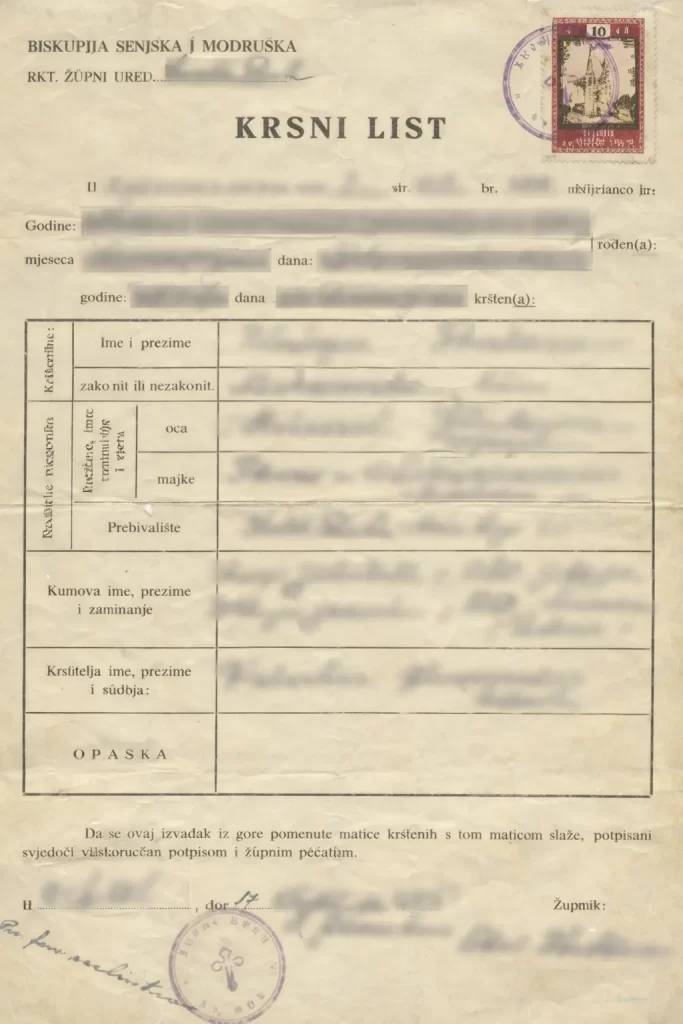
- Civil registry records are required for every generation
Major advantages
- Residency required: No
- Language test: No
- Dual citizenship: Allowed
- Spouse may also qualify (often overlooked)
This path explains most searches for: how to get dual citizenship in Croatia and Croatian dual citizenship
Croatian Citizenship by Marriage (Article 10)
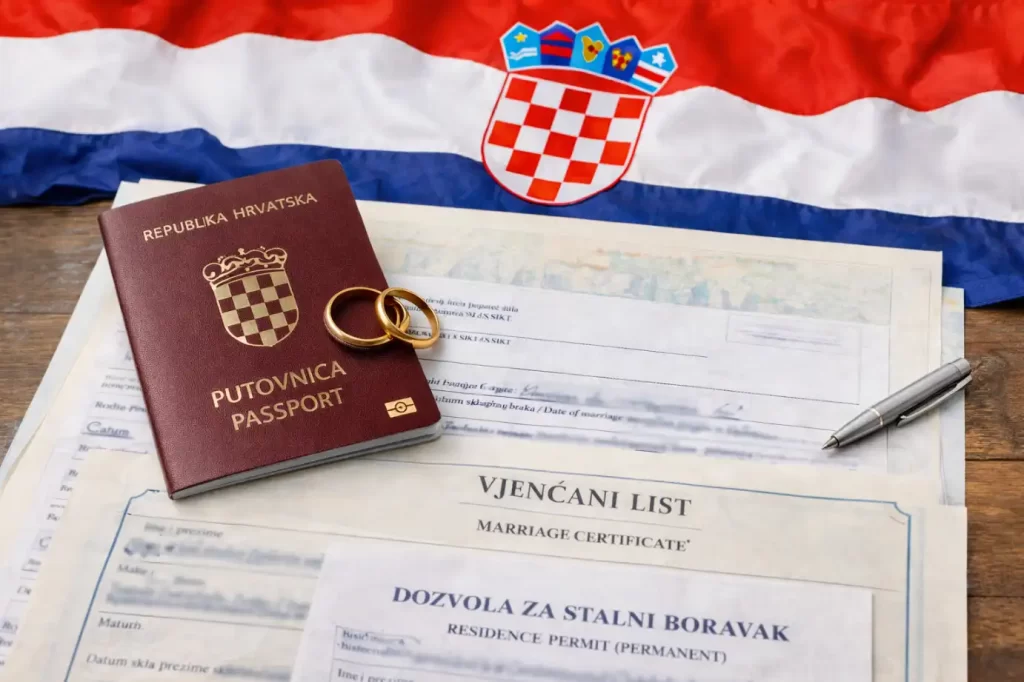
Many online guides are wrong about this route.
Correct legal reality (2026)
- Marriage alone does not grant citizenship
- The foreign spouse must first obtain permanent residence
- Permanent residence via marriage takes ~4 years
- Citizenship is applied for after permanent residence
Timeline
- Realistic total: ~5 years
Additional rules
- Language test: Required (unless exempt)
- Same-sex marriages and life partnerships: Treated equally
- Dual citizenship: Depends on route and circumstances
Members of the Croatian People (Article 16)
If you cannot prove a specific emigrant ancestor, you may still qualify if you can demonstrate:
- Declared Croatian ethnicity in official records
- Cultural or linguistic continuity
Common among ethnic Croats from Bosnia & Herzegovina and Serbia.
Major advantages
- Residency required: ❌ No
- Language test: ❌ No
- Dual citizenship: ✅ Allowed
Croatian Citizenship by Naturalization (Article 8)
This is the standard path without Croatian roots.
All requirements are mandatory
- Minimum 8 years of continuous legal residence
- Permanent residence status
- Croatian language & culture exam (B1 level)
- Clean criminal record
- Proof of integration
- Renunciation of previous citizenship
Residency rule
- Max absence: 10 months total in 5 years, or 6 months in one trip
Key limitation
- Dual citizenship: Not allowed
Croatian Citizenship by Special Interest (Article 12)
Granted exceptionally, not routinely.
Applies to individuals who provide:
- Significant economic contribution
- Scientific, cultural, or sporting value
- Clear national interest benefit
This is not an investment citizenship program. Dual citizenship may be allowed depending on the case.
Does Croatia Allow Dual Citizenship?
| Legal Basis | Dual Citizenship |
|---|---|
| Origin / Birth | Allowed |
| Descent (Art. 11) | Allowed |
| Croatian People (Art. 16) | Allowed |
| Marriage | Case-dependent |
| Naturalization (Art. 8) | Not allowed |
Yes, Croatia allows dual citizenship but only on specific legal bases.
Croatian Citizenship Requirements (General)
Applicants must generally:
- Be over 18
- Respect Croatian legal order
- Not pose a security risk
Additional requirements depend on the article used.
Croatian Citizenship Required Documents
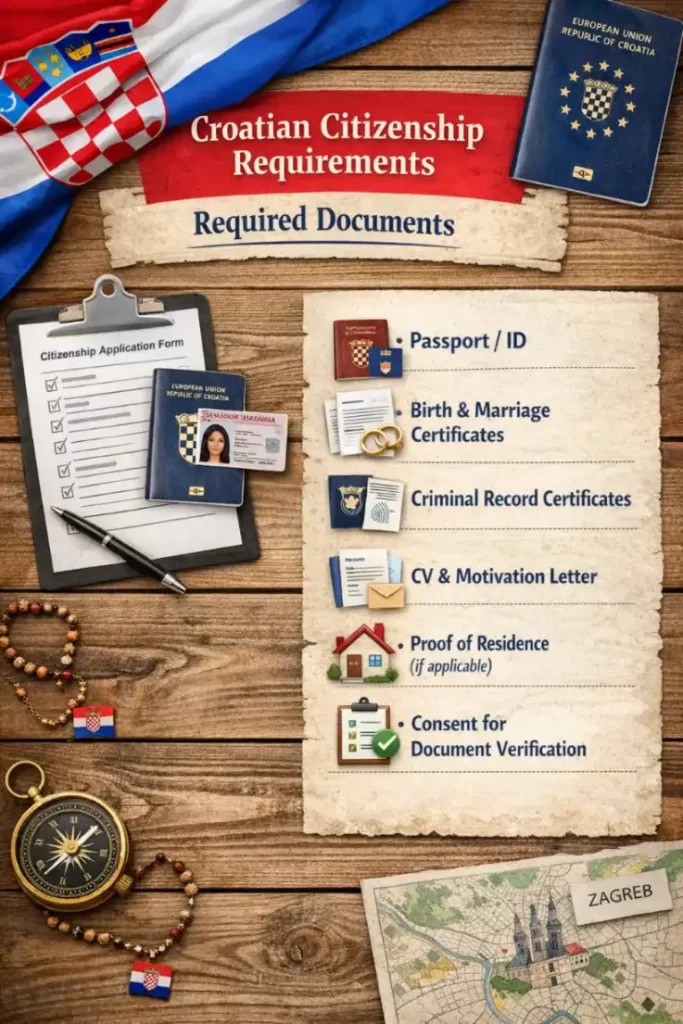
- Citizenship application form
- Passport / ID
- Birth & marriage certificates
- Criminal record certificates
- CV & motivation letter
- Proof of residence (if applicable)
- Consent for document verification
Foreign documents must be apostilled and officially translated.
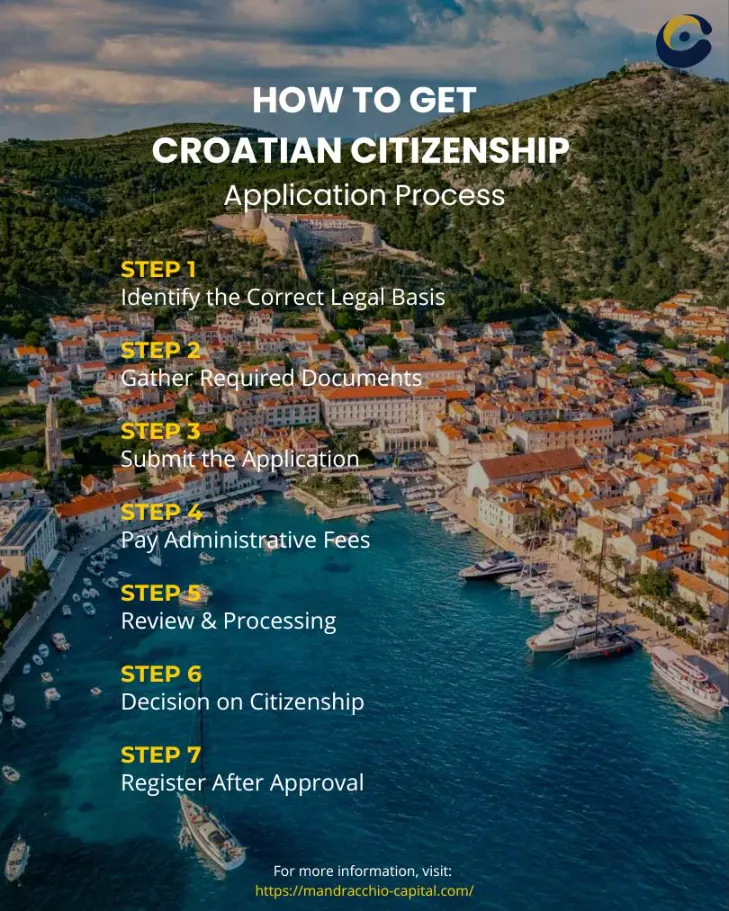
How to Get Croatian Citizenship: Application Process
Where to apply for Croatian Citizenship?
- Abroad: Croatian embassy or consulate
- In Croatia: Local police administration (MUP)
Applications are submitted in person
(Exception: disability → legal representative)
How to Apply for Croatian Citizenship?
Step 1 — Identify the Correct Legal Basis
Applying under the wrong article is one of the biggest reasons for rejection or long delays.
Step 2 — Gather Required Documents
Also confirming apostille + court translation requirements. This prevents you from collecting documents that later become invalid or unusable. Foreign documents usually must be apostilled and officially translated into Croatian
Step 3 — Submit the Application
You must apply in person:
- Outside Croatia: Croatian embassy/consulate
- Inside Croatia: competent police administration (MUP)
Step 4 — Pay Administrative Fees
Fees are typically paid during the process, not all at once.
Fees are typically paid during the process, not all at once.
Step 5 — Review & Processing
There is no public online tracker; updates are usually by mail or via the consulate.
Step 6 — Decision on Citizenship
If approved: You receive an official Decision on Admission to Croatian Citizenship. For naturalization, proof of release from prior citizenship may be requested (case-by-case)
Step 7 — Register After Approval (Critical Final Step)
After receiving a positive decision, your citizenship is recorded in the Knjiga državljana (Register of Citizens) — this enables you to request your Domovnica (Proof of Citizenship). Once you have your Domovnica, you can obtain your OIB (Personal Identification Number) and then apply for your Croatian passport.
How long does it take to get Croatian citizenship?
- Descent / origin: ~12–24 months
- Naturalization: Long-term path (8+ years total)
- Marriage-based citizenship: usually 12–24+ months
(Can take longer if the marriage history, residence status, or documents need extra verification.) - Special Interest (Article 12): typically 18–36+ months
(More discretionary, often involves higher-level review and additional supporting evidence.) - Re-admission / restoration (Article 15): around 6–18+ months
(Can be faster than other routes, but depends heavily on prior records in Croatia.) - Member of the Croatian people (Article 16): usually 12–24+ months
(May require proof of cultural/community ties + clean documentation chain.)
Honestly, the timelines are all over the place. I’ve heard of people getting Croatian citizenship through their grandparents in as little as 10 months, while others waited 2–3 years, and some are still stuck at 4–5 years with the same reply every time: ‘soon.’
A friend who applied through Chicago waited about a year just to get the Domovnica, then almost another year for the passport. Another family I know applied in March 2023 and got notified around 26 months later.
Note: The timelines vary by individual case, document completeness, country of filing, and government workload. Estimates are based on past client cases handled by Mandracchio Capital, not statutory minimums.
Croatian Citizenship Fees
| Item | Fee |
|---|---|
| Application fee | €139.36 |
| Final decision fee | €334.46 |
| Permanent residence | €83.62 |
| Biometric permit | €31.85–€59.73 |
| Language exam | ~€100–€150 |
Consular filing fees and document legalization are additional.
Special & Often Missed Scenarios
- Adoption: Adopted children of Croatian citizens may qualify
- Statelessness safeguards: Protects children at risk of statelessness
- Found in Croatia / parents unknown: Special provisions apply
- Guarantee before renunciation (Art. 8a): Allows safer renunciation planning
- Minor children: Can be included with parents under specific rules
Benefits of Croatian Citizenship
- EU freedom of movement & Long-Term Flexibility
- Visa-free travel to 170+ countries
- Easier travel in Europe and access during emergencies
- No residence requirement to maintain citizenship
- Education opportunities for children (often low-cost or free)
- Access to socialized healthcare systems in the EU
- Retirement flexibility: not just Croatia, but any EU country
- Ability to buy property, start a business, or relocate without visa
- High safety and quality of life
- Even if you never move, it still benefits children and grandchildren
Disadvantages of Croatian citizenship to consider
- No citizenship by investment
- Long timeline without ancestry
- Dual citizenship limits for naturalization
- Heavy documentation burden
How Mandracchio Capital Supports Your Croatian Citizenship Application
At Mandracchio Capital, we support you with end-to-end strategic guidance for Croatian residency and citizenship ensuring your application is legally correct, efficiently structured, and future-proof.
- Eligibility assessment
We analyze your personal, family, and residency background to confirm whether you qualify, and under which legal basis. - Correct article selection
Choosing the right article of the Croatian Nationality Law is critical. We identify the strongest, fastest, and safest route based on your profile. - Document mapping & compliance
We map every required document in advance, verify civil-registry chains, and ensure apostille and translation compliance, minimizing rejections and delays. - Residency + citizenship coordination
For applicants who need residence first (naturalization, marriage), we align temporary residence → permanent residence → citizenship into one coherent strategy.
Mandracchio Capital was founded by Prof. Dr. Šime Jozipović, an academic and legal expert with a long-standing focus on EU mobility, cross-border residency, and citizenship law.
Our work combines legal precision with real-world application experience, particularly for foreign founders, professionals, families, and diaspora applicants.
Over the years, we have supported hundreds of international clients in navigating Croatian company formation, residency permits, and long-term settlement strategies, many of whom later progressed to permanent residence or citizenship eligibility.
We worked with:
- Non-EU professionals and investors
- Croatian diaspora and descendants
- Families planning relocation or long-term EU access
- Founders using business residence as a strategic pathway
Our approach is advisory-led, not form-driven: we focus first on strategy, then on execution.
FAQ: Croatia Citizenship (2026)
How to Get Croatian Citizenship? There are 6 main legal bases for acquiring Croatian citizenship. Choosing the correct article is the most important strategic decision:
- Origin / Birth (Articles 4 & 5)
- Descent / Emigrants (Article 11)
- Naturalization (Article 8)
- Marriage (Article 10 + spouse-of-descendant via Article 11 where applicable)
- Special Interest (Article 12)
- Re-admission (Article 15)
Plus: “Member of the Croatian people” (Article 16) is an additional pathway often used when you cannot prove an emigrant ancestor but can prove Croatian affiliation.
How to get Croatian Citizenship by Descent?
Most applicants use Article 11 (emigrants and descendants). You generally qualify if you can prove:
- Your ancestor emigrated from Croatia before 8 October 1991, and
- You are a direct descendant in a straight line (child, grandchild, great-grandchild, etc.), supported by a complete civil-record “chain” (birth/marriage certificates linking each generation).
How do you get Croatian citizenship through descent?
You apply under Article 11 either:
- Abroad at a Croatian embassy/consulate, or
- In Croatia at MUP (police administration), if you’re applying locally.
You’ll submit: application form, ID, background/criminal record evidence (as required), and—most importantly—proof of lineage (civil registry records) showing your direct connection to the emigrant ancestor.
Is it easy to get citizenship in Croatia?
It depends on the basis:
- Easier (but paperwork-heavy): Descent (Article 11) and Origin (Articles 4/5), usually no residence requirement and generally no language/culture test for descent.
- Harder (time-heavy): Naturalization (Article 8), requires 8 years of lawful continuous residence, permanent residence, language/culture exam (with exemptions), and usually renunciation of prior citizenship.
So it’s “easy” only when your legal basis is strong and your documentation is clean.
Does Croatia allow dual citizenship?
Yes, Croatia allows dual citizenship, but not equally for all routes.
- Usually allowed: Origin (4/5), Descent (11), Croatian people (16), re-admission cases
- Usually restricted: Standard naturalization (8) often requires renouncing the prior citizenship (unless a specific exception applies)
Also: even if Croatia allows it, your current country might not, so you must check both sides.
Is it easy to get PR in Croatia?
PR (permanent residence / long-term residence) is typically more predictable than citizenship, but not necessarily “easy.”
- Most non-Croatian-root applicants qualify after 5 years of continuous lawful residence (with strict absence limits).
- PR usually requires proof of: stable residence basis, income/means, health insurance, and (in many cases) Croatian language knowledge (with exemptions depending on age/education).
PR is a major checkpoint because it’s usually required before citizenship by naturalization, and often for citizenship by marriage (Article 10).
How to obtain Croatian citizenship for myself and my family?
The “best” family strategy depends on which article you qualify under:
- If you qualify by descent (Art. 11): you may apply without living in Croatia, and your spouse may also qualify in many cases under the descent framework (big advantage). Minor children are typically planned into the same overall strategy via parent linkage and documentation.
- If you qualify by naturalization (Art. 8): children may be included depending on parents’ status and the child’s residence situation; plan PR and timing carefully.
- If citizenship is via marriage (Art. 10): expect a PR-first pathway, then citizenship, family planning depends on children’s current citizenship and residence.
For families, the #1 cause of delays is missing a single link in the birth/marriage chain or mismatched names/dates across records. Mapping the family tree to required documents before applying saves months.
Not sure which route applies to you? Send your question via email or the contact form below. We update this guide weekly using real client questions and recent case outcomes.