Last Updated: June 2025 | Reviewed by: Prof. Dr. Šime Jozipović, Mandracchio Capital
Many European countries offer retirement-style residence permits that allow non-EU citizens to live in Europe without working locally. These programs are typically designed for financially independent individuals who can support themselves through pensions, investments, or other passive income.
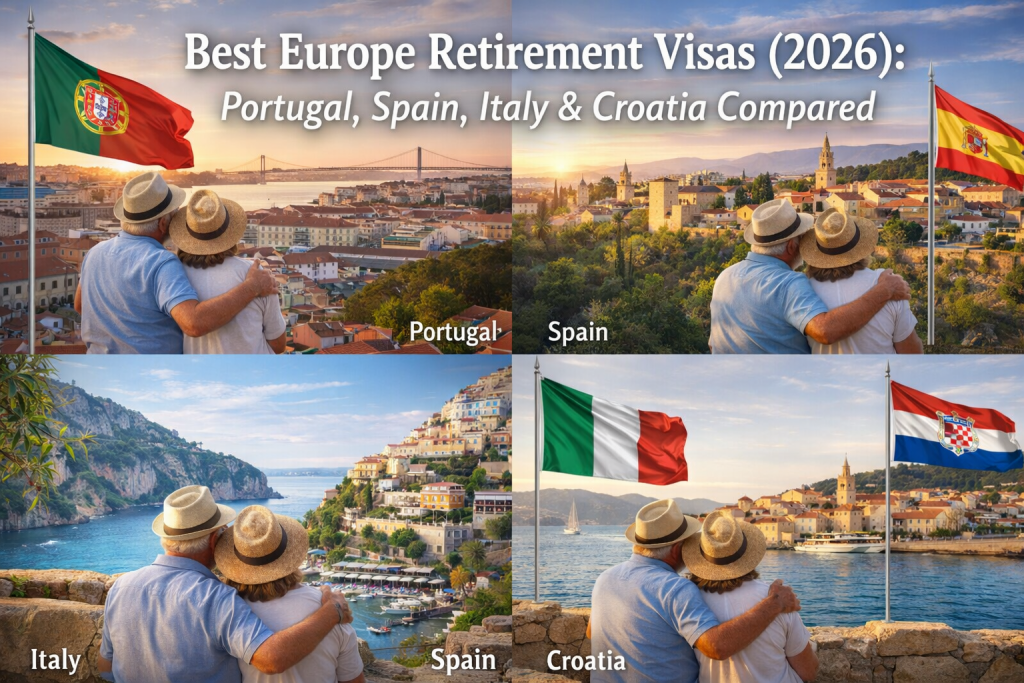
The best European retirement visas in 2026 include Portugal’s D7 Visa, Spain’s Non-Lucrative Visa, Italy’s Elective Residence Visa and Croatia’s residence permit for financially independent persons. Most require proof of passive income, private health insurance, and accommodation, while offering a pathway to permanent residency after approximately five years.
For a broader explanation of how passive-income residence permits work across Europe, see our guide on
retirement visas in Europe.
This guide compares the leading European retirement visa options in 2026, including income requirements, residency timelines, healthcare access, and which destinations may best suit international retirees.
Quick Overview: Best European Retirement Visas (2026)
| Country | Visa Type | Monthly Income (approx.) | Key Advantage |
|---|---|---|---|
| Portugal | D7 Passive Income Visa | ~€760 | Lowest income requirement |
| Spain | Non-Lucrative Visa | ~€2,400 | Lifestyle and healthcare |
| Italy | Elective Residence Visa | ~€2,580 | Culture and tax incentives |
| Greece | Financially Independent Person | ~€2,000 | Affordable Mediterranean living |
| France | Long-Stay Visitor Visa | ~€1,800 | Strong healthcare system |
| Croatia | Financially Independent Persons Residence | ~€2,500–€3,000 | Adriatic lifestyle with lower costs |
Portugal: D7 Passive Income Visa (lowest income threshold)
Spain: Non-Lucrative Visa (strong lifestyle + healthcare)
Italy: Elective Residence Visa (culture + tax incentives in some areas)
Greece: Financially Independent Person permit (affordable Mediterranean)
France: Long-Stay Visitor Visa (excellent healthcare access)
Croatia: Financially Independent Persons residence (EU + Adriatic lifestyle)
Why Europe Is One of the Best Places to Retire
For retirees from the United States, Canada, Australia, and other international markets, Europe offers a rare combination of quality of life, healthcare access, cultural heritage, and legal stability.
Healthcare
European healthcare systems are widely regarded as among the best in the world, consistently ranking high for access, quality, and patient outcomes, according to 2025 data from the European Observatory on Health Systems and Policies and the WHO Global Health Observatory. Countries such as France, Spain, Germany, and Portugal offer universal or near-universal healthcare access once legal residency is established. Even countries requiring private insurance for retirees, such as Croatia and Greece, have high-quality private healthcare at significantly lower costs than comparable services in the United States.
Lifestyle and Climate
Europe provides remarkable diversity of landscapes and lifestyles. Mediterranean regions such as Portugal, Spain, Italy, Greece, and Croatia offer warm climates, coastal living, and historic towns that attract retirees seeking a slower pace of life.
Safety and Stability
Many European countries rank among the safest globally. EU membership also provides a framework of legal stability, institutional transparency, and strong infrastructure, factors that are particularly important for retirees planning long-term residence abroad.
How Retirement Visas in Europe Work
European retirement visas are generally referred to legally as passive income residence permits or financially independent person permits.
According to the European Commission Migration Portal and national immigration authorities, these residence permits typically require proof of passive income, health insurance, and accommodation.
They allow non-EU citizens to live in a European country without taking local employment.
Most programs require:
- Proof of stable passive income (pension, dividends, rental income, or investments)
- Private health insurance
- Accommodation in the host country
- Clean criminal record
- Evidence that the applicant does not intend to work locally
Initial residence permits are typically granted for one to two years, with renewal options. After approximately five years of legal residence, many countries allow applications for permanent residency, and some also provide pathways to citizenship.
Residents may also benefit from Schengen Area mobility, allowing travel across 27 European countries within the standard 90/180-day rule.
Best European Retirement Visas in 2026
Below are the most widely used retirement residence programs for non-EU retirees.
Portugal – D7 Passive Income Visa
Portugal’s D7 Visa is widely considered the most accessible retirement visa in Europe.
It allows individuals with stable passive income to establish legal residence in Portugal and eventually apply for permanent residency or citizenship.
Key Details
- Minimum income: approximately €760 per month (based on the Portuguese minimum wage benchmark)
- Residence permit valid initially for 2 years
- Permanent residence eligible after 5 years
- Citizenship eligible after 5 years
Portugal combines a relatively low income threshold with a high quality of life. Cities such as Lisbon, Porto, and the Algarve region have well-established international communities and excellent infrastructure for retirees.
Portugal’s tax policies, including the historically popular Non-Habitual Resident (NHR) framework, have also made it attractive to foreign retirees seeking favourable tax treatment.
Spain – Non-Lucrative Visa
Spain’s Non-Lucrative Visa (NLV) allows financially independent individuals to live in Spain without engaging in local employment.
Key Details
- Minimum income: approximately €2,400 per month
- Private health insurance required
- Initial residence permit valid for 1 year
- Permanent residence after 5 years
Spain offers one of Europe’s highest standards of living, with excellent healthcare, vibrant culture, and world-class cuisine.
Popular retirement destinations include Valencia, Málaga, Alicante, and the Balearic Islands, all known for strong expat communities and Mediterranean climates.
Italy – Elective Residence Visa
Italy’s Elective Residence Visa is designed for retirees with substantial independent income who wish to live long-term in Italy.
Key Details
- Minimum income: approximately €31,000 annually
- Proof of accommodation required
- Private health insurance mandatory
- Permanent residence after 5 years
Italy’s cultural appeal is unmatched. Historic cities, renowned cuisine, and scenic landscapes, from Tuscany to the Amalfi Coast, make the country particularly attractive to retirees seeking lifestyle quality.
Some regions in southern Italy also offer 7% flat-tax incentives on foreign income for new residents.
Greece – Financially Independent Person Visa
Greece’s Financially Independent Persons visa provides a straightforward residency pathway for retirees who can demonstrate stable income.
Key Details
- Minimum income: approximately €2,000 per month
- Residence permit valid for 2 years
- Private health insurance required
- Citizenship eligibility after 7 years
Greece offers Mediterranean living at relatively moderate costs compared with Western Europe. Destinations such as Crete, the Peloponnese, and the Cyclades islands have become increasingly popular with international retirees.
France – Long-Stay Visitor Visa
France offers retirees a Long-Stay Visitor Visa, allowing non-EU nationals to reside in the country without employment.
Key Details
- Income requirement: roughly €1,800 per month
- Access to public healthcare after establishing residence
- Initial permit valid for 1 year
- Permanent residence after 5 years
France is frequently ranked among the best countries in the world for healthcare and quality of life. The country’s infrastructure, cultural institutions, and transportation networks make it particularly attractive for retirees seeking an active lifestyle.
Croatia – Residence for Financially Independent Persons
Croatia does not offer a specifically branded retirement visa. However, the Croatian Foreigners Act allows non-EU nationals to obtain temporary residence as financially independent persons, a framework that functions similarly to a retirement permit.
For a detailed explanation of eligibility, documentation requirements, and the application process, see our full guide on how to retire in Croatia.
Key Details
- Estimated income requirement: €2,500–€3,000 per month
- Private health insurance required
- Permanent residence possible after 5 years
For a detailed breakdown of housing costs, utilities, and typical monthly budgets, see our guide on
the cost of retiring in Croatia.
Croatia has become increasingly popular with international retirees in recent years. The country joined the Schengen Area in 2023, giving residents visa-free mobility across most of Europe.
Key advantages include:
- Adriatic coastal lifestyle
- Lower cost of living compared with Western Europe
- High safety levels
- EU membership and legal stability
Cities such as Split, Dubrovnik, and Zadar, as well as the Istrian peninsula, offer Mediterranean living with significantly lower property prices than comparable coastal destinations in Italy or France.
For retirees seeking a quieter European environment, Croatia represents an attractive balance between affordability, lifestyle, and stability.
Mandracchio Capital assists international retirees with legal planning for residence in Croatia, including financially independent person permits, property acquisition, and long-term relocation strategies.
Best European retirement destinations for Americans
American retirees are among the largest groups exploring European residence options.
The best choice often depends on income level and lifestyle preferences.
| Priority | Best Option | Why |
|---|---|---|
| Lowest income requirement | Portugal | Most accessible visa |
| Cultural lifestyle | Italy / Spain | Food, history, climate |
| Affordable coastal living | Croatia / Greece | Lower cost Mediterranean |
| Fastest citizenship path | Portugal | Citizenship after 5 years |
For retirees seeking affordability and coastal living, Croatia and Greece increasingly appear as strong alternatives to the more established Western European destinations.
Income thresholds are based on official government guidance and publicly available immigration requirements published by national authorities.
How to Choose the Best European Retirement Visa
Selecting the right retirement visa requires balancing several factors.
Income Requirements
Each country sets different financial thresholds. Portugal’s D7 requires the lowest income, while Italy’s elective residence visa requires significantly higher financial proof.
Healthcare Access
Some countries eventually allow access to public healthcare systems, while others require ongoing private coverage.
Tax Considerations
International retirees, particularly Americans, must consider cross-border tax obligations, including the impact of tax treaties and local residency rules.
Long-Term Residency Goals
If permanent residence or EU citizenship is a goal, the required timeline and conditions differ significantly between countries.
Is Croatia an Underrated Retirement Destination?
Croatia remains one of the most underrated retirement destinations in Europe.
The country offers over 1,200 Adriatic islands, historic coastal towns, and a Mediterranean climate comparable to Italy or Greece. Yet the cost of living remains significantly lower than Western European equivalents.
Croatia also ranks among the safest countries in Europe, and EU membership provides strong institutional stability.
For retirees seeking a quieter lifestyle with access to Europe’s broader travel network, Croatia offers a compelling alternative to more expensive Mediterranean destinations.
Professional Legal Support for Croatian Residence
Navigating Croatian residence law, property purchases, and tax considerations requires specialist local expertise.
Mandracchio Capital is a Croatian legal advisory firm specialising in:
- residence and immigration law
- real estate transactions
- international tax planning
- cross-border legal matters
The firm was founded by Prof. Dr. Šime Jozipović, Associate Professor of Tax Law and European Business Law at the University of Split.
Mandracchio Capital advises international retirees seeking to establish legal residence in Croatia and provides support throughout the residency application process.
Frequently Asked Questions
Which European country has the easiest retirement visa?
Portugal’s D7 Visa is widely considered the most accessible retirement visa in Europe due to its relatively low income requirement and clear path to citizenship.
Which retirement visa in Europe requires the lowest income?
Portugal currently offers the lowest income threshold among major European retirement visas.
Can Americans retire in Croatia?
Yes. American citizens can obtain Croatian residence through the financially independent persons permit, provided they demonstrate sufficient passive income, accommodation, and health insurance.
Do retirement visas allow work?
Most retirement visas prohibit local employment. They are designed for individuals supported by pensions or passive income.
What Is the Easiest Retirement Visa in Europe?
Portugal’s D7 Visa is widely considered the easiest European retirement-style visa for many applicants because it has one of the lowest income thresholds and a well-documented path to long-term residence. However, “easiest” depends on your income source, consular processing, and whether you can meet stay requirements. Greece and Croatia can also be practical options for retirees with higher monthly passive income.
Which European Retirement Visa Has the Lowest Income Requirement?
Among major European retirement-style visas, Portugal’s D7 Visa typically has the lowest income requirement, often benchmarked against the Portuguese minimum wage for the main applicant. Other popular options, Spain, Italy, Greece, France, and Croatia generally require higher monthly proof of funds or passive income.
Do European retirement visas allow work?
Most retirement-style permits prohibit local employment and require passive income. If you intend to work, you typically need a different residence category.
How long to permanent residency in Europe as a retiree?
Many countries allow permanent residency after about 5 years of continuous legal residence, but the rules vary by visa type and country.
Can Americans retire in Croatia?
Yes. Americans can apply for temporary residence as financially independent persons if they meet income, insurance, and accommodation requirements.
{ “@context”: “https://schema.org”, “@type”: “FAQPage”, “mainEntity”: [ { “@type”: “Question”, “name”: “Which European country has the easiest retirement visa?”, “acceptedAnswer”: { “@type”: “Answer”, “text”: “Portugal’s D7 Visa is widely considered the most accessible retirement-style visa in Europe due to its relatively low income requirement and clear pathway to long-term residence and citizenship. However, what is easiest depends on factors such as income source, residency obligations, and consular processing rules.” } }, { “@type”: “Question”, “name”: “Which retirement visa in Europe requires the lowest income?”, “acceptedAnswer”: { “@type”: “Answer”, “text”: “Portugal’s D7 Visa generally has the lowest income threshold among major European retirement-style residence permits, typically benchmarked to the Portuguese minimum wage. Other countries such as Spain, Italy, Greece, France, and Croatia usually require higher proof of passive income or financial resources.” } }, { “@type”: “Question”, “name”: “Can Americans retire in Croatia?”, “acceptedAnswer”: { “@type”: “Answer”, “text”: “Yes. American citizens can obtain Croatian residence as financially independent persons if they demonstrate sufficient passive income, valid health insurance, and accommodation in Croatia. The permit is typically issued as temporary residence and may be renewed annually, with permanent residence possible after several years of legal stay.” } }, { “@type”: “Question”, “name”: “Do European retirement visas allow work?”, “acceptedAnswer”: { “@type”: “Answer”, “text”: “Most European retirement-style residence permits prohibit local employment because they are designed for individuals supported by pensions, savings, or passive income. If you intend to work locally, you typically need a different residence category such as a work permit or business residence permit.” } }, { “@type”: “Question”, “name”: “How long does it take to obtain permanent residency in Europe as a retiree?”, “acceptedAnswer”: { “@type”: “Answer”, “text”: “In many European countries, permanent residency can be obtained after approximately five years of continuous legal residence. However, the exact timeline depends on the country, visa type, and whether minimum stay requirements are met each year.” } } ] }