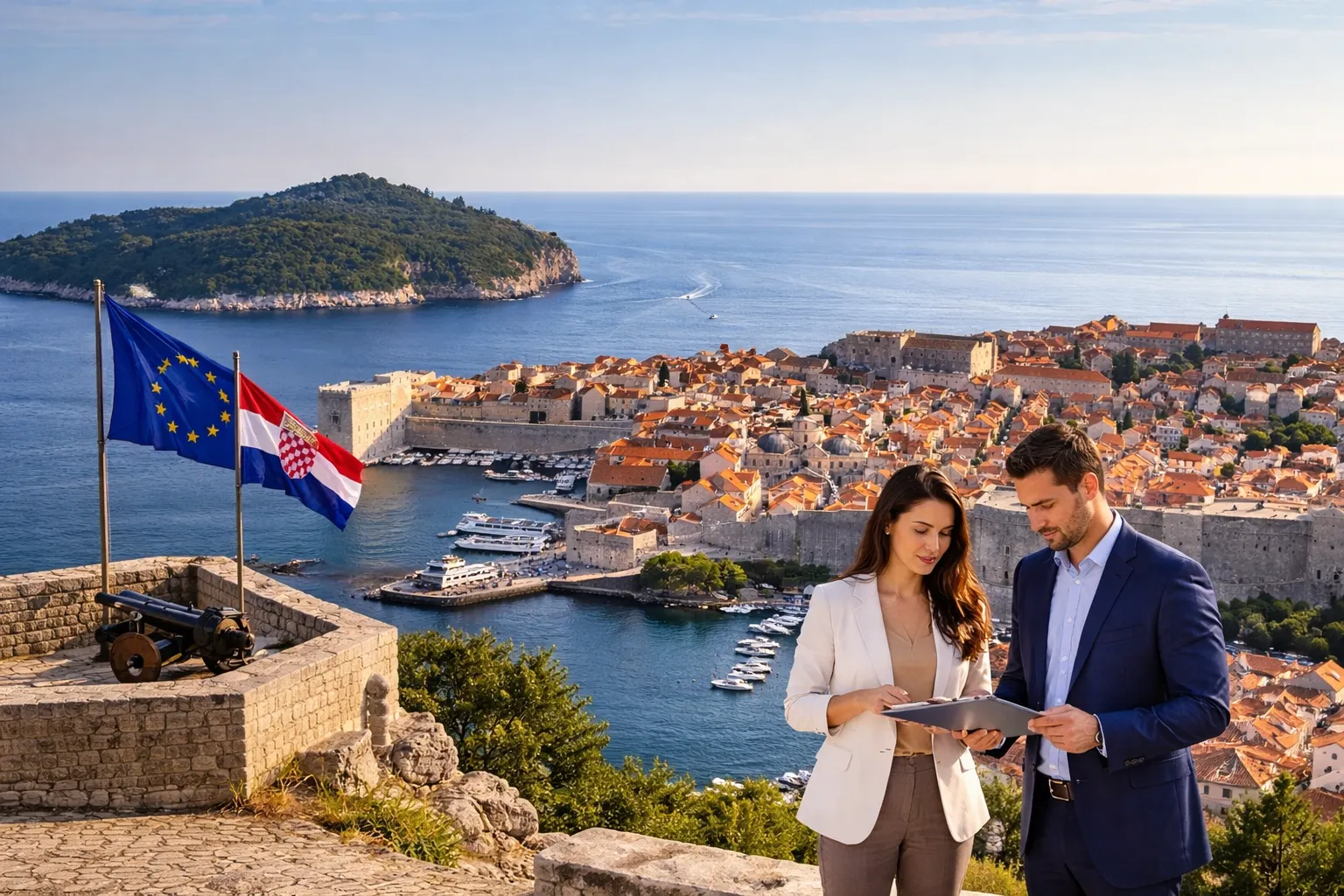
If you are a foreigner living, investing, working, or running a business in Croatia, your tax exposure depends primarily on one factor: tax residency status. This is also the starting point for understanding the broader issue of taxation for expats living in Croatia, especially where cross-border income, pensions, dividends, or remote work arrangements are involved.
Do Foreigners Pay Tax in Croatia? Yes. Foreigners may be required to pay tax in Croatia depending on their tax residency status. Croatian tax residents are taxed on worldwide income, while non-residents are taxed only on Croatian-source income such as salary, rental income, or business profits earned in Croatia.
Croatia follows standard EU taxation principles, but it also applies strict residency rules, withholding taxes, and local tax elements that foreign individuals often underestimate.
My name is Šime Jozipović, founder and CEO of Mandracchio Capital. As a Croatian lawyer based in Split, with a Master of Laws (LL.M.) from Harvard Law School and a doctorate in international tax planning. I write this guide to explain everything you need to know about tax in Croatia for foreigners in 2026, including:
- Income tax rules for foreign residents and non-residents
- Corporate tax for foreign-owned companies
- Withholding tax on dividends and cross-border payments
- VAT obligations
- Property tax
- Capital gains
- Permanent Establishment (PE) risks
- US expat considerations
Key Takeaways
- Important: Croatia has a fully active double taxation treaty with the UK, in force since 2015, but its provisions treat different types of income very differently, particularly pensions.
- Key Insight: Croatia and the United States signed a double taxation agreement in December 2022, but it has not yet entered into force. US citizens must currently rely on domestic tax relief mechanisms.
- Crucial: Croatia and Australia signed a new double taxation agreement in November 2025, which is still pending ratification. Australian residents currently rely on the Foreign Income Tax Offset to manage cross-border tax liability.
- Essential: Tax residency determines which country has the primary right to tax your income. Establishing Croatian tax residency can trigger significant tax obligations as well as treaty protections.
- Practical Tip: Obtaining a certificate of tax residency from your home country’s tax authority is often required before claiming treaty benefits with the Croatian Tax Administration (Porezna uprava).

Understanding the Broader Croatia Tax System
While this guide focuses specifically on tax in Croatia for foreigners, it is important to understand how the broader Croatian tax framework operates.
Croatia applies a structured system divided between national and local authorities, covering personal income tax, corporate income tax, VAT, capital taxation, property-related taxes, and mandatory social security contributions. Municipalities also have discretion over certain income tax rates and property tax levels.
For a full structural breakdown of how taxation is organised across national and local levels, see our detailed pillar guide on the Croatia Tax System.
Overview tax in Croatia for foreigners
| Tax Type | Rate | Notes |
|---|---|---|
| Personal Income Tax | 15% – 33% | Rates depend on municipality |
| Corporate Income Tax | 10% / 18% | 10% rate applies to companies with revenue under €1M |
| Dividend Tax | 10% | Final withholding tax for individuals |
| Capital Gains Tax | 12% | Shares may be exempt after 2 years of ownership |
| Value Added Tax (VAT) | 25% | Reduced rates of 13% and 5% apply to certain goods and services |
| Real Estate Transfer Tax | 3% | Typically paid by the property buyer |
Do Foreigners Pay Tax in Croatia? Tax in Croatia for foreigners
Yes but how much you pay depends on your residency status.
Croatia distinguishes between:
Croatian tax residents
Taxed on worldwide income
Non-residents
Taxed only on Croatian-source income
This distinction is critical.
In practice, many foreign nationals unintentionally trigger Croatian tax residency by relocating mid-year without reviewing their “center of life” position. Even partial-year relocation can create worldwide taxation exposure if residency criteria are met.
(Croatian tax residency rules are primarily governed by the Croatian Income Tax Act (Zakon o porezu na dohodak) and related implementing regulations issued by the Croatian Tax Administration (Porezna uprava))
Tax for Foreign Retirees in Croatia
In practice, the system is relatively predictable, but it depends heavily on residency status, pension type, and applicable double taxation treaties.
Pension Tax Rates
Foreign pensions received by Croatian tax residents are generally treated as income similar to employment income. Current Croatian income tax brackets apply:
- 20% on the monthly tax base up to €3,981.68
- 30% on the portion above that amount
However, for many pension payments, Croatian law applies an immediate 50% reduction to the calculated tax, which effectively results in lower effective tax rates. Depending on the income level and personal allowances, retirees often see effective taxation in roughly the 10–15% range, though individual situations vary.
Foreign Pension Taxation
Foreign pensions are typically taxable in Croatia once you become a tax resident. However, double taxation agreements (DTAs) between Croatia and other countries determine which country has the primary right to tax the pension.
For example:
- Some treaties allow Croatia to tax private pensions if the retiree lives there.
- Certain government or public service pensions may remain taxable only in the country that pays them.
Because treaty provisions differ, retirees should always check the rules that apply to their specific country of origin.
Administrative Requirements
Foreign retirees receiving pension income usually need to complete several administrative steps:
- Register with the Croatian Tax Administration (Porezna uprava)
- Submit Form RPO to obtain a Croatian tax card and apply personal allowances
- Report foreign pension income for tax calculation purposes
In many cases, registration must occur within eight days of receiving taxable income in Croatia.
Other Relevant Taxes
Croatia does not impose certain taxes common in other jurisdictions:
- No net wealth tax
- No inheritance tax for close family members
However, general consumption taxes still apply, including VAT (PDV) of 25% on most goods and services.
Because pension taxation depends on tax residency status, treaty provisions, and income structure, foreign retirees should review their situation carefully before relocating to Croatia. Proper tax planning can often prevent double taxation and clarify long-term obligations.
Tax for Digital Nomads Living in Croatia
Croatia introduced a dedicated residence pathway through the Croatia Digital Nomad Residence Permit, allowing non-EU remote workers to live in Croatia while working for foreign employers or clients.
A key feature of this program is that digital nomads are generally exempt from Croatian income tax on foreign employment income, provided certain conditions are met.
This means that a digital nomad who:
- works remotely for a non-Croatian company
- receives income from outside Croatia
- does not perform services for Croatian clients
may not be subject to Croatian income tax on that income during the validity of the digital nomad residence permit.
However, several important limitations apply.
Key Conditions for Digital Nomads
Digital nomads typically must:
- work exclusively for a foreign employer or foreign clients
- avoid providing services to Croatian companies
- maintain foreign-sourced employment income
If these conditions are not respected, Croatian tax authorities may treat the income differently.
Tax Residency Still Matters
Holding a digital nomad residence permit does not automatically eliminate tax residency considerations.
If a digital nomad:
- remains in Croatia long-term
- establishes strong personal or economic ties
- transitions to another residence permit
Croatian tax residency rules may eventually apply.
Tax Residency Rules in Croatia
A foreigner is generally considered a Croatian tax resident if:
- You stay in Croatia more than 183 days in a tax year
- You maintain a permanent home in Croatia
- Your “center of life” (family, economic interests) is in Croatia
If classified as resident, Croatia may tax:
- Salary earned abroad
- Foreign pensions
- Dividends
- Rental income
- Capital gains
Non-residents are taxed only on Croatian-source income.
Key Aspects of Croatian Tax Residency
- 183-Day Rule: Presence in Croatia for at least 183 days in one or two consecutive calendar years triggers tax residency.
- Habitual Residence: You are a resident if you own or possess a home available to you for at least 183 days, regardless of actual occupancy.
- Center of Vital Interests: If you have homes in two countries, residency is determined by where your family resides (spouse, children).
- Worldwide Income: Tax residents must report and pay taxes on income earned in Croatia and abroad.
- Non-Resident Status: Individuals without a home or habitual abode who do not spend 183 days in Croatia are considered non-residents, paying tax only on Croatian-sourced income.
- Digital Nomads: Income connected to digital nomad status may be exempt from income tax.
Why Deregistering Tax Residency Is Not Optional
One of the most misunderstood aspects of the Croatian tax system is that tax residency does not automatically end when you leave the country.
Many individuals assume that:
- deregistering their address, or
- leaving the Croatian health insurance system
is enough.
In practice, this is incorrect.
To formally cease being a Croatian tax resident, you must go through the official procedure with the Croatian Tax Administration, typically by submitting Form TI.
Without this step:
- You may still be treated as a Croatian tax resident
- You may be required to report worldwide income in Croatia
- Double taxation risks increase significantly, even if you already pay tax abroad
In short: Leaving Croatia ≠ ending Croatian tax residency
Croatia Income Tax for Foreigners
Croatia applies a decentralised income tax system.
Municipalities choose their rates within national bands:
- Lower rate: approx. 15%-23%
- Higher rate: approx. 25%-33%
If a municipality does not set rates, default national rates apply.
Key point for foreigners:
Your tax rate depends on where you live in Croatia, not just how much you earn.
Certain capital income is taxed at final flat rates (most commonly 12%).
Tax on Salary for Foreign Employees
If you work in Croatia:
- Employee pension contribution: 20%
- Employer health contribution: 16.5%
- Income tax applied on taxable base after allowances
Total employment cost in Croatia is significantly higher than net salary due to mandatory contributions.
Tax on Dividends and Capital Gains
Dividend tax (individuals):
10% (final withholding)
Capital gains tax:
12% on shares and financial assets
A two-year holding exemption may apply to certain financial assets.
Real estate capital gains:
Exempt if owned for more than two years and not used for business activity.
Otherwise taxable.
Croatia Corporate Tax for Foreign-Owned Companies
Croatia corporate tax rates (2026):
- 10% (revenue up to €1,000,000)
- 18% (above €1,000,000)
Foreigners can fully own Croatian companies.
Resident companies are taxed on worldwide profits.
Non-resident companies are taxed if they create a Permanent Establishment (PE).
Permanent Establishment (PE) Risk for Foreign Companies
We regularly see foreign investors surprised by the interaction between PE rules and management presence in Croatia.
Foreign companies may become taxable in Croatia if:
- They have a fixed place of business
- A dependent agent operates in Croatia
- Strategic management is exercised from Croatia
If management and control are effectively in Croatia, the company may be treated as Croatian tax resident.
In practice, Permanent Establishment risks most commonly arise when foreign founders continue operating their overseas company while living in Croatia. Strategic decision-making from Croatian territory may shift the company’s effective management location.
Withholding Tax in Croatia (2026)
Croatia applies withholding tax on payments to non-residents:
- Dividends: 15%
- Interest: 15%
- Royalties: 15%
- Certain service payments: 15%
Rates may be reduced under Croatia Double Taxation Treaties or EU directives.
VAT in Croatia for Foreigners
Croatia VAT rate (standard): 25%
Reduced rates: 13% and 5%
VAT registration becomes mandatory once turnover exceeds €40,000 annually.
Foreign entrepreneurs operating in Croatia may need:
- Croatian VAT number
- Local invoicing compliance
- E-fiscalisation reporting
OSS / IOSS systems apply for EU cross-border sales.
In practice, VAT issues for foreign entrepreneurs usually arise from cross-border digital services and misunderstood place-of-supply rules. Early structuring often prevents later compliance penalties.
Property Tax in Croatia for Foreigners
From 1 January 2025, Croatia introduced an annual property tax.
The tax applies primarily to:
- Secondary homes
- Vacant properties
- Non-primary residences
Primary residences are typically exempt.
Rates range from €0.60 to €8.00 per m² per year, depending on municipality.
For a detailed breakdown of exemptions, calculation methods, municipal discretion, and compliance risks, see our full guide to Croatia Property Tax.
Why this matters: Property ownership is one of the most common triggers of unexpected local tax obligations for foreign investors in Croatia.
Real Estate Transfer Tax
Real Estate Transfer Tax (RETT):
- 3% of market value
- Paid by buyer
- Applies when transaction is not subject to VAT
Tax on Foreign Pension Income
If you become Croatian tax resident, your foreign pension may become taxable in Croatia.
Treatment depends on:
- Public vs private pension
- Applicable Double Taxation Treaty
- Credit or exemption method
Proper treaty analysis is essential.
US Citizens Living in Croatia
US citizens remain subject to US taxation regardless of residence.
If resident in Croatia, they may face:
- Croatian worldwide taxation
- US federal filing obligations (Form 1040)
- FBAR reporting
- Treaty coordination
The US–Croatia Double Taxation Treaty helps reduce double taxation but does not remove filing obligations.
OECD Pillar Two (Global Minimum Tax)
Large multinational groups with revenue above €750 million are subject to a 15% global minimum effective tax rate under OECD Pillar Two rules.
Most small foreign founders are unaffected.
E-Invoicing and Fiscalisation
Croatia expanded mandatory e-invoicing from 1 January 2026.
Applies to:
- B2B
- B2G
- B2C transactions
Foreign businesses operating in Croatia must ensure compliant invoicing software.
Frequently Asked Questions – Tax in Croatia for Foreigners
Do foreigners pay tax in Croatia?
Yes. Foreigners may be required to pay tax in Croatia depending on their tax residency status and the source of their income. Non-residents are generally taxed only on Croatian-source income, while tax residents are taxed on worldwide income.
What is tax residency in Croatia?
You are typically considered a Croatian tax resident if you:
- spend more than 183 days in Croatia during the relevant tax period
- maintain a permanent home in Croatia
- have your centre of personal or economic interests located in Croatia
Once tax residency is established, Croatia generally has the right to tax your global income, subject to applicable double taxation agreements.
Is Croatia a high-tax country?
Croatia’s corporate tax system is relatively competitive, with rates of:
- 10% for small businesses
- 18% for larger companies
However, labor taxation can be higher due to mandatory social security contributions and municipal surtaxes.
Can Croatia tax my foreign income?
Yes. If you are classified as a Croatian tax resident, Croatia may tax your worldwide income, including earnings from foreign employment, investments, or business activities. In many cases, double taxation agreements allow foreign taxes already paid to be credited against Croatian tax liabilities.
Is there wealth tax in Croatia?
No. Croatia currently does not impose a general wealth tax on individuals.
Is property tax high in Croatia?
Property taxation in Croatia is generally moderate compared with many EU countries. However, the exact tax burden depends on the location of the property and local municipal regulations.
Do I need an OIB number in Croatia?
Yes. The OIB (Personal Identification Number) is required for nearly all financial and legal activities in Croatia, including:
- paying taxes
- opening a bank account
- purchasing property
- registering a company
It is issued by the Croatian Tax Administration (Porezna uprava).
What should foreigners know about Tax in Croatia for Foreigners?
Understanding Tax in Croatia for Foreigners requires reviewing several key factors, including tax residency status, applicable double taxation agreements, income type, and reporting obligations. Foreign residents should carefully assess how Croatian tax rules interact with the tax system of their home country to avoid double taxation and remain compliant with international tax regulations.
Conclusion: What This Means for Foreigners
Understanding tax in Croatia for foreigners requires more than knowing tax rates.
Residency classification, treaty protection, PE risks, and social contributions can significantly affect your overall tax burden.
Before relocating or starting business operations in Croatia, a structured cross-border tax review is strongly recommended.
Mandracchio Capital Experience in Croatian Tax Matters
Mandracchio Capital, founded by Prof. Dr. Šime Jozipović, is a Croatia-based legal and business advisory firm supporting international founders, investors, and expatriates navigating Croatia’s regulatory and tax framework.
The firm regularly advises clients on matters including:
- Croatian tax residency and cross-border taxation
- corporate structuring and market entry into Croatia
- international tax compliance and reporting obligations
- property taxation and real estate transactions
Our advisory work focuses on the practical application of Croatian tax law in international contexts, helping clients understand how Croatian regulations interact with the legal and tax systems of their home countries.
This approach is particularly relevant for individuals relocating to Croatia, foreign investors establishing a local presence, and expatriates managing cross-border income streams.