
Overwhelmed by conflicting information about company liquidation in Croatia?
Worried about hidden costs, unexpected tax bills, or personal liability when terminating a business?
We’ve seen many founders struggle not because they wanted to close a company but because they didn’t understand the rules early enough.
If you’re already doing business in Croatia or planning to start a company in Croatia, knowing how to close a d.o.o. properly is just as important as knowing how to open one. In this guide, we walk you through every legal way on how to close a company in Croatia, explain real costs, timelines, and risks, and show you how to exit cleanly, compliantly, and permanently under Croatian law in 2026.

Key Takeaways
- Closing a company in Croatia follows two main paths:
- Simplified Dissolution: For solvent companies with no assets, debts, or employees (approx. 2–3 months).
- In addition: companies may cease to exist through court judgment or bankruptcy proceedings.
- Regular Liquidation: For companies with remaining assets or liabilities (approx. 1.5–2 years).
Legal Framework Governing Company Closure in Croatia
Company termination procedures (except bankruptcy) are governed primarily by the Companies Act (Zakon o trgovačkim društvima).
Bankruptcy is regulated separately under the Bankruptcy Act.
Key institutions involved:
- Trgovački sud (Commercial Court)
- Narodne novine
- Croatian Tax Administration
- FINA Financial Agency
- Ministry of Justice, Public Administration and Digital Transformation
Closing a Croatian limited liability company (d.o.o.) is a regulated legal process that must be executed correctly to avoid post-closure liability, tax reassessments, or creditor claims.
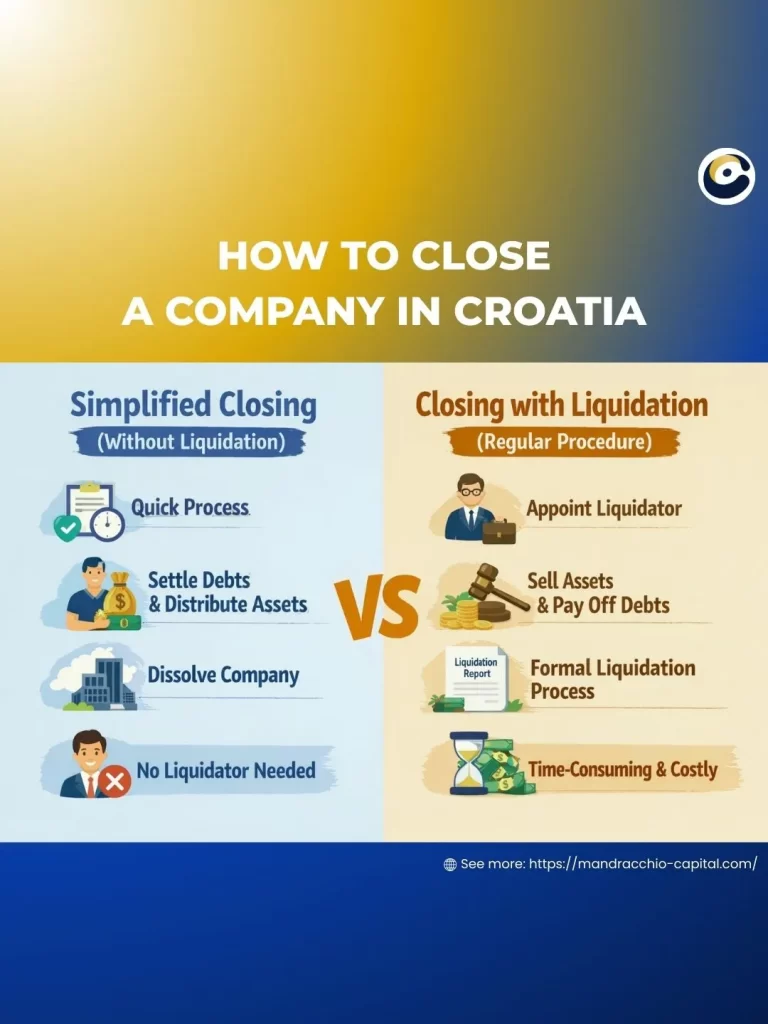
Two Main Ways to Close a company in Croatia
Simplified Closing of a d.o.o. (Without Liquidation): Croatia allows a shortened, low-cost closure procedure without liquidation. This option was introduced because liquidation procedures are often lengthy, complex, and expensive.
and the second way is Regular closure through liquidation (likvidacija), which follows the standard winding-up procedure
When Is Simplified Closing Allowed?
- All company members unanimously agree
- The company has no outstanding obligations, including:
- Employees or former employees
- Creditors (disputed or undisputed)
- Taxes, social contributions, or other public levies
- The company does not perform activities listed in Article 34(4) of the Companies Act (activities requiring special permits or reserved by law)
- Personal Liability: Shareholders must sign a notarized statement agreeing to be jointly and severally liable with their personal assets for any company debts that appear within 2 years of deletion.
- Asset Distribution Plan: Even if the company has zero assets, the notarized decision must include a Plan for Distribution of Assets (Plan raspodjele imovine).
This procedure is commonly used for:
- Dormant companies
- Never-traded d.o.o.s
- Project-based entities that settled all obligations
Simplified dissolution without liquidation: Simplified closure process
1. Notary Procedure
All members must appear before a javni bilježnik and provide:
- Odluka o prestanku društva (Decision on termination)
- A notarized declaration confirming:
- The company has no outstanding obligations
- Members accept joint and several liability for any later-discovered debts
The notary files the application with the Trgovački sud.
2. Public Notice & Creditor Period
- The court publishes a notice in Narodne novine
- Creditors have 30 days to submit claims
If a creditor files a valid claim:
- The procedure automatically converts into liquidation
- Members may become personally liable
If no claims are filed:
- The company is deleted after the 30-day period
Timeline: ~2 months
Approximate cost: €199
Obligations & Tax Steps for Simplified Closure
1. Director Insurance & Contribution Risk (Critical)
A director must exist until deletion of the company.
If a director:
- Is not employed, or
- Is registered on a lower contribution base than the statutory minimum
→ The Croatian Tax Administration may assess additional social contributions.
If assessed after deletion, the liability is personal, not corporate.
2. Mandatory Notification to the Tax Administration
- Must be filed at least 30 days before formal closure actions
- Formal actions include:
- Signing notarial documents
- Filing with the court register
Can be done:
- Directly, or
- Through legal counsel with power of attorney
3. Tax Clearance Certificate
A certificate confirming no outstanding public debts is mandatory.
This certificate does not only cover Corporate Income Tax (CIT / porez na dobit). In Croatia, “public debts” can include all financial obligations owed to the state, such as:
- VAT (PDV) if the company is registered in the VAT system
- Social security contributions pension and health insurance payments for employees and/or the director
- Mandatory chamber fees contributions to the Croatian Chamber of Economy (HGK) or the Croatian Chamber of Trades and Crafts (HOK)
- Tourism and forestry fees Croatia-specific charges that foreign founders often overlook
Best practice:
- Pre-check via e-Porezna: Your accountant should review the company’s balance in the e-Tax portal about 1 week in advance to resolve any minor discrepancies.
- Clear small outstanding amounts: Pay any remaining balance (even a few euros extra) to cover daily interest accruals.
- Request the official certificate from the Tax Administration.
- Notarize immediately: Ideally, notarization should happen within 24 – 48 hours after the certificate is issued.
- Timing tip: The certificate should be issued on the same day or one day before notarization, because courts may independently verify your tax status.
4. Corporate Income Tax After Dissolution
Under Article 35 of the Corporate Income Tax Act:
- Final tax return must be submitted within 8 days of the tax period’s end
For simplified closure:
- The tax period ends on the date the court determines dissolution
5. Financial Statements After Closure (FINA)
Even after deletion, the company must submit to FINA:
- GFI for public disclosure
- Within 6 months of business termination
- (Accounting Act, Art. 47)
- GFI for statistical purposes
- By 30 April of the following year
- (Accounting Act, Art. 50)
6. Retention of Business Records
After dissolution, records must be preserved:
Retention periods (Accounting Act, Art. 10):
- 11 years – accounting books and journals
- 6 years – payroll records
Documents may be:
- Kept by the owner, or
- Entrusted to the Croatian Chamber of Commerce
Electronic storage is permitted.
Closing a company With Liquidation (Regular Procedure)
Liquidation (likvidacija) is the standard legal procedure to close a Croatian d.o.o. when the company cannot be shut down immediately or when it has assets, liabilities, or potential creditor exposure.
In practice, liquidation is required when:
- The company still has assets and/or creditors
- The company has unresolved obligations (tax, payroll, invoices, contracts)
- You cannot meet the legal conditions for a simplified closure
- The company had business activity that requires formal winding down
1. File the liquidation decision with the Commercial Court (Trgovački sud)
The shareholders adopt a formal decision to liquidate the company and submit it to the court for registration.
2. Update the company name to include “u likvidaciji”
Once registered, the company’s official name must include:
“u likvidaciji” (in liquidation)
This signals to banks, partners, and public authorities that the company is in the closing phase.
3. Appoint a liquidator (usually the director)
A liquidator is responsible for managing the company during liquidation. In most cases, the liquidator is the existing director, but a different person can be appointed if needed.
4. Close operations and collect receivables
The liquidator must:
- finish outstanding business activities (if any)
- issue final invoices (if applicable)
- collect unpaid receivables
- terminate or settle ongoing contracts
5. Settle creditors and clear public debts
Before the company can be deleted, it must settle:
- supplier invoices and private debts
- payroll obligations (if employees exist)
- taxes and contributions
- any other outstanding liabilities
This step often requires careful accounting reconciliation and communication with the Tax Administration.
6. Prepare liquidation reports (opening + closing)
Croatian law typically requires formal reporting, including:
- opening liquidation balance/report
- closing liquidation balance/report
Your accountant will usually prepare these, and they must align with tax filings and the company’s real financial position.
7. Distribute remaining assets to shareholders (if any)
After all liabilities are settled, any remaining assets may be distributed to members/shareholders according to the company structure and legal rules.
8. Apply for deletion from the register
Finally, the liquidator submits the request to delete the company from the court register.
Creditors have 6 months to report claims.
Estimated timeline: up to 12 months
In practice, timing depends on:
- how quickly tax clearance can be obtained
- whether the company had employees
- whether VAT was involved
- whether there are outstanding invoices/contracts
- how clean the accounting is
Approximate base cost: €300-400+ (excluding accounting & tax work)
Other Ways a Company May Cease to Exist
Termination by Court Judgment
Under Article 468 of the Companies Act, members holding at least 10% of share capital may sue for termination if:
- The company’s purpose cannot be achieved
- Other significant legal reasons exist
Bankruptcy
If assets are insufficient to satisfy creditors, bankruptcy must be initiated.
- Governed by the Bankruptcy Act
- Results in company deletion after proceedings conclude
Post-Deletion Liability
For companies closed under simplified procedure without liquidation:
- Members are jointly and severally liable with their entire personal assets
- Creditors may enforce claims within 2 years from publication of deletion
If an objection is filed within 30 days:
- Simplified closure is revoked
- Regular liquidation is imposed
Key Regulations (current in 2026)
- Companies Act (OG 111/93 → 136/24)
- Companies Register Act (OG 1/95 → 123/23)
- Bankruptcy Act (OG 71/15 → 27/24)
- Accounting Act
- Ordinances on company registration, tax declarations, and bankruptcy filings
Cost of Closing a Company in Croatia
Cost of Simplified Company Closure in Croatia (Without Liquidation)
The simplified closing procedure is officially regulated under Article 472.a of the Croatian Companies Act (Zakon o trgovačkim društvima).
In practice, total costs usually range between €200 and €300, covering:
- notary certification of shareholder resolutions and declarations,
- court register filing fees,
- publication of the notice to creditors.
How Much Does It Cost to Liquidate a Company in Croatia?
Liquidating a company in Croatia means closing a company through the formal liquidation procedure (likvidacija društva) under the Croatian Companies Act (Zakon o trgovačkim društvima).
Based on common legal and accounting practice in Croatia, total costs usually exceed €300 – €400+ (Accounting Fees not included), and may increase depending on complexity. This assumes you are doing the paperwork yourself.
Typical cost components include:
- court registration and publication fees,
- notary fees,
- administrative and accounting costs during liquidation,
- potential liquidator-related expenses.
Croatia offers one of the most cost-efficient company closure systems in the EU, but mistakes can create long-term personal liability especially for directors and shareholders in simplified closures.
At Mandracchio Capital, we:
- Assess eligibility for simplified vs. liquidation closure
- Coordinate notaries, courts, accountants, and tax authorities
- Eliminate director contribution risks
- Ensure permanent, clean deletion with no future exposure
If you are considering closing a Croatian d.o.o., contact us for a structured, compliant exit strategy.
FAQ
How much does it cost to close a company in Croatia?
The cost depends on the closure method and the company’s situation. In general, closing a company includes fixed administrative/notary fees plus professional fees (legal + accounting).
- Simplified dissolution is usually cheaper because the procedure is shorter and less complex.
- Regular liquidation is more expensive due to mandatory filings, creditor procedures, and longer accounting/tax work.
Extra costs may apply if the company has employees, unpaid taxes, debts, or ongoing contracts.
How long does it take to close a company in Croatia?
- Simplified dissolution: usually around 2–3 months (only possible if the company is clean: no debts, no assets, no employees).
- Regular liquidation: typically 12–24 months, depending on the company’s status and whether there are creditors or unresolved liabilities.
What is the process of closing down a company in Croatia?
The process usually includes:
- Confirming whether simplified dissolution is possible, or liquidation is required
- Passing a shareholder decision to close the company
- Settling all obligations (tax, accounting, suppliers, employees if any)
- Submitting closure documents to the competent authorities/court register
- Completing the final steps until the company is officially deleted from the register
If the company still has assets or liabilities, liquidation is required and the procedure becomes longer and more formal.