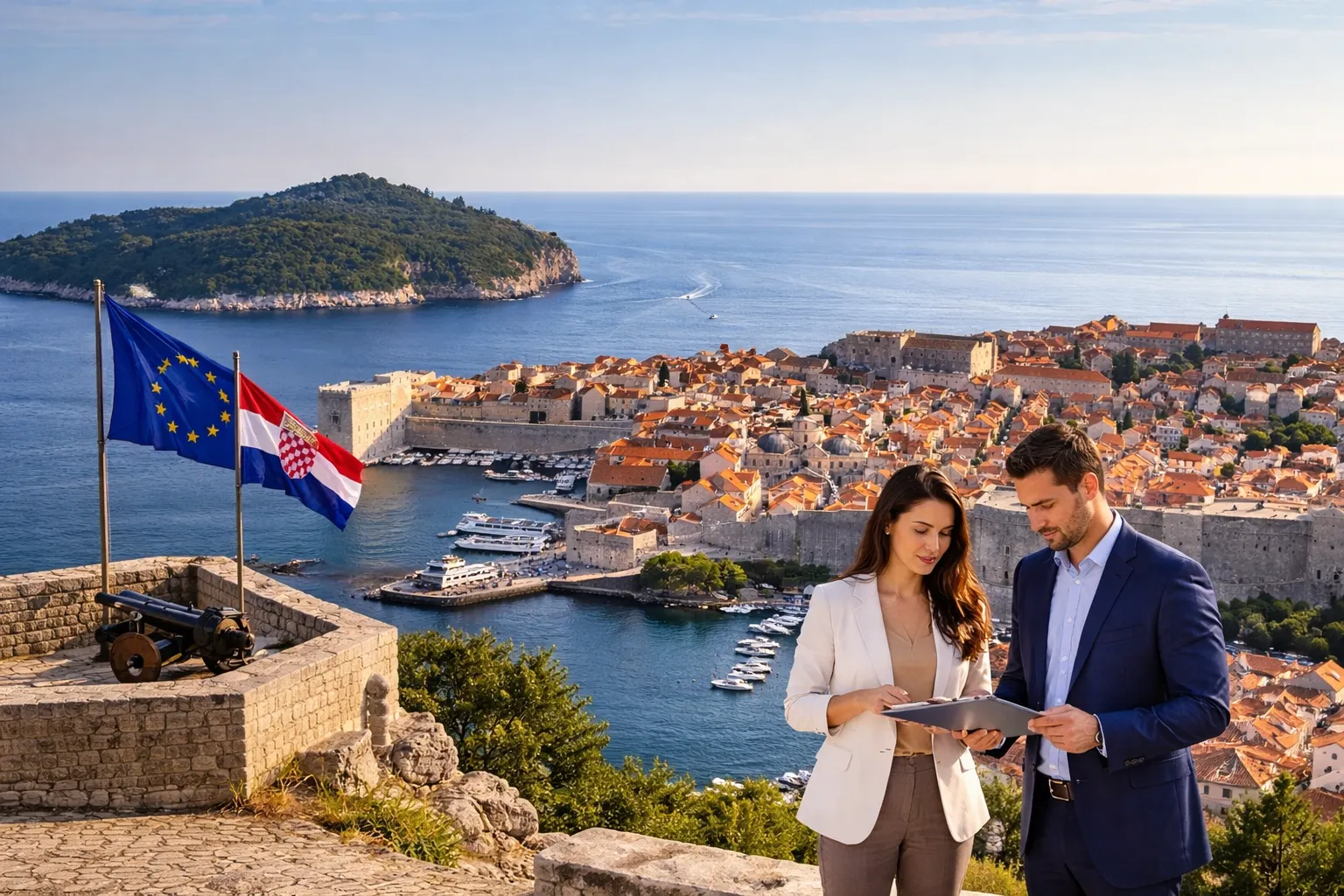
Foreign entrepreneurs can legally establish and operate companies in Croatia, but the country functions within a structured administrative system that differs from many common-law or fast-registration jurisdictions.
Understanding this framework before incorporation is often more important than the incorporation procedure itself.
This overview explains how the Croatian business environment works from a legal and operational perspective.

Croatia Business Environment: Quick Facts
Croatia is a member of the European Union, Eurozone and Schengen Area and allows full foreign ownership of companies.
Most common company type
d.o.o. (limited liability company)
Minimum share capital: €2,654.46
Corporate income tax
10% for revenue up to €1,000,000
18% above €1,000,000
VAT (PDV)
Standard rate: 25%
Reduced rates: 13% and 5%
Typical incorporation timeline
Approximately 2–4 weeks (longer if banking or immigration review applies)
Key sectors for foreign investors
IT and digital services
Consulting and remote services
Tourism support businesses
Renewable energy projects
Trade and e-commerce
Main business hubs
Zagreb
Split
Rijeka
Investment Incentives in Croatia
Croatia offers government-supported incentives designed to attract foreign investment, particularly in projects that create long-term economic value.
Qualifying activities typically include:
• Technology and innovation
• Manufacturing and industrial production
• Tourism development projects
• Renewable energy and infrastructure
Available incentives may include:
• Corporate tax reductions
• Employment subsidies
• Capital investment grants
Eligibility depends on the investment size, number of employees and the sector classification of the project.
For many international founders, incentives become relevant only after the company begins real operations rather than at the incorporation stage.
Read more: Investment Incentives in Croatia: What Investors Can Access
Is Croatia Open to Foreign Businesses?
Croatia permits both EU and non-EU nationals to own and operate companies under the same corporate law used by domestic entrepreneurs.
Foreign investors may hold 100% of shares and are not required to appoint a local partner.
In practice, Croatia does not restrict entry, it regulates activity.
Authorities focus primarily on legitimacy of operations, tax compliance, and economic substance rather than nationality of ownership.
For founders planning to proceed with incorporation, the procedural steps are explained in our full guide:
Starting a business in Croatia
Legal Business Structures Available
Foreign founders typically choose between several structures:
Limited Liability Company (d.o.o.)
The standard corporate form used by international businesses. Provides liability protection and full operational flexibility.
Simple Limited Liability Company (j.d.o.o.)
Lower capital entry version of the LLC, usually transitional and later converted.
Branch Office
Used by existing foreign companies expanding into Croatia. Parent company remains liable.
Sole Trade (Obrt)
Available mainly for residents and small service activities due to personal liability.
Croatian law does not prohibit foreign ownership — but it regulates who is allowed to actively manage the company.
Learn more: Company Formation in Croatia: Common Company Type for Foreign Investors
Basic Registration Process
Although procedures differ slightly depending on structure, starting a company in Croatia generally involves:
- Registration with the Commercial Court
- Obtaining an OIB (Croatian tax identification number)
- Opening a corporate bank account
- Registration with the Tax Administration
- VAT registration where applicable
When documentation is prepared correctly, incorporation typically takes around 2–4 weeks.
Delays most commonly occur during banking compliance checks or when foreign documentation requires verification.
Read more: 7 steps to Start a Company in Croatia as a Foreign Entrepreneur 2026
Directors, Work Rights, and Control of the Company
Ownership and operational control are separate legal concepts in Croatia.
A shareholder may live abroad and receive dividends.
However, the person acting as Director must have the legal right to work in Croatia.
This distinction is especially relevant for non-EU nationals, whose residency and labor authorization determine whether they can manage daily operations.
A detailed explanation of these differences is covered here: Starting business in Croatia for foreigners
Tax and Compliance Logic
Croatia follows a rules-based compliance model.
Authorities expect companies to be operationally credible rather than merely registered.
This includes:
• Proper invoicing format
• Accounting records maintained locally
• Salary and contribution obligations where applicable
• Consistency between declared activity and real transactions
Registration itself is not difficult, maintaining compliance is what determines long-term operability.
Read more: Croatia Tax System: Master Guide for Individuals (Foreigners included) and Companies
Employment and Labor Costs
Operating a business in Croatia requires accounting for employment costs beyond net salaries.
Employers must contribute to mandatory social systems, including:
• Pension insurance
• Health insurance
• Employment contributions
Because contributions are calculated from the gross salary, the real cost of hiring employees is significantly higher than the agreed net pay.
Understanding total labor cost is essential for realistic business planning, particularly for founders relocating and acting as company directors.
Banking and Administrative Reality
Corporate banking in Croatia functions as a regulatory checkpoint rather than a simple formality.
Banks assess ownership transparency, business purpose, and expected financial flows before activating accounts.
Administrative bodies follow a similar approach:
documents must be correct before approval rather than corrected afterward.
Because of this, incorporation timelines depend more on preparation quality than on legal complexity.
Where Foreign Entrepreneurs Usually Encounter Problems
Foreign founders rarely face legal rejection.
Instead, difficulties typically arise from mismatched expectations:
• assuming ownership automatically grants work rights
• registering activity without operational substance
• opening a company before planning tax position
• misunderstanding director responsibilities
These issues do not prevent entry, they delay operability.
Croatia as an Operational Base
Croatia is often used not only as a domestic market but as an EU operating jurisdiction.
Its value lies in regulatory stability and EU integration rather than rapid setup speed.
Businesses structured correctly tend to operate predictably.
Businesses structured incorrectly experience administrative friction.
Business Culture and Working Environment
Business communication in Croatia combines formal legal structure with relatively flexible day-to-day cooperation.
Relationships and reliability are valued, and administrative processes follow written rules rather than informal agreements.
Foreign founders often find that clarity and documentation matter more than speed.
Major business activity is concentrated in:
• Zagreb – administrative and corporate center
• Split – tourism and international services
• Rijeka – logistics and maritime trade
Final Note
In Croatia, incorporation is a technical step, not the strategic one.
The real decision is how the business will legally function after registration.
For regulatory differences affecting non-EU founders: 7 Topics Non-EU Nationals Should Know Before Doing Business in Croatia
For founders planning to actually launch operations, the full step-by-step process is explained in our guide on Starting a Business in Croatia for foreigner: 2026 Handbook.
Sources & Data References
The information in this guide is based on a combination of Croatian legal framework, official institutional publications, and practical regulatory procedures observed in real company formations handled for international founders.
Primary regulatory framework and official institutions:
• Croatian Companies Act (Zakon o trgovačkim društvima)
• Croatian Tax Administration (Porezna uprava) guidance on corporate taxation and VAT (PDV)
• Ministry of Justice & Commercial Court registration procedures
• Croatian Bureau of Statistics (NKD activity classification)
• Croatian Pension Insurance Institute (HZMO) and Health Insurance Fund (HZZO) contribution requirements
• Croatian National Bank and EU anti-money laundering banking compliance standards
• Ministry of Economy investment incentive programs for entrepreneurs and foreign investors
About Mandracchio Capital
Mandracchio Capital is a European legal and business structuring advisory working with international founders, investors, and companies entering Croatia and the wider EU market.
Our work focuses on aligning company formation, taxation, and residency requirements so businesses operate legally from the first day of activity rather than only appearing compliant on paper.
The observations described in this article are based on recurring regulatory and administrative patterns encountered during cross-border company setups, including banking onboarding reviews, director eligibility, tax-residency alignment, and operational compliance after incorporation.