
The introduction of a digital euro has become an active policy project within the European Union, led by the European Central Bank. As legislative proposals advance and technical preparations continue, questions increasingly focus on the legal classification, institutional implications, and systemic risks of introducing a central bank digital currency (CBDC) in the euro area.
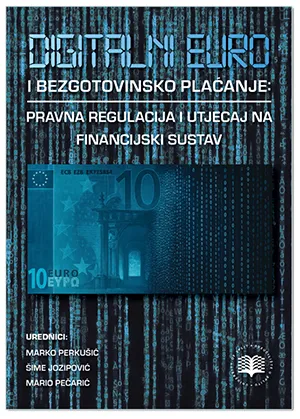
In 2025, a scientific monograph titled Digital Euro was published to examine these issues from legal and financial perspectives. This article provides bibliographic details and a structured overview of the publication and its scope, commonly referred to as the digital euro book in academic and policy discussions.
For readers seeking a comprehensive academic treatment of the topic, the digital euro book offers a structured legal and financial analysis. For a structured overview of the current policy timeline and regulatory framework, see our detailed analysis: Digital Euro: Legal design, privacy trade-offs, and the ECB timeline (2026–2029).
Publication Details

Title: Digital Euro
Authors: Marko Perkušić, Šime Jozipović, Mario Pečarić
Publisher: University of Split, Faculty of Forensic Sciences
Year of publication: 2025
ISBN: 978-953-8566-06-6
Length: 342 pages
Format: Print on demand
The digital euro book is a scientific monograph bringing together contributions from legal, financial, and banking scholars analyzing the regulatory and systemic implications of introducing a digital euro.
Structure of the Monograph
The digital euro book is divided into two main parts:
Part I – Legal Framework and Regulatory Classification
The first part examines the legal architecture necessary for introducing a digital euro within the European Union. Topics include:
- Legal tender status of the digital euro
- Comparison with existing non-cash payment instruments
- Privacy and anonymity considerations
- Distinction between digital euro and electronic money
- Relationship to cryptocurrencies and relevant regulatory frameworks (including AML obligations)
One of the core analytical themes explored in the digital euro book is the distinction between central bank money and commercial bank money. Unlike bank deposits, which represent liabilities of commercial banks, a digital euro would be a direct liability of the European Central Bank, raising questions about contractual relations and regulatory adjustments.
The authors also examine parallels with electronic money regulation and consider where technical similarities exist, despite clear legal differentiation.
Part II – Financial System and Economic Implications
The second part of the digital euro book addresses the potential effects of introducing a digital euro on the broader financial system. Areas analyzed include:
- The role and independence of the ECB
- Monetary stability and systemic risk
- Liquidity risks for commercial banks
- Deposit migration and refinancing challenges
- Risk management in banking intermediation
- Impact on fintech innovation and competition
- Cross-border monetary effects
Several chapters in the digital euro book consider the balance between user privacy and anti-money laundering obligations, emphasizing the need for a comprehensive regulatory framework that reconciles public interest objectives with fundamental rights.
The book also discusses comparative perspectives, including other CBDC implementations such as the digital yuan and the eNaira, to highlight differences in regulatory design and institutional context.
Key Legal Questions Addressed
Based on the authors’ published summary and public interview statements, the monograph addresses questions such as:
- How should the digital euro be legally classified within EU law?
- How can privacy protections coexist with AML and counter-terrorist financing requirements?
- What are the implications of granting digital euro status as legal tender?
- Could digital euro adoption influence the future role of cash?
- What risks might arise for commercial banks in a transition period?
The analysis does not treat the digital euro as a purely technical innovation, but as a structural reform affecting contractual relations, regulatory design, and monetary governance.
Authors and Academic Background

Šime Jozipović
Šime Jozipović is an associate professor specializing in commercial law, financial regulation, and digital markets law. His academic work focuses on the legal regulation of digital payment systems, central bank digital currencies, and emerging financial technologies within the European Union framework. He has conducted research on the regulation of new technologies in connection with the Harvard Innovation Lab and has published scientific articles on cryptocurrencies, digital tokens, and digital currencies.
In addition to his academic work, he founded Mandracchio Capital, a legal advisory practice assisting investors, expatriates, retirees, and early-stage businesses operating in Croatia. The practice focuses on company formation, regulatory compliance, residency-related legal matters, and cross-border structuring within the Croatian and broader EU legal framework. He is also registered as a mentor within the HAMAG-BICRO entrepreneurship and innovation programme in Croatia.
Marko Perkušić
Marko Perkušić is an assistant professor at the University Department of Forensic Sciences, University of Split, where he teaches and conducts research in the legal aspects of digital payment systems, electronic transactions, and financial technologies. He holds a doctoral degree in the legal regulation of electronic payment mechanisms and digital means of payment.
His research addresses the legal classification of central bank digital currencies, comparisons between CBDCs and electronic money, smart contracts, and the application of European secondary legislation to digital financial instruments. His work contributes to the academic debate on regulatory design and privacy protection in digital payment systems within the EU legal framework.
Mario Pečarić
Mario Pečarić is a Full Professor in the field of finance and banking. Since November 2017, he has served as Professor at the University of Split, Faculty of Economics, Business and Tourism, within the Department of Finance. He is also affiliated with the University of Rijeka, Faculty of Economics and Business, in the Department of Finance and Banking.
His academic research focuses on monetary policy, financial stability, capital flows, and the structural implications of financial globalization. He has published on the efficiency of monetary transmission mechanisms, including the effects of ECB quantitative tightening on Euribor–OIS spreads (Bank i Kredyt, 2025), as well as on monetary independence and capital liberalization in the context of eurozone accession (ST Open, 2025).
Intended Audience
The monograph is primarily relevant for:
- Legal practitioners in financial regulation
- Banking and compliance professionals
- Fintech founders and digital asset specialists
- Policymakers and public administration officials
- Academic researchers in monetary and financial law
It is structured as a scholarly analysis rather than a technical implementation guide.
Availability
The book is distributed through print-on-demand channels.
Publication details and ordering information are available here: DIGITALNI EURO, Ur: Marko Perkušić, Šime Jozipović, Mario Pečarić
Citation Example
APA (example format):
Perkušić, M., Jozipović, Š., & Pečarić, M. (2025). Digital Euro. University of Split, Faculty of Forensic Sciences.