
Starting a company in Croatia as a foreigner is legally possible for both EU and non-EU founders, but the process is document-driven and procedural. Most delays and frustrations do not come from legal barriers, but from incomplete paperwork, poor preparation, or misunderstanding how Croatian authorities expect documents to be presented.
This guide explains exactly which documents required to start a company in Croatia, how they differ for EU and non-EU founders, and how to prepare them properly so you don’t lose time, money, or business momentum.
If you are looking for a strategic view, not just incorporation paperwork, we recommend starting with our full handbook: Starting a Business in Croatia for Foreigners: Founder Handbook
For non-EU founders, you should also review the key challenges before incorporation: 7 Topics Non-EU Nationals Should Know Before Doing Business in Croatia
Key Takeaways — Company Formation in Croatia
- The documents required to start a company in Croatia are clear, but highly formal and detail-driven.
- Both EU and non-EU founders are legally allowed to register companies in Croatia.
- Most delays and rejections come from paperwork errors and poor sequencing, not legal barriers.
- Non-EU founders: residency planning must run in parallel with incorporation, not after.
- Proper preparation upfront saves time, money, and lost business opportunities.
How to Start a Company in Croatia for Foreigner?
Before listing documents, it’s important to understand how Croatia approaches company formation.
Croatia follows a formal civil-law system. Authorities do not assess your business idea or nationality,they assess whether:
- Documents are complete
- Forms are correct
- Steps are followed in the correct order
This applies equally to:
- EU citizens
- Non-EU citizens (US, UK, Canada, Australia, Asia)

Business structure most foreigners use
Most foreign founders register a d.o.o. (limited liability company) because it:
- Allows 100% foreign ownership
- Is accepted by banks and authorities
- Works for residency, trading, and EU operations
(Other forms exist, but d.o.o. is the standard.)
Required Documents to Start a Company in Croatia
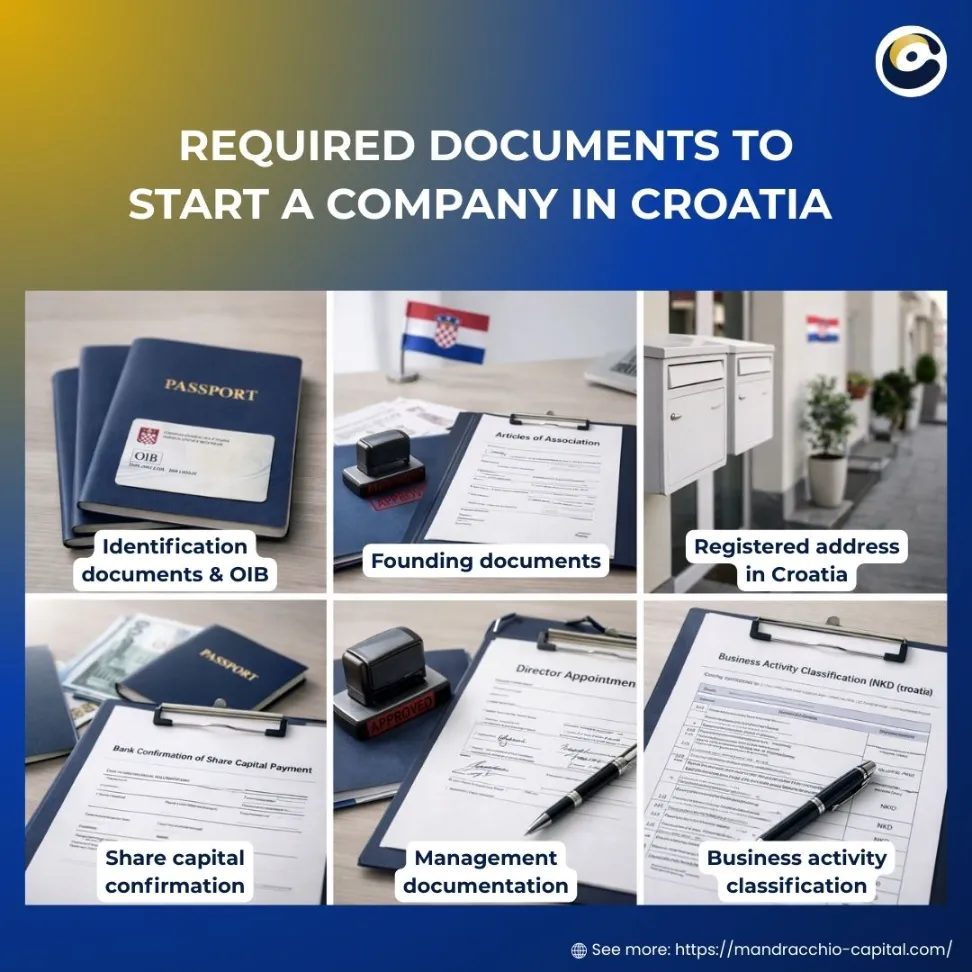
1. Identification documents & OIB
- Valid passport (all shareholders and directors)
- Certified passport copies (in some cases)
Croatian authorities require clear identification of all individuals involved. For non-EU founders, passport validity and consistency of personal data are critical
OIB – The First Step
In Croatia, the OIB (Osobni identifikacijski broj) is the single tax and identification number used for both individuals and legal entities.
For foreigners, obtaining an OIB is required before signing incorporation documents before a notary.
Before incorporation: Personal OIB is required to be listed in the Articles of Association / Statement of Establishment
Read more: Everything about OIB for Foreigner to Live and Start a Business in Croatia
2. Founding documents
Under the Croatian Companies Act (ZTD), you must prepare one of the following:
- Articles of Association – Društveni ugovor (if there are multiple shareholders), or
- Statement of Establishment – Izjava o osnivanju (if there is a single shareholder)
For Articles of Association
This draft is usually prepared by:
- a Croatian lawyer, or
- a notary (sometimes with a lawyer involved)
The document includes:
- company name
- registered seat
- business activities (NKD)
- share capital
- director(s) and representation rules
They must be signed before a Croatian notary, or signed abroad and properly notarised and apostilled, and then accepted by a Croatian notary and the Commercial Court (Trgovački sud).
Company name reservation: Names must be unique and compliant with Croatian naming rules. Many rejections happen here due to similarity with existing companies or restricted terms.
3. Registered address in Croatia
- Lease agreement, ownership document, or consent from property owner
Every Croatian company must have a registered seat (sjedište) – company’s official, legally registered address in Croatia Virtual or serviced addresses are possible, but they must be legally valid.
You must provide one of the following:
- A lease agreement for: an office, or a residential property (if business activity is allowed)
- Ownership Document: a land registry extract (vlasnički list) or purchase deed
- Owner’s Consent (If you use an address you do not own)
Virtual & Serviced Addresses
Virtual or serviced offices are permitted in Croatia if:
- the address is a real, physical location, and
- the property owner provides written consent.
Differences for EU vs Non-EU Founders
EU Founders
- No additional residency or immigration requirements affect the registered address.
- EU founders may register a company using a leased or serviced address without restrictions.
Non-EU Founders
- The same address rules apply for company registration.
- However, if the founder later applies for:
- a work and residence permit as a director, or
- residence through company ownership,
immigration authorities may require: proof that the address is suitable for real business activity, and consistency between the company address and the director’s declared residence.
4. Share capital confirmation
- Proof of share capital deposit
- Standard d.o.o.: €2,500
- Simplified j.d.o.o.: €1 (not recommended for most foreigners)
Capital is deposited into a temporary bank account before registration or paid after registration, depending on the method used.
Deposit before registration (most common): Share capital is deposited into a temporary bank account or via FINA, or Share capital is paid after registration into the company’s permanent bank account.
5. Management documentation
- Appointment decision for director(s)
- Specimen signatures (notarized)
- Director’s declaration of acceptance
Directors do not need to be Croatian residents, but their appointment must be clearly documented and notarized.
6. Business activity classification (NKD codes)
The company is registered with the Croatian Bureau of Statistics, which assigns: official NKD (Nacionalna Klasifikacija Djelatnosti) business activity codes. Choosing incorrect or overly broad NKD codes can create problems later especially for licensing, VAT, or residency purposes.
(Full) The official list of codes used to classify every business activity in Croatia – NKD
This is the core list of documents required to start a company in Croatia. These apply to both EU and non-EU founders, with additional requirements explained later.
Note: If you are not physically present in Croatia, you will almost always need a Power of Attorney authorising a lawyer or notary to act for you.
Step-by-Step: How to Register a Company in Croatia
While this article focuses on documents, understanding the sequence is essential.
Typical steps include:
- Choose a Name
- Define Your Business Activities
- Obtain Your OIB
- Sign and Notarize Incorporation Documents
- Temporary Bank Account & Deposit Share Capital
- Commercial Court registration
- Register with the Tax Authority
- Croatian Bureau of Statistics & Obtain a Company Stamp
- Arrange Accounting and Social Insurance Registrations
- Launch Operations & Apply for Residence
For a full procedural breakdown, read: Your 10 Steps Guide to Registering a Company in Croatia: d.o.o.
How to Prepare the Founding Documentation
Preparing documents required to start a company in Croatia is where most foreign founders lose time.
Articles of Association / Statement of Establishment
These must be:
- Properly translated (if prepared abroad)
- Legally consistent with Croatian company law
- Aligned with your long-term goals (residency, hiring, EU operations)
Passport copies
- Names must match exactly across all documents
- Middle names and spelling differences often cause rejections
Specimen signatures
- Must be notarized
- Must match future banking documents
These documents are not “just formalities.” Croatian authorities cross-check them at multiple stages
At Mandracchio Capital, we prepare and review founding documentation for foreign founders to ensure:
- legal consistency across all authorities,
- correct translations and notarisation,
- alignment with long-term business and residence plans.
This step is handled as part of our standard company formation support to prevent downstream delays.
EU vs Non-EU Founders: What’s Different?
EU founders
- No residence permit required to own or manage a company
- No work authorization needed to act as director
- Faster post-registration compliance
Non-EU founders
In addition to company documents, you must plan ahead for:
- Temporary residence (business basis)
- Work and stay compliance
- Timing between incorporation and residency application
Important: Company registration alone does not grant the right to live or work in Croatia.
What Can Be Avoided When Preparing Documents
Most founders don’t fail because Croatia is “too difficult.” They fail because they:
- Use generic templates not aligned with Croatian law
- Choose incorrect business activities
- Submit incomplete or inconsistent documentation
- Misjudge timelines and miss business opportunities
Delays often mean:
- Missed contracts
- Lost market entry timing
- Extra travel and notary costs
- Re-submission fees
- Delayed residence permits (for non-EU founders)
For founders, time lost often costs more than legal fees.
Working with a local lawyer will help:
- Correct documents the first time
- Faster registration
- Predictable timelines
- Reduced financial and opportunity loss
This is especially critical if your company is tied to:
- Investment timing
- Client onboarding
- Immigration planning
- EU expansion
Frequently Asked Questions (FAQ)
Do I need to be in Croatia to sign documents?
Not always. Some documents can be notarized abroad with apostille, but in-person signing is often faster.
Can a non-EU citizen own 100% of a Croatian company?
Yes. Croatia allows full foreign ownership.
Does company registration give me residency?
No. Residency is a separate legal process.
How long does company registration take?
When documents are prepared correctly, incorporation can take 1–3 weeks, depending on complexity.