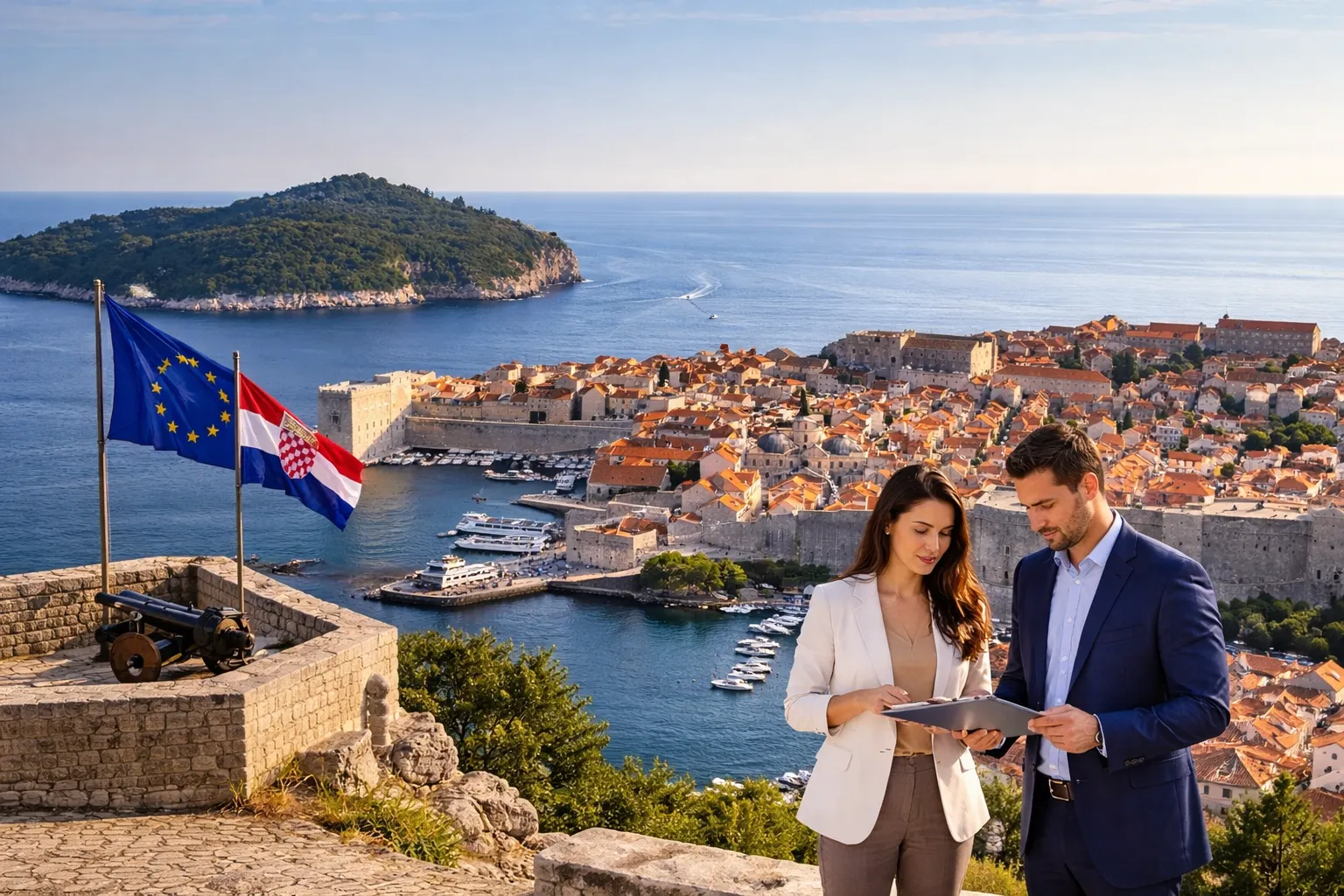
Croatia is no longer just a holiday destination. Today, it’s increasingly viewed as a credible EU base for foreign founders who want a stable legal environment, lower operating costs than Western Europe, and access to the European market.
If you’re a foreigner planning to open a company in Croatia, hire locally, or build long-term operations inside the EU, Croatia offers several advantages that are often overlooked in mainstream “business abroad” guides.
Let’s explore the real benefits of doing business in Croatia that matters for foreigners, for both EU and non-EU founders.
Full EU + Schengen integration (simpler cross-border business)
Croatia is fully integrated into:
the European Union
the Schengen Area
the Eurozone
For business owners, that often means fewer operational headaches when dealing with EU partners and clients.
Practical advantage: you avoid common friction points like currency exchange and many cross-border barriers when operating across countries like Germany, France, Austria, and Italy.
Croatia is better for “real operations” (not just a legal setup)
Croatia tends to be more attractive when you actually want a physical base:
hire local employees
build a team and office
run daily operations in Europe
enjoy a lifestyle that supports long-term consistency
Many founders also choose Croatia for the quality of life: 2,700+ hours of sunshine, a Mediterranean rhythm, and the ability to live close to the Adriatic coast while still running a serious business in cities like Zagreb or Split.
High quality of life + lower cost of living
Croatia offers a high quality of life while staying relatively affordable compared to Western Europe and major US cities.
Daily expenses like:
groceries
utilities
dining out
entertainment
rent
…can be significantly cheaper, which gives founders more breathing room especially in the early stages.
A proven destination with a large expat community
Croatia is not an “unknown” destination anymore.
Many foreigners relocate here long-term, and the expat community includes large groups from:
Germany
the UK
Italy
France
the US
A larger expat base generally means easier onboarding, better informal support networks, and more international business demand.
Founder of Mandracchio Capital speaking to the Foreign Business Owners Association in Split–Dalmatia on hidden costs of starting a business in Croatia for expats.
Great base for traveling around Europe
Croatia’s location and transportation options (airports, Croatia Airlines, buses, ferries) make it convenient and relatively affordable to visit other European countries.
This is especially valuable if your business requires EU travel, client meetings, or cross-border partnerships.
Very safe compared to many Western countries
Croatia is widely perceived as a very safe country, with low violent crime rates compared to many Western countries.
For founders moving with families (or simply choosing where to live long-term), safety is a major factor.
Massive investment incentives (tax holidays + cash grants for hiring)
Croatia has one of the most under-discussed advantages in the region: investment incentives.
Depending on your investment size and number of employees, Croatia may offer:
Tax holidays (profit tax reduction up to 10 years) Eligible investors can potentially receive:
50% reduction
75% reduction
100% reduction in profit tax for up to 10 years
Cash for jobs (non-refundable grants per employee) Companies may receive grants of approximately:
€3,000 to €9,000 per new employee (depending on program conditions)
Competitive corporate tax environment (including 10% profit tax under €1M)
For small and medium businesses, Croatia can be attractive from a tax planning perspective.
In practice, Croatia offers a 10% corporate profit tax rate for companies earning under €1M in annual revenue (subject to eligibility and applicable rules).
This is one reason Croatia is frequently compared with other EU jurisdictions when founders are deciding where to build.
“I want an EU base that’s legitimate, affordable, and not over-complicated, but still strong enough to scale.”
A significant share of university students (nearly 30%) are enrolled in STEM fields, supporting hiring in:
IT and software development
engineering and technical services
product development and innovation
For tech-enabled businesses, this is a real advantage.
High English proficiency (easier onboarding for foreign-led teams)
Croatia consistently ranks among the Top 10 globally for English proficiency (EF English Proficiency Index).
This reduces friction in:
hiring and onboarding
internal documentation
customer support
international sales and partnerships
100% foreign ownership allowed (no local partner required)
You can own 100% of your Croatian company as a foreigner.
You do not need a Croatian partner to establish a company (subject to sector-specific rules and compliance).
Lower labor costs vs. the US and UK (more affordable hiring)
Another major advantage for foreign founders is that hiring local Croatian employees is often significantly more affordable than hiring in the US or the UK, especially for roles like:
operations and admin support
customer service
junior–mid level marketing
finance/accounting assistance
many technical roles (depending on seniority)
For startups and SMEs, this can extend runway and make it easier to build a local team without Western Europe-level payroll pressure.
Average monthly salary comparison – Croatia vs UK vs US (estimated, in EUR)
Role (mid-level experience)
Croatia (EUR)
UK (EUR converted)
US (EUR converted)
Software Developer (Dev)
€2,500 – €3,700
€5,500 – €7,500
€8,000 – €12,000+
Marketing / Manager
€1,600 – €2,300
€4,000 – €5,500
€6,000 – €9,000
Support / Admin Staff
€1,100 – €1,500
€2,800 – €3,500
€3,500 – €4,500
Minimum wage (gross)
~€1,050
~€2,400
€1,200 – €2,500 (state-dependent)
Learn the basics to starting a business in Croatia as a foreigner
Key issues to know (especially for non-EU nationals)
Non-EU founders should be careful: Croatia is a strong base, but residence, compliance, and documentation can become complex if you don’t plan correctly.
Downsides of doing business in Croatia for foreign founders
Croatia can be a strong EU base, but it’s not a “set-it-up-and-forget-it” jurisdiction. Foreign founders should expect more paperwork than anticipated (especially for banking and notarization), slower administrative timelines than typical startup hubs, and stricter scrutiny in regulated sectors. For non-EU nationals, residence and work permits can become complex if the company structure isn’t planned correctly from day one. Local business culture also leans traditional, which rewards preparation and persistence over speed.
But Croatia rewards founders who plan properly, especially if they are non-EU.
Building a Business in Croatia with Mandracchio Capital
At Mandracchio Capital, we work with international founders and investors building operational companies in Croatia.
We advise on company formation, tax positioning, investment incentives, regulatory compliance, and long-term structuring within the Croatian and EU market.
Our experience includes supporting foreign-owned businesses across sectors from initial incorporation and banking setup to ongoing compliance, hiring, and cross-border tax coordination.
Because Croatia rewards substance over shortcuts, our role is to help founders build structures that are operationally viable, legally stable, and aligned with both Croatian law and EU standards.
FAQ: Benefits of doing business in Croatia for foreigners
Is Croatia a good country to start a business as a foreigner?
Yes. Croatia is an EU member state and offers a stable legal environment, full Euro/Schengen integration, and growing opportunities for foreign-owned companies.
Can a foreigner own 100% of a company in Croatia?
Yes. In most cases, foreigners can own 100% of a Croatian company without needing a local partner.
Is Croatia good for hiring IT and engineering talent?
Yes. Croatia has a strong STEM talent pipeline and a growing tech ecosystem, making it attractive for IT, engineering, and innovation-driven businesses.
Does Croatia offer investment incentives for foreign companies?
Yes. Croatia may offer investment incentives such as profit tax reductions, grants per new employee, and support for R&D or equipment investment, depending on eligibility.
Is Croatia part of the Eurozone and Schengen?
Yes. Croatia is part of the EU, the Eurozone, and the Schengen Area, which simplifies cross-border business operations in Europe.
Published:
This article is legally reviewed by:
Prof. Šime Jozipović, LL.M. (Harvard)
Jean Monnet Professor · Legal Advisor
Prof. Dr. Šime Jozipović is a Croatian legal expert specializing in corporate, business, financial law and the Founder of Mandracchio Capital. He has advised international and domestic clients on company formations, investment structuring, and dispute resolution across technology, tourism, maritime, and energy sectors. He holds LL.M. degrees from LMU Munich and Harvard University, completed his doctorate summa cum laude at LMU, and is registered with the Croatian Bar Association. Dr. Jozipović has held research positions at Harvard Law School and the Max Planck Institute.
Disclaimer: While our contributors include legal professionals, the information provided on the Mandracchio Capital blog is for general informational purposes and does not constitute legal, financial, or tax advice.
We’re here to help!
Fill out the form, and we’ll connect to explore how we can support you.
+385 91 122 2777
Stepinčeva 14, Split
contact@mandracchio-capital.com
Living or Doing Business in Croatia? Stay Informed
No more searching everywhere, get visa, permit & cost-of-living updates directly in your inbox