Many expats assume permanent residence is something you “switch to” once you’ve lived in Croatia long enough. In reality, Croatia treats permanent residence as a status you earn, not a default upgrade. The rules are precise, procedural, and unforgiving if misunderstood.
This guide explains in detail how to get permanent residency in Croatia – the requirements, what truly counts toward the five-year requirement, where people lose time, and how to prepare properly, before year five arrives.
Croatia Permanent Residence Requirements
- Five-Year Rule: You must complete five uninterrupted years of qualifying legal residence.
- Permit Type Matters: Not all temporary residence permits count toward permanent residence.
- Timing Is Critical: Applications must be submitted at a very specific moment.
- Dual Filing Required: Permanent residence and a temporary extension must be filed together.
- No Shortcuts: Croatia has no official residency by investment or Golden Visa program.
Croatia Permanent Residence Requirements
Non-EU / Third-Country Nationals Legal Requirements Checklist
This is the system that applies to citizens of the US, UK, Canada, Australia, Asia, and most of the world.
| Requirement | What is required |
|---|---|
| Five-Year Residence | You must hold a qualifying temporary residence permit for five uninterrupted years, staying within legal absence limits (max 10 months total, max 6 months per absence). |
| Application Form | Form 1a filed at your local police station (MUP). |
| Passport & Photo | A valid passport and a 30×35mm biometric photo. |
| Financial Means | Proof that you can support yourself without relying on Croatian social assistance. |
| Health Insurance | Valid Croatian or internationally recognized health insurance. |
| Accommodation | Proof of a registered residential address in Croatia. |
| Language & Culture | Passing the Croatian language and culture exam, unless legally exempt. |
| Criminal Record | Criminal background check from your home country, translated and legalized. |
| Security Check | You must not pose a risk to public order, national security, or public health. |
EU / EEA Citizens Legal Requirements Checklist
EU/EEA citizens can also obtain permanent residence in Croatia, but under EU free-movement law rather than the Croatian Aliens Act. During their first five years of residence, EU citizens must generally have lawful status (such as work, self-employment, or sufficient financial means and health insurance), but once they have completed five continuous years of legal residence in Croatia, they acquire a right to permanent residence and are no longer required to prove income, health insurance, or language knowledge.
They only need to show their identity and five-year residence history when applying for a permanent residence card (Form 3b) at the police (MUP).
| Requirement | What is required |
|---|---|
| Five-Year Residence | Five years of lawful residence in Croatia under EU registration rules. |
| Application Form | Form 3b (EU permanent residence card). |
| Identity Document | Valid passport or EU ID card. |
| Residence Proof | Evidence that you lived in Croatia continuously (registrations, address records, etc.). |
EU citizens:
- Have permanent residence as a legal right after five years
- Do not take a language exam
- Do not submit criminal record certificates
- Do not prove income in the same way
Special Categories
Different timelines or rules apply to:
- Spouses of Croatian citizens (often eligible after 3 years of marriage)
- Family members of EU/EEA citizens
- Certain protected or humanitarian categories
The Core Rule: Five Years of Continuous Legal Residence
At the center of all Croatia permanent residence requirements is one condition that cannot be negotiated:
you must complete five continuous years of legal residence in Croatia.
This five-year period is calculated very precisely:
• It starts from the issue date of your first temporary residence permit
• It does not start from your arrival date
• Tourist stays and visa-free periods do not count
Many people discover too late that they assumed the clock started earlier than it did. Croatia does not round up, estimate, or make exceptions here.
If your goal is permanent residency Croatia, the permit you hold in year one already determines your eligibility in year five.
What “Continuous Residence” Actually Means
“Continuous” does not mean you can never leave Croatia but absences are tightly regulated.
You must stay within these limits:
• No more than 10 months total outside Croatia during five years
• No single absence longer than 6 consecutive months
If either limit is exceeded, your five-year clock resets.
This often happens unintentionally, for example, when people assume remote work abroad, family emergencies, or extended travel won’t matter. They do.
This is one of the most common ways people fail to meet Croatia permanent residence requirements despite living in Croatia for years.
Residence Periods That Do NOT Count (Where Years Are Lost)
This is where permanent residence planning often fails quietly.
The following residence permits do not count toward permanent residence:
• Seasonal workers
• Service providers
• Posted workers
• Volunteers
• Trainees
• Intra-corporate transferees and their families
• Frontier workers
• Secondary school students
• “Other purposes” permits
• Time spent in prison
Special situations:
• University students: Only half of study time counts
• Asylum holders: Only part of pre-approval time may count
Many people spend years on permits that feel “legal” but legally don’t advance them toward permanent residence.
This is why permit strategy from the beginning matters more than people expect when planning how to get permanent residency in Croatia.
How to Apply for Permanent Residence in Croatia
Permanent residence planning must begin months before the fifth year ends.
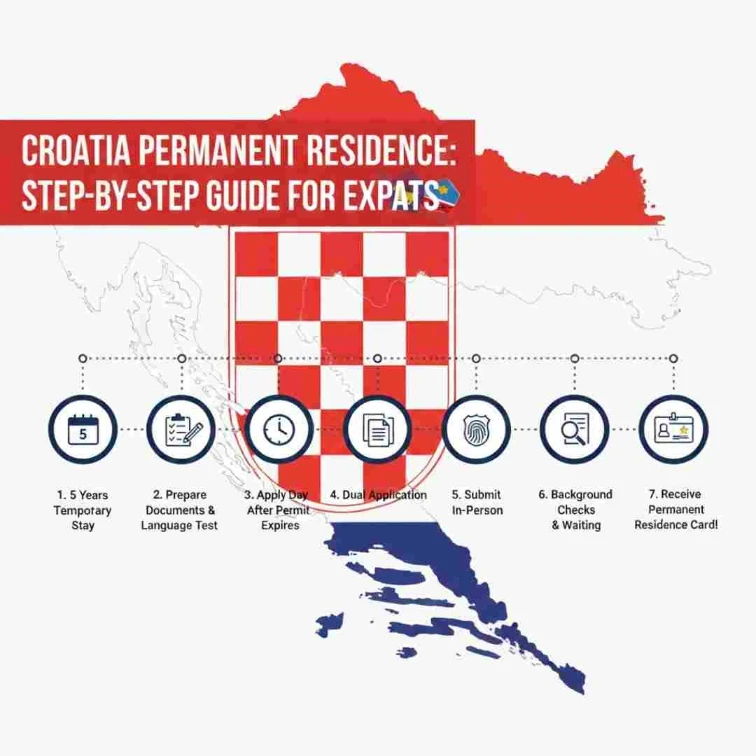
The permanent residence process in Croatia follows a strict legal sequence, whether you are an EU citizen or a non-EU (third-country) national. Many applicants qualify in principle but lose time or legal status because they misunderstand permit type, residence history, or filing deadlines.
Step 1 — Legal Eligibility Review
Before filing, your residence history must be reviewed to confirm that:
- Your residence basis qualifies under the applicable legal framework
- Your absences are within allowed limits
- You have not lost any residence years
At Mandracchio Capital,we review residence histories, permit types, and absence records to identify risks before the application window opens.
Step 2 — Document & Language Preparation
Several weeks before eligibility is reached, the police (MUP) confirms:
- Which documents apply to your nationality and residence category
- Whether any language, culture, or registration requirements apply
We can assist you in identifying what their specific MUP office will require and in preparing documents in the correct legal format.
Step 3 — Timing the Filing Window
Croatia applies strict timing rules. Permanent residence applications must be filed at the legally correct moment, based on your current residence status.
Applying too early or too late can break eligibility. We help you plan this filing window so it is not missed.
Step 4 — Application Submission
Applications are submitted at your local police administration (MUP).
In non-EU cases, this includes both a permanent residence application and a temporary extension to keep your legal status active during processing.
EU citizens submit a permanent residence card application under EU law.
We support you through this filing so their legal status remains uninterrupted during review.
Step 5 — Review, Checks, and Decision
After submission, authorities conduct:
- Residence verification
- Security or background checks (where applicable)
- Possible interviews or document requests
Once approved, you receive a biometric permanent residence card, and your status no longer requires annual renewal.
We assist with authority communication, follow-ups, and resolving procedural issues until a final decision is issued.
To understand the exact rules for your category, read: Permanent Residence in Croatia: EU vs Non-EU Application Process
Correct application timing with the police
Although permanent residence cannot be submitted early, applicants must demonstrate procedural readiness:
- The permanent residence application may only be filed the day after the temporary permit expires
- Applicants are strongly expected to contact the police two months in advance to:
- Declare intent to apply
- Receive nationality-specific requirements
- Begin document preparation
Failure to align timing correctly can result in loss of legal status.
Mandatory dual application (permanent + temporary extension)
Applicants must submit two applications at the same time:
- Long-term (permanent) residence application
- Temporary residence extension (bridging permit)
This is required because applicants must hold valid residence status at all times while permanent residence is under review.
- Non-EU/EEA nationals apply under “Autonomous Stay”
- EU/EEA nationals apply under “Extension”
Only one temporary extension is granted during the permanent residence process.
Ready to Secure Your Permanent Residence
If you want clarity on whether you already meet the Croatia permanent residence requirements, or how to structure the final steps correctly, speak with our legal coordination team.
At Mandracchio Capital, founded by Prof. Šime Jozipović, LL.M. (Harvard), we work with vetted Croatian lawyers and compliance specialists to help foreign nationals navigate the permanent residence process with clarity and legal certainty. Our team has supported 500+ international projects and helped structure €500 million+ in cross-border investments and relocations in Croatia.
What we do for permanent residence clients:
- Audit your residence and permit history for legal eligibility
- Identify risks tied to absences, permit type, or timing
- Define the exact documents your local MUP office will require
- Coordinate translations, apostilles, and legal formatting
- Support correct filing and follow-up until a decision is issued
Clients We Assist With Croatia Permanent Residence:
- Foreign business owners and investors
- Families with Croatian or EU connections
- Clients whose residence history is complex or fragmented
If you want to know whether your five years truly count and how to protect your permanent residence outcome, our legal coordination team can help you move forward with confidence.
FAQ
How much money do I need when applying for Croatian permanent residence?
You must show stable and sufficient financial means, but there is no fixed “one-size” amount written in law.
Croatian authorities assess whether your income or savings are enough to support normal living expenses without relying on social assistance. The required amount is usually linked to the minimum living standard thresholds published annually by the Ministry of the Interior (MUP). These benchmarks can change slightly each year.
Most successful applicants demonstrate regular monthly income (salary, pension, or business income) or documented savings that clearly cover housing, food, healthcare, and daily expenses in Croatia. The goal is clarity and stability, not maximizing numbers.
How do I prove financial means for Croatian permanent residence?
Financial means are proven through documented, verifiable sources, not informal statements or cash.
Accepted proof typically includes:
- Employment contracts and recent payslips
- Pension statements
- Bank statements showing consistent balances or deposits
- Business income documentation (for company owners or self-employed applicants)
Croatian authorities look for continuity and credibility, not just a single high balance on paper. One-time deposits without explanation may raise questions.
Practical guidance:
Prepare at least 6–12 months of financial history, translated if required, and ensure your income source matches your legal residence basis. If your residence is employment-based, your income should come from that employment. Consistency matters more than amount.
Can savings alone be used to meet Croatia permanent residence requirements?
Yes, savings can be used, but they must be sufficient, traceable, and realistic for long-term living.
Applicants without regular income often rely on:
- Long-term savings
- Investment income
- Retirement funds or pensions
Authorities assess whether your savings can reasonably support you beyond the application moment, not just for approval.
If using savings, provide clear bank documentation, explain the origin of funds if requested, and ensure balances remain stable throughout the review period.
Do financial requirements differ by nationality?
Yes, financial expectations can vary slightly depending on nationality and residence basis.
For example:
- Retirees are often assessed differently from employees
- Family-reunification cases focus on household income
- Business owners must show operational viability
This is why applicants are advised to contact MUP two months before applying, as part of preparing for croatia permanent residence requirements.
Does owning property replace the financial requirement?
No. Property ownership alone does not replace the requirement to prove financial means.
Owning a home helps demonstrate legal accommodation, but you must still show you can afford daily living costs, healthcare, and ongoing expenses without state assistance.
Treat housing and financial means as two separate requirements. Both must be satisfied independently.
How long must I live in Croatia to qualify?
You must complete five uninterrupted years of qualifying legal residence.
Can I just keep renewing temporary residence instead?
No. After five years, Croatia expects you to transition or change your legal basis.
How long does approval take?
For non-EU nationals, 12–18 months or longer is common.